

TL;DR:
- Brand storytelling turns your brand into a memorable guide that helps customers reach their goal.
- Emotionally connected customers are more likely to purchase, return, and refer others, increasing visits and sales.
Brand storytelling turns your brand from a product supplier into a memorable guide that helps customers reach a desired state. Position the customer as the hero, your brand as the guide, and every piece of content you create starts pulling in the same direction. Emotionally connected customers are more likely to purchase, return, and refer others. Industry research reports up to 8x more visits and sales from emotionally connected customers compared to merely satisfied ones.
The four elements every marketer needs to remember:
- Protagonist/customer — the hero with a goal or problem
- Conflict/pain — the obstacle standing between them and the outcome
- Brand as guide — your product, team, or values as the solution
- Proof/resolution — real results that make the story credible
Table of Contents
- What is brand storytelling, and how does it work?
- Why does brand storytelling matter for your business?
- What are the core elements and types of brand stories?
- How do you build your brand story step by step?
- Real brand examples: what Warby Parker, Airbnb, Nike, and Burt’s Bees actually did
- What does the data say, and how do you measure storytelling’s impact?
- How do you adapt your brand story for different audiences?
- What are the most common brand storytelling mistakes to avoid?
- Why does authenticity matter more than production value?
- How do you integrate brand storytelling into company culture?
- Key Takeaways
- The story-first shift most brands still haven’t made
- Useful sources and further reading
What is brand storytelling, and how does it work?
Brand storytelling is the strategic use of narrative to communicate your identity, values, and the customer’s journey. It is not a tagline or a product description. It is a structured story arc that moves people.
The anatomy looks like this: Protagonist → Conflict → Guide → Resolution. A direct-to-consumer eyewear brand, for example, does not just say “affordable glasses.” It tells the story of a customer who needed prescription lenses but couldn’t justify the cost, found a better path, and now sees clearly without financial stress. The brand is the guide, not the star. HBS Online frames it as helping customers move from “what is” to “what could be” — a shift that makes your brand feel personally relevant.
Pro Tip: Before writing any campaign copy, write one sentence that completes this frame: “My customer wants [goal], but [obstacle] stands in the way. Our brand helps them [resolution] by [proof].” That sentence is your story spine.
Why does brand storytelling matter for your business?
Stories work because they trigger emotional processing, not just rational evaluation. When a customer feels something, they remember it. When they remember it, they come back.

Story-based brand content is significantly more engaging than standard advertising. That engagement gap translates directly to purchase behavior. Emotional advertising has also been shown to deliver roughly twice the profit impact of purely rational, message-focused advertising in long-term studies (Binet & Field findings, summarized by System1 Group). That is not a marginal edge. That is a structural advantage for brands willing to invest in narrative.
The business outcomes stack up fast:
- Higher purchase intent — emotional connection correlates with conversion, not just awareness
- Stronger recall — stories are encoded differently in memory than feature lists
- Greater trust — consistent narrative signals authenticity and reliability
- Long-term loyalty — customers who feel part of a brand story churn less
For how to track these outcomes, see the measurement section below.
What are the core elements and types of brand stories?
Every effective brand story shares five building blocks. Get these right and the format almost doesn’t matter.
- People — the customer is the hero, always. Your brand is Yoda, not Luke.
- Purpose/values — why your brand exists beyond revenue. This is the “why” that converts observers into participants.
- Plot/conflict — the real obstacle your customer faces. Vague pain points produce vague stories.
- Proof — specific results, reviews, or before-and-after moments that make the resolution believable.
- Tonal guardrails — the voice rules that keep every piece of content sounding like the same brand.
The five story types worth knowing
Origin story — why you started, told through a founder’s real challenge. Works best for new audiences who don’t know you yet.
Customer-as-hero — a real guest or client’s transformation. This is the most shareable format and the most trusted. Product narratives that apply storytelling increase perceived symbolic value and strengthen brand loyalty, which is exactly what this format delivers.
Product-as-solution — a specific dish, service, or feature framed as the answer to a named problem. Useful at the consideration stage.
Values-driven/cause story — your brand’s stance on something that matters to your audience. Risky if not authentic, powerful when it is.
Episodic brand universe — a recurring cast, setting, or motif that builds familiarity over time. Consistent fluent devices like visual cues, taglines, and recurring characters improve brand recognition and memory across campaigns.
Pro Tip: Match story type to audience stage. A cold audience needs your origin story or a customer-as-hero arc. A warm audience ready to buy needs the product-as-solution format with proof. Don’t run a values-driven story to someone who hasn’t heard of you yet.
How do you build your brand story step by step?
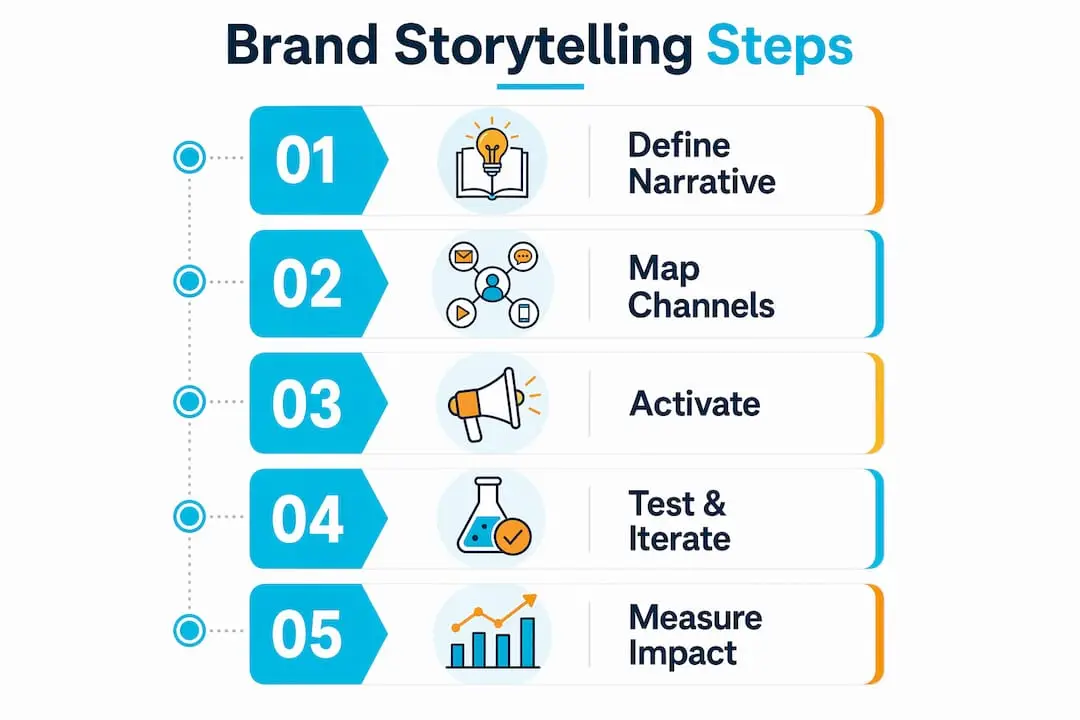
Step 1: Define your core narrative
Write one paragraph that follows this arc: status quo → conflict → resolution → proof. This is your narrative foundation. Every campaign, post, and piece of menu copy should reference it. Without this foundation, tactical storytelling (individual posts, reels, ads) fails to reinforce a consistent identity. Build the foundation first, then scale the tactics.
From the core narrative, extract three to four messaging pillars: the recurring themes your brand always returns to. For a restaurant, those might be “local sourcing,” “family tradition,” “bold flavor,” and “community gathering.” Every piece of content should touch at least one pillar.
Step 2: Map your narrative to channels
Different channels carry different parts of the story. Here’s how to assign them:
| Format | Strategic job | Best use case |
|---|---|---|
| Instagram Reels / TikTok | Emotional hook, first impression | Origin clips, behind-the-scenes, chef moments |
| Email newsletter | Depth and relationship | Customer-as-hero stories, seasonal narratives |
| Website / About page | Credibility and trust | Full origin story, values, team profiles |
| Google Business / Reviews | Social proof | Customer resolution stories, ratings |
| In-venue signage / menus | Ambient reinforcement | Dish origin notes, sourcing callouts |
| Paid social ads | Conversion trigger | Product-as-solution with proof |
Poor UX on the platform presenting your story lowers perceived brand value regardless of narrative quality. Your story assets need to load fast, display cleanly, and work on mobile. Presentation is part of the story.
Step 3: Activate, test, and iterate
- Launch two creative variants of the same story (different hooks, same core narrative).
- Measure engagement rate, save rate, and click-through rate over 14 days.
- Pull the winner forward. Add a new proof element (a customer quote, a result).
- Repeat the cycle monthly.
Pro Tip: Proof beats polish. A shaky phone video of a real customer moment outperforms a studio-produced ad with no emotional truth. Capture real moments first, then refine the production.
Real brand examples: what Warby Parker, Airbnb, Nike, and Burt’s Bees actually did
️ Warby Parker built its origin story around a founder who lost his glasses and couldn’t afford replacements. The conflict was relatable and specific. The resolution — stylish, affordable eyewear with a home try-on program — was the brand’s entire business model expressed as a story. The transferable lesson: your origin story and your value proposition should be the same sentence.

Airbnb shifted from “rent a room” to “belong anywhere.” The customer became a traveler seeking authentic connection, not just accommodation. Hosts became characters in a global community story. For smaller brands, the tactic is the same: reframe your product as access to an experience or community, not just a transaction. Ionhospitality helps restaurants do exactly this by turning their social content into a restaurant loyalty and traffic engine built on genuine guest stories.
✔️ Nike has run the customer-as-hero format for decades. “Just Do It” is not about shoes. It is about the athlete inside every customer, facing doubt and choosing to move anyway. The brand is the guide, the equipment is proof. The lesson for smaller brands: your product does not need to be the hero. The customer’s transformation is the story.
Burt’s Bees leads with its origin story and values-driven narrative: a beekeeper and an artist, natural ingredients, environmental stewardship. The brand’s packaging, social content, and campaigns all reinforce the same story. The lesson: when your values are specific and consistent, they become a gourmet experience in themselves. Customers don’t just buy the product; they buy into the worldview.
| Brand | Narrative angle | Tactical execution | Transferable lesson |
|---|---|---|---|
| Warby Parker | Founder conflict = customer conflict | Home try-on as story proof | Origin story and value prop should be one |
| Airbnb | Belonging over accommodation | Host/guest community content | Reframe product as access to experience |
| Nike | Customer as athlete-hero | “Just Do It” across every channel | Let the customer’s transformation be the story |
| Burt’s Bees | Values + founder origin | Consistent packaging and social voice | Specific values repeated consistently build identity |
What does the data say, and how do you measure storytelling’s impact?
The business case for emotional storytelling is well-documented. Emotionally connected customers visit and spend more, and emotional advertising drives stronger long-term profit outcomes than rational messaging. The 8x visits and sales figure cited earlier is the ceiling, but even a fraction of that lift justifies the investment.
Measurement checklist
Track these four layers to attribute storytelling impact:
- Awareness — brand lift surveys, share of voice, branded search volume
- Engagement — time on page, video completion rate, saves and shares
- Sentiment — qualitative review themes, DM responses, comment tone
- Funnel outcomes — click-through rate, reservation conversions, repeat visit rate, lifetime value
Restaurant-focused storytelling checklist ️
- ✅ Write a one-paragraph origin story for your restaurant and post it on your About page and Google Business profile.
- ✅ Add a sourcing or origin note to at least three menu items (e.g., “Our tomatoes come from a 4th-generation farm in New Jersey”).
- ✅ Launch a weekly social series featuring one team member or regular guest per week.
- ✅ Brief your front-of-house staff on two or three story talking points they can share naturally with guests.
- ✅ Collect one customer story per month and turn it into a short-form video or caption.
- ✅ Require every campaign brief to reference the core narrative before any creative is produced.
Pro Tip: Build a one-page narrative playbook: your core story paragraph, three messaging pillars, tonal guardrails, and two approved story types. Share it with every team member who creates content. Consistency at scale requires a system, not just inspiration.
How do you adapt your brand story for different audiences?
The core narrative stays fixed. The lens shifts. A restaurant telling its origin story to a 28-year-old food-curious local on Instagram uses short video, casual language, and behind-the-scenes footage. The same story told to a corporate event planner on LinkedIn uses case study language, capacity details, and outcome metrics.
Three practical moves:
- Segment by stage. Cold audiences need emotional hooks and origin content. Warm audiences need proof and specifics. Buyers need resolution stories with clear calls to action.
- Adjust the protagonist. A family dining audience sees a parent as the hero. A private events audience sees a planner as the hero. The brand’s role as guide stays the same; the hero’s face changes.
- Match the platform’s native format. A story that works as a 60-second Reel won’t land as a 600-word email without restructuring. Adapt the container, not the core. Ionhospitality’s restaurant niche marketing approach is built on exactly this principle.
What are the most common brand storytelling mistakes to avoid?
Most storytelling fails not because the story is bad, but because the execution breaks one of these rules.
Making the brand the hero. Customers don’t care about your brand’s journey. They care about their own. The moment your story becomes about how great you are, you’ve lost them.
No narrative foundation. One-off posts with no connection to a core story create noise, not identity. Strategic storytelling requires a foundation that every tactical piece references. Without it, you’re just posting.
Inconsistent voice across channels. If your Instagram sounds playful and your email sounds corporate, customers don’t feel they know you. Tonal guardrails in your narrative playbook fix this.
Skipping the proof. A story without resolution is just a complaint. Every brand story needs a real, specific outcome that makes the resolution believable.
Over-producing at the expense of truth. Polished content that feels staged erodes trust faster than a rough video that feels real.
Why does authenticity matter more than production value?
Authenticity is not a soft concept. It is a measurable trust signal. Customers can detect when a brand story is manufactured for effect versus lived experience. The gap between what a brand claims and how it actually behaves is where trust breaks down.
Transparency accelerates trust in two specific ways. First, it lowers the customer’s perceived risk. When a brand admits a limitation or shares a real challenge, it signals honesty. Second, it differentiates. Most brands project only their best moments. A brand willing to show the messy middle stands out. The Whiteout Tequila origin story is a strong example of this: a specific, personal founding narrative that makes the product feel earned rather than manufactured.
For restaurants, authenticity means: real staff, real sourcing, real guest moments. Not stock photography. Not generic captions. The story your guests tell each other after dinner is the most authentic version of your brand. Capture it.
How do you integrate brand storytelling into company culture?
A brand story that lives only in marketing is fragile. When your team doesn’t know the story, they can’t tell it. When they can’t tell it, every guest interaction is a missed opportunity.
Internal integration looks like this:
- Onboarding — new hires learn the origin story and messaging pillars in their first week.
- Staff briefings — front-of-house teams get two or three story talking points before each shift.
- Campaign briefs — every brief references the core narrative before any creative is approved.
- Recognition — celebrate team members who embody the brand’s values publicly. That becomes content.
When the story is operational, not just aspirational, it compounds. Guests hear it from the host, read it on the menu, see it in the social feed, and feel it in the service. That consistency is what builds a brand people talk about.
Key Takeaways
Brand storytelling works when the customer is the hero, the brand is the guide, and every channel reinforces the same core narrative with real proof.
| Point | Details |
|---|---|
| Customer is always the hero | Position your brand as the guide, not the star, to create emotional relevance. |
| Foundation before tactics | Write your core narrative paragraph before creating any campaign content. |
| Emotional connection drives revenue | Industry research links emotional storytelling to up to 8x more visits and sales. |
| Consistency builds recognition | Consistent story devices across channels improve brand memory and trust over time. |
| Measure all four layers | Track awareness, engagement, sentiment, and funnel outcomes to attribute storytelling impact. |
The story-first shift most brands still haven’t made
Most marketing teams treat storytelling as a content format. It is not. It is an operating system. The brands that win long-term are the ones where the story is embedded in hiring, training, product development, and customer service, not just the Instagram grid.
The practical recommendation: require every campaign brief to include one sentence that references the core narrative. That single rule forces alignment across every team member who touches the brand. It sounds simple. Almost no one does it consistently.
For restaurants, the opportunity is even more direct. You already have the raw material: real people, real food, real moments. The story is happening in your dining room every night. The only question is whether you’re capturing it and putting it to work. Ionhospitality’s social media advertising service is built to do exactly that: take your real story and amplify it across the channels where your next guests are already scrolling. If you’re ready to put your story in front of the right audience, book a discovery call and we’ll show you how.
Useful sources and further reading
- What Is a Brand Story? — HBS Online — Covers the “customer as hero / brand as guide” framework and the narrative anatomy marketers should use as a template.
- What Is a Brand Story? — HubSpot — Summarizes industry research on emotional connection and the visits/sales lift associated with story-driven marketing.
- Brand Storytelling — Podium — Supports engagement and conversion claims; useful for the business case sections.
- The Role of Storytelling in Brand Love — PMC/NCBI — Academic research on how product narratives increase perceived symbolic value and brand loyalty.
- Emotional Advertising and Long-Term Profit — System1 Group — Summarizes Binet & Field findings on emotional vs. rational advertising efficiency; supports the profit-impact claim.
- UX and Brand Perception — Taylor & Francis — Research on how platform UX affects perceived brand image; relevant for story asset presentation.
- Strategic vs. Tactical Storytelling — Springer — Academic summary distinguishing strategic narrative foundation from one-off tactical content; supports the “foundation first” argument.

Add a Comment