
TL;DR:
- Effective marketing and operational strategies can significantly increase dine-in traffic. Building a strong online presence, loyalty programs, and consistent guest experiences encourage repeat visits and attract new customers. Using data-driven adjustments and targeted marketing channels like SMS boosts same-day and slow-hour seatings.
Improving dine-in traffic is the process of applying targeted marketing, operational upgrades, and guest experience improvements to attract and retain more customers eating at your restaurant. The stakes are real. Acquiring a new customer costs 5–7 times more than keeping an existing one, which means your most profitable growth lever is already sitting in your dining room. This guide covers the four core strategies restaurant owners use to fill seats consistently: digital presence, loyalty programs, in-restaurant experience, and technology-driven marketing. Each section gives you specific, tested tactics you can act on this week.
How to improve dine-in traffic through your online presence
89% of dining research happens on mobile devices before a guest ever walks through your door. That number means your Google Business Profile, social media pages, and website are your actual front door. If they look outdated or incomplete, you lose guests before they even consider your menu.
Start with your Google Business Profile. Confirm your hours are current, your menu link works, and your photos are recent. Over 90% of diners check reviews before visiting, so your review response strategy matters as much as the reviews themselves. Reply to every review, positive or negative, within 24 hours. That habit signals to new guests that you run a tight, attentive operation.
Local SEO is your second priority. Guests searching “best tacos near me” or “Italian restaurant open now” are ready to spend money right now. Your job is to show up in those results. Keep your name, address, and phone number identical across Google, Yelp, Apple Maps, and your website. Inconsistencies confuse search algorithms and cost you rankings. For a full checklist on getting this right, the restaurant website checklist from Ionhospitality covers every element worth auditing.
Here is what your online presence needs to cover consistently:
- ✅ Google Business Profile with updated hours, menu link, and at least 10 recent photos
- ✅ Social media pages with pinned posts showing your current specials and reservation link
- ✅ Online reservation or waitlist tool visible on your homepage and Google profile
- ✅ Review responses posted within 24 hours on Google and Yelp
- ✅ Consistent NAP data (name, address, phone) across every directory listing
Pro Tip: Professional food photos increase menu item sales by 2–3 times compared to text-only listings. Shoot your top five dishes with natural light and post one new photo per week across Google and Instagram. That single habit compounds fast.
What loyalty programs and retention tactics boost repeat diner visits?
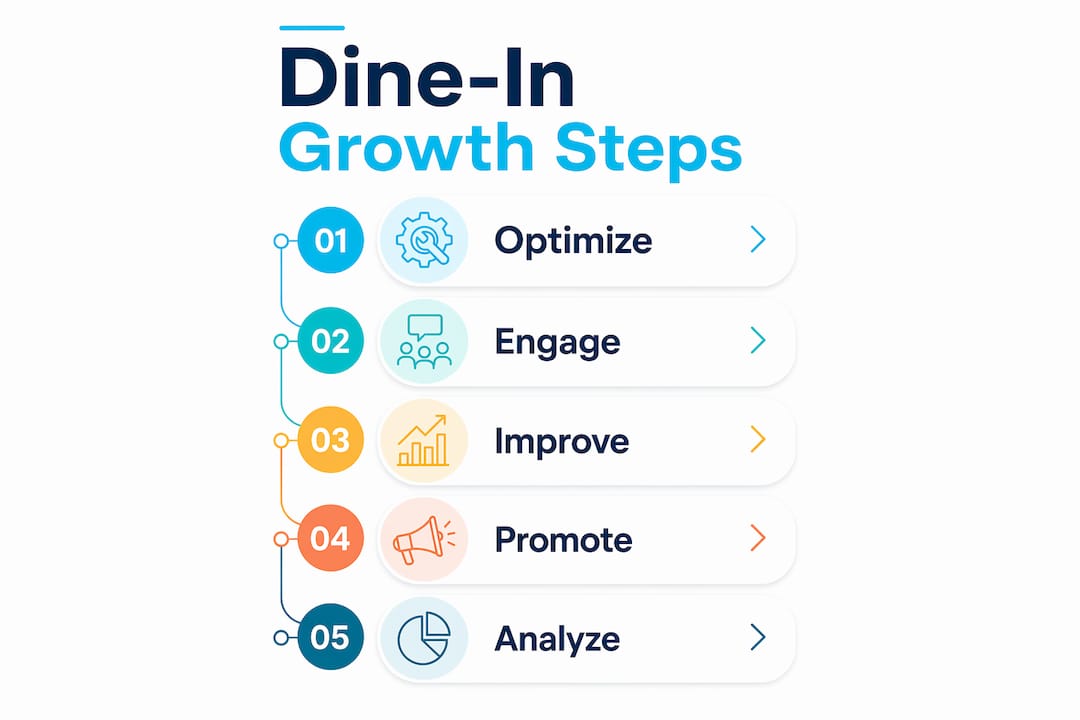
Loyalty programs are the most direct way to increase customer retention and make your dine-in traffic predictable. Enrolled loyalty members visit 20–30% more often and spend more per visit than non-members. That is not a marginal gain. It is the difference between a slow Tuesday and a profitable one.
The biggest mistake restaurant owners make with loyalty is overcomplicating it. Guests do not want to carry a punch card or download an obscure app. A simple digital program tied to a phone number or email address is enough to start. The goal is capturing contact information so you can follow up, not building a tech product.
Avoid the discount trap. Permanent discounts train guests to wait for deals and erode your margins over time. Permanent discounting conditions customers to expect reduced prices, which makes full-price visits feel like a bad deal. Use perks instead: a free appetizer on a third visit, early access to a new menu, or a birthday dessert. These feel generous without cutting into your core pricing.
Here is how to set up a loyalty program that actually works:
- Choose a digital platform that captures email or phone at the point of sale without friction.
- Set a simple reward structure — one point per dollar, redeemable after a clear threshold.
- Send a welcome message within 24 hours of sign-up with a small first-return offer.
- Schedule follow-up messages at 14 days and 30 days for guests who have not returned.
- Use birthday and anniversary triggers to send personalized perks that feel thoughtful, not automated.
- Review redemption data monthly to see which rewards drive return visits and which ones sit unused.
Pro Tip: Turning a first-time visitor into a regular starts with capturing their contact info at the table. Train your staff to mention the loyalty program during checkout, not as an afterthought, but as a genuine benefit. That one conversation is your highest-ROI customer retention move.
How does improving the in-restaurant experience encourage more frequent visits?
Consistency is the single biggest driver of repeat visits. Guests return when they know exactly what to expect: the same food quality, the same service speed, and the same welcoming environment. One bad experience erases three good ones in a guest’s memory.
Your front-of-house sets the tone before a single dish arrives. Clear signage, clean menus, and a logical seating flow reduce friction and make guests feel comfortable immediately. Visible operational improvements like clear signage and consistent service speed directly increase return rates. Small details compound: a host who greets guests by name on their second visit, a server who remembers a regular’s usual order, a table that is clean and set before the guest sits down.
The restaurant ambiance you create shapes whether guests linger, spend more, and come back. Lighting, music volume, and table spacing all affect how long guests stay and how comfortable they feel. A dining room that feels rushed or loud pushes guests out faster and reduces average ticket size.
Technology also plays a direct role in the experience. Self-service kiosks increase average ticket size by 25% by reducing wait times and presenting consistent upsell prompts. Guests who order at their own pace tend to add more items than when they feel pressure from a busy server.
Key ambiance and service elements that drive return visits:
- Music volume set low enough for conversation at every table
- Lighting adjusted by daypart: bright for lunch, warmer for dinner
- Seating flow that does not crowd tables or create bottlenecks near the entrance
- Visible cleanliness in the dining room, restrooms, and host stand
- Staff greetings within 60 seconds of a guest being seated
- Limited-time events like themed nights or seasonal menus that give guests a reason to return soon
Pro Tip: Host one recurring weekly event, a trivia night, a chef’s tasting, or a live music set, and promote it consistently. Regulars plan their week around predictable events. That habit fills your slowest night without a single discount.
What technologies and marketing channels drive same-day and slow-hour traffic?
SMS marketing achieves a 98% open rate, often within 3 minutes of delivery. No other channel comes close for same-day traffic. When you need to fill seats on a slow Wednesday afternoon, a text message at 11:00 AM offering a lunch special reaches guests before they have already made a plan. Email and social posts cannot match that speed.
SMS works best when it is specific and rare. Send no more than two to four messages per month. Each message should have a clear offer, a clear expiration, and a clear call to action. “Lunch special today only: buy one entrée, get a free dessert. Valid until 3 PM” outperforms any vague “come see us” message every time.
Targeted promotions for slow dayparts are a smarter play than blanket discounts. Use your POS data to identify your three slowest time slots each week. Build specific offers for those windows and promote them only to loyalty members or SMS subscribers. That approach fills seats without training your full customer base to expect lower prices. For more on mobile marketing tactics that work for restaurants, Ionhospitality has a dedicated breakdown worth reading.
Tactics that move same-day and slow-hour traffic:
- SMS promotions sent by 11:00 AM for lunch and by 4:00 PM for dinner, with same-day expiration
- ️ Self-order kiosks during peak hours to reduce wait times and increase order size
- Daypart-specific offers built from POS data on your slowest windows
- Loyalty program integration so slow-hour offers go only to enrolled members, protecting brand value
- Social media stories posted in real time to show available seating and daily specials
Pro Tip: SMS marketing’s immediacy beats social and email for driving same-day foot traffic. Build your SMS list at the point of sale, not through a website pop-up. Guests who give their number in person are far more likely to open and act on your messages.
How do you analyze and adjust strategies for sustained traffic growth?
Data review is not optional if you want consistent growth. Check your POS dashboard weekly for three numbers: visit frequency per guest, average ticket size, and table turn time. Those three metrics tell you whether your loyalty program is working, whether your upsell strategy is landing, and whether your service is fast enough to handle volume.
The most common mistake restaurant owners make is ignoring retention data while chasing new guests. New foot traffic is expensive and unpredictable. Your existing guest base is your most reliable growth engine. If your visit frequency per guest is flat or declining, no amount of new customer acquisition will fix your revenue problem.
Test one change at a time. If you launch a new loyalty reward and a new SMS campaign in the same week, you cannot tell which one moved the needle. Run changes in isolation for two to four weeks, measure the result, and then move to the next test. That discipline separates restaurants that grow from those that stay stuck.
| Strategy category | Primary benefit | Effort level |
|---|---|---|
| Google Business Profile optimization | Increases first-time visits from local search | Low |
| Loyalty program setup | Boosts repeat visit frequency by 20–30% | Medium |
| SMS marketing campaigns | Drives same-day and slow-hour traffic | Low |
| In-restaurant experience upgrades | Increases average ticket size and return rate | Medium |
| Self-service kiosk implementation | Raises ticket size by up to 25% | High |
| POS data review and iteration | Identifies what is working and what is not | Low |
Key Takeaways
Restaurants that combine digital presence, loyalty programs, and consistent in-restaurant experience see the most reliable and sustained growth in dine-in traffic.
| Point | Details |
|---|---|
| Online presence drives first visits | Keep your Google Business Profile current with photos, hours, and a working menu link. |
| Loyalty programs increase visit frequency | Enrolled members visit 20–30% more often, making traffic more predictable. |
| Consistency creates repeat guests | Uniform food quality, service speed, and ambiance are the top drivers of return visits. |
| SMS fills slow hours fast | A 98% open rate makes SMS the fastest channel for same-day seat fills. |
| Data guides every decision | Review visit frequency, ticket size, and turn time weekly to know what to fix next. |
What I have learned about dine-in traffic after years in restaurant marketing
Most restaurant owners I talk to are obsessed with getting new customers. They want more ads, more reach, more followers. I get it. New guests feel like growth. But the math does not support that obsession.
The restaurants I have seen grow consistently are the ones that treat their existing guests like gold. They capture contact info at every visit. They send a follow-up within a week. They build a loyalty structure that rewards the people who already love them. That approach costs a fraction of paid acquisition and produces guests who spend more and refer their friends.
The other thing I have seen kill otherwise good restaurants is inconsistency. A great Saturday followed by a mediocre Tuesday is not a brand. Guests do not give you credit for your best days. They remember the time the food was cold or the server seemed annoyed. Operational consistency is not glamorous, but it is the foundation that every other marketing strategy sits on top of.
The atmosphere you create in your dining room is also more powerful than most owners realize. I have watched restaurants with average food and exceptional ambiance outperform technically superior kitchens because guests felt good being there. People eat with their emotions first.
My honest advice: fix your retention before you spend another dollar on acquisition. Build your SMS list. Set up a simple loyalty program. Make your Google profile look like you care. Those three moves, done consistently, will outperform any ad campaign you can buy.
— Doug
How Ionhospitality helps restaurants fill more seats
Running every one of these strategies on your own is a full-time job on top of an already full-time job. Ionhospitality specializes in social media advertising built specifically for restaurants, creating the kind of viral word-of-mouth that puts real guests in real seats with zero commissions.
From local search optimization to loyalty-driven campaigns and private event promotion, Ionhospitality handles the marketing so you can focus on the food and the guest experience. If you want a clear picture of what is holding your dine-in traffic back and what to do about it, book a discovery call and get a plan built around your specific restaurant.
FAQ
How long does it take to see results from loyalty programs?
Most restaurants see measurable increases in return visit frequency within 60–90 days of launching a digital loyalty program. The key is capturing contact info at the point of sale from day one.
What is the fastest way to fill seats on a slow day?
SMS marketing is the fastest channel, with a 98% open rate typically within 3 minutes. Send a specific, time-limited offer before the meal period starts and include a clear call to action.
How do I increase dine-in traffic without discounting?
Use value-based perks instead of price cuts. Free appetizers, birthday desserts, and early menu access reward loyal guests without conditioning your full customer base to expect lower prices.
Does restaurant ambiance really affect how often guests return?
Yes. Lighting, music volume, and seating comfort directly influence how long guests stay and whether they return. Guests who feel comfortable linger longer, spend more, and are more likely to book again.
How many photos should my Google Business Profile have?
Start with at least 10 recent, high-quality food and interior photos. Professional food photos increase menu item sales by 2–3 times compared to text-only listings, and Google rewards profiles with active photo uploads in local search rankings.

Add a Comment