

TL;DR:
- Engagement metrics help restaurants understand guest behavior and predict retention. Tracking data across channels improves marketing efficiency and reduces guest loss. Personalized outreach based on unified data significantly increases guest retention.
Engagement metrics are defined as the quantitative measures of how guests interact with your restaurant across every channel, from social media to in-person visits to online orders. Understanding why restaurants need engagement metrics is not optional anymore. 69% of previously active guests went inactive entering 2026. That number means most of your regulars are quietly drifting away right now, and without tracking the right data, you will never see it coming. The good news is that restaurants using 1:1 personalized marketing retained 2.7 times more guests than those running generic campaigns.
Why restaurants need engagement metrics: the core case
Engagement metrics in a restaurant context include customer retention rate, visit frequency, average spend per visit, social media engagement rate, and review sentiment scores. These are the numbers that tell you whether your guests are falling in love with your restaurant or quietly moving on. Tracking them gives you a real picture of guest health across your entire customer base, not just the vocal minority who leave reviews.
Here are the key metrics every restaurant owner should track:
- Customer retention rate. The percentage of guests who return within a set period. This is your single most important growth indicator.
- ⭐ Average rating score. A rolling average of your review scores across Google, Yelp, and other platforms. It acts as a proxy for overall guest perception.
- Social media engagement rate. A healthy Instagram rate sits between 2%–4%. Dropping below 1% signals your content is not connecting with your audience.
- Visit frequency and lifetime value (LTV). How often a guest returns and how much they spend over their entire relationship with you. High LTV guests are your most profitable segment.
- Win-back campaign metrics. Track open rates, click rates, and redemption rates on campaigns targeting lapsed guests. Win-back rates jumped 550% when restaurants switched from broadcast messaging to 1:1 personalized outreach.
Pro Tip: Do not rely solely on loyalty program data to measure engagement. Loyalty members are not representative of your full guest base, and using only that data leads you to overestimate how engaged your customers actually are.
How engagement metrics reveal customer behavior and predict retention
Unified guest data is the foundation of accurate behavior prediction. When your POS, reservation system, WiFi login data, and online ordering platform all feed into one profile per guest, patterns emerge that no single system can show you alone. Failure to unify guest data across these sources hides the behavioral signals that predict churn before it happens.
Here is what that unified view reveals:
- Cooling-off signals. A guest who visited weekly and now visits monthly is sending a warning. Engagement metrics catch this drift early, before the guest disappears entirely.
- Sentiment trends from reviews. Negative sentiment appears weeks before visit frequency declines. Treat review scores as a leading indicator, not a lagging one.
- First interaction source impact. Engagement-captured and reservation-captured guests visit more frequently and spend more than guests acquired through other channels. Knowing where your best guests come from tells you where to focus your marketing budget.
- Behavioral plus sentiment combination. A guest who visits less AND leaves a 3-star review is at high churn risk. Combining both signals gives you a far more accurate picture than either metric alone.
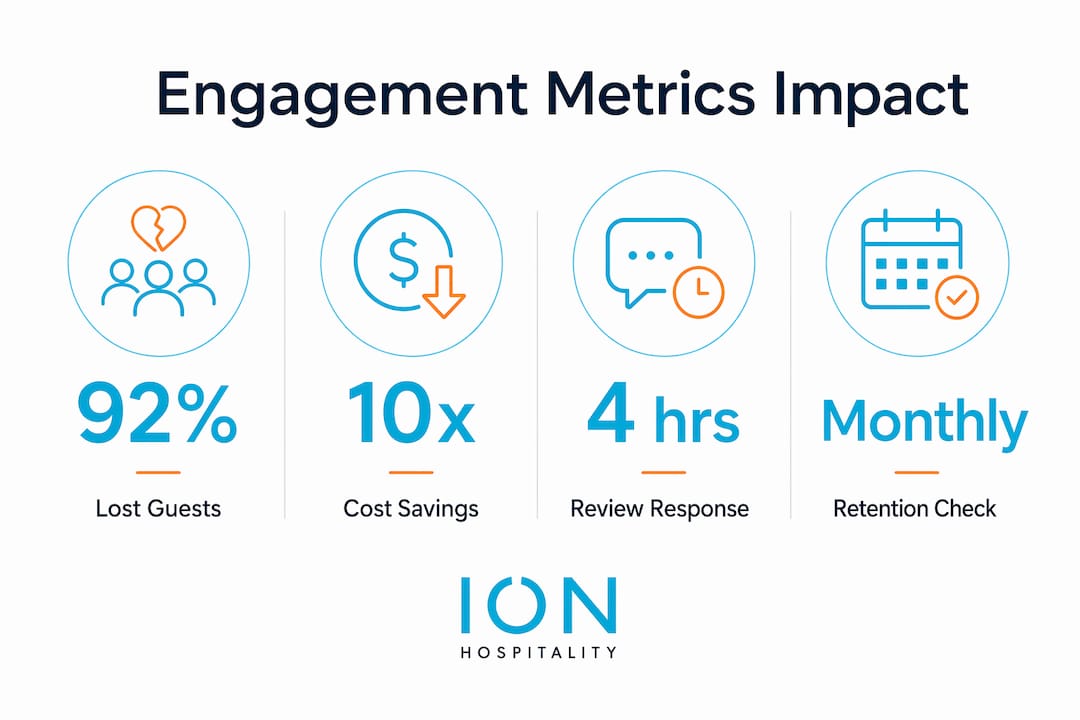
The practical implication is significant. 92% of first-time guests without targeted follow-up marketing never returned. That is not a service problem. That is a data and follow-up problem.
Pro Tip: Responding to negative reviews within 4 hours improves sentiment recovery significantly. Set up alerts so your team sees negative feedback the moment it posts, not the next morning.

You can also use catering inquiries as an engagement signal. Guests who ask about catering for business events often represent high-LTV relationships worth nurturing with personalized follow-up.
Why tracking metrics makes your marketing spend work harder
Acquiring a new guest costs 10 times more than keeping an existing one. That single fact should reshape how you allocate your entire marketing budget. In 2025, brands lost 1.4 active guests for every new guest they added. Spending more on acquisition while ignoring retention is running a leaky bucket.
Engagement data fixes this by showing you exactly where to spend and who to target.
| Marketing approach | What it relies on | Typical outcome |
|---|---|---|
| Broadcast promotions | Generic audience segments | Low redemption, high cost per conversion |
| Loyalty-only data | A small, skewed member subset | Overestimates engagement, misses at-risk guests |
| Unified engagement data | Full guest behavioral profiles | Targeted 1:1 outreach, 2.7x higher retention |
Operationally, integrated engagement data also improves forecasting. When you know which days your high-frequency guests typically visit, you can schedule labor more accurately. Integrating delivery platforms with POS eliminates manual errors and produces accurate sales reports that actually reflect what is happening in your restaurant. That accuracy flows directly into better purchasing decisions and less food waste.
Pro Tip: Use your restaurant marketing KPIs to set a monthly retention benchmark. If retention drops two months in a row, that is your signal to run a win-back campaign before the loss compounds.
How to collect, unify, and act on engagement data
Data fragmentation is the biggest obstacle most restaurants face. Your POS knows what guests ordered. Your reservation system knows when they booked. Your WiFi portal knows how often they visited. But if those systems never talk to each other, you are making decisions with incomplete information.
Here is how to build a system that actually works:
- Audit your current data sources. List every touchpoint where guest data is collected: POS, reservations, online ordering, WiFi, social media, and review platforms. Identify which ones are siloed.
- Integrate into a single guest profile. Use a CRM or guest data platform that pulls from all sources. The goal is one record per guest that shows visit history, spend, sentiment, and channel preference.
- Segment by engagement level. Divide your guest base into active, at-risk, and lapsed segments. Each group needs a different message and a different offer.
- Automate personalized outreach. Set triggers based on behavior. A guest who has not visited in 45 days gets a personalized win-back message. A guest who just left a 2-star review gets a service recovery offer within hours.
- Measure every campaign. Track open rates, redemption rates, and incremental visits per campaign. This tells you which messages work and which ones to cut. Your social media engagement data should feed into this loop as well, showing you which content drives actual visits versus passive likes.
The restaurants that win at retention are not the ones with the biggest budgets. They are the ones who use their data to send the right message to the right guest at the right time. That is what unified engagement data makes possible.
Key Takeaways
Restaurants that track and act on engagement metrics retain significantly more guests, spend less on acquisition, and generate higher lifetime value from every customer relationship.
| Point | Details |
|---|---|
| Retention beats acquisition | Acquiring a new guest costs 10 times more than keeping an existing one. |
| Unified data predicts churn | Combining POS, WiFi, reservations, and review data reveals cooling-off signals weeks before guests leave. |
| Personalized outreach works | 1:1 marketing retains 2.7 times more guests than generic broadcast campaigns. |
| Review sentiment is a leading metric | Negative sentiment appears before visit frequency drops, giving you time to recover the relationship. |
| Capture source shapes LTV | Guests acquired through engagement and reservation channels visit more often and spend more over time. |
What I have learned about engagement metrics after years in restaurant marketing
Most restaurant owners I talk to are not ignoring engagement data because they do not care. They are ignoring it because no one has shown them what to do with it. They run a loyalty program, collect some emails, and call it a day. That is not a retention strategy. That is a checkbox.
The restaurants that genuinely grow year over year share one habit: they treat guest data as a living system, not a static list. They check retention rates monthly. They respond to reviews within hours. They know which channel brings in their best guests and they put more money there. They do not wait for a slow quarter to figure out why guests stopped coming.
The loyalty program trap is real. I have seen operators convinced they have strong engagement because their loyalty members are active. But loyalty members are often your most forgiving guests anyway. The guests you need to worry about are the ones who visited three times and disappeared. Those guests never joined your loyalty program. You will never see them in that data. That is exactly why broader engagement metrics matter.
The other mistake I see constantly is treating a bad review as a customer service issue and nothing more. A 2-star review is a marketing signal. It tells you a guest is at high churn risk. If you respond fast and recover that relationship, you have a chance to turn a detractor into a repeat visitor. If you ignore it, you have confirmed their decision to leave.
Build your customer retention system around engagement data, not gut instinct. The numbers tell you what your instincts cannot.
— Doug
How Ionhospitality helps restaurants put engagement data to work
Knowing your engagement metrics is one thing. Acting on them with precision is another. Ionhospitality specializes in social media advertising built specifically for restaurants, using engagement data to target the right guests with the right message at the right moment.
Every campaign Ionhospitality runs is tied to real guest behavior, not guesswork. From win-back ads targeting lapsed guests to content that drives private event bookings, the work is grounded in the same engagement metrics this article covers. Restaurants that work with Ionhospitality get more repeat visits, more online orders, and more private event revenue, all without paying commissions. If you are ready to turn your engagement data into actual revenue, book a discovery call and see what a data-driven marketing strategy looks like for your restaurant.
FAQ
What are engagement metrics in a restaurant context?
Engagement metrics measure how guests interact with your restaurant across channels, including visit frequency, retention rate, review sentiment, and social media engagement rate. They give you a complete picture of guest health beyond what any single system can show.
Why do restaurants lose so many first-time guests?
92% of first-time guests without targeted follow-up never return. The cause is a lack of personalized outreach after the first visit, not poor food or service.
How often should restaurants review their engagement data?
Review retention rate and visit frequency monthly, and monitor review sentiment weekly. Negative sentiment appears weeks before visit frequency drops, so early detection is the key to recovery.
What is a healthy social media engagement rate for restaurants?
A healthy Instagram engagement rate sits between 2%–4%. A rate below 1% signals that your content strategy is not connecting with your audience and needs to change.
How does personalized marketing improve restaurant retention?
1:1 personalized marketing retains 2.7 times more guests than non-targeted campaigns and improves new guest retention by 300%. The difference is sending messages based on actual guest behavior rather than broadcasting the same offer to everyone.

Add a Comment