

TL;DR:
- Effective restaurant email marketing aligns campaigns with each guest’s lifecycle to boost reservations and engagement.
- Structured sequences like welcome, promotional, and win-back emails outperform single messages, especially when timed correctly.
Most restaurants send emails. Few actually get bookings from them. The gap between a deleted email and a reservation comes down to strategy, and most restaurant marketers are working without one. The good news: restaurant email marketing earns an average of $36 for every $1 spent, making it one of the highest-return channels you have. This article breaks down the best examples of restaurant email campaigns across every key category, with the strategic reasoning behind what makes each one work. No guesswork. Just proven formats you can steal and adapt today.
Table of Contents
- Key takeaways
- 1. What makes examples of restaurant email campaigns actually work
- 2. Welcome and onboarding email examples
- 3. Weekly and recurring promotional email examples
- 4. Win-back and lifecycle email examples with discount ladders
- 5. Event and seasonal email campaign examples
- 6. Comparing restaurant email campaign types at a glance
- My honest take on restaurant email strategy
- Let Ionhospitality handle your restaurant marketing
- FAQ
Key takeaways
| Point | Details |
|---|---|
| Match campaign to the moment | Use the right email type for each stage of the guest lifecycle to maximize relevance and bookings. |
| Welcome emails work fast | Send your welcome email within 1 hour of signup or first order to capture peak customer intent. |
| Sequencing beats single blasts | Multi-touch campaigns like discount ladders outperform one-off promotional emails for re-engagement. |
| One CTA per email | Every email should have a single, clear call to action directing guests to reserve or order. |
| Segmentation drives results | Layering geography with behavioral data makes your emails more relevant and your open rates climb. |
1. What makes examples of restaurant email campaigns actually work
Before you copy a template, you need to know how to evaluate one. Not every email that looks good converts. Here is the framework we use to judge whether a campaign is worth borrowing.
- Match the email to the guest’s lifecycle stage. A welcome email, a win-back offer, and a holiday event announcement each serve a different moment. Matching campaigns to moments when guests are most ready to act is the starting point for any effective strategy.
- One CTA, one goal. Tying every email to a single booking or order CTA removes friction and focuses the reader’s attention. Multiple CTAs split attention and kill conversion.
- Subject lines and preview text do the heavy lifting. Your subject line determines whether the email gets opened or trashed. Optimized mobile design with a strong subject, crisp preview text, and key info near the top directly affects open rates and conversions.
- Segment before you send. Start with geography, then layer in guest behavior like visit frequency, average spend, or last order date. Local relevance matters more than most marketers realize.
- Respect your frequency. Sending too often burns your list. Sending too rarely loses momentum. Weekly or biweekly is the sweet spot for most restaurants.
Pro Tip: Run a 60/40 rule on your emails: 60% visuals, 40% text. That ratio keeps mobile readers engaged without making the email feel like a wall of copy.
2. Welcome and onboarding email examples
The welcome email is the single highest-performing email you will ever send. It arrives when the guest is most excited about your restaurant. That window is short.
Sending your welcome within 1 hour of a first reservation or order captures that fresh intent before it fades. Restaurants that wait 24 hours or more see significantly lower open rates on their welcome messages.
A strong welcome sequence for a restaurant like Saffron Indian Kitchen looks like this:
- Email 1 (immediate): A warm thank-you with a small incentive, like 10% off their next visit, and a clear “Book Again” button.
- Email 2 (Day 3): A short brand story. Who you are, what makes your kitchen different, one signature dish with a great photo.
- Email 3 (Day 7): A direct reservation invitation with your current menu highlights and a prominent “Reserve a Table” CTA.
Each email does one job. Together, they build a relationship before the guest has even decided whether to return. That is the point. Think about restaurant customer retention strategies that start at the very first interaction, not after the guest has already gone cold.
Pro Tip: Never start your welcome email with “Thank you for signing up.” That is the most forgettable opener possible. Lead with the benefit: “Your 10% off is waiting inside.”
3. Weekly and recurring promotional email examples
Consistency builds anticipation. When your guests know that every Tuesday morning they will get your Taco Tuesday offer, they start looking for it. That is habit-forming marketing.
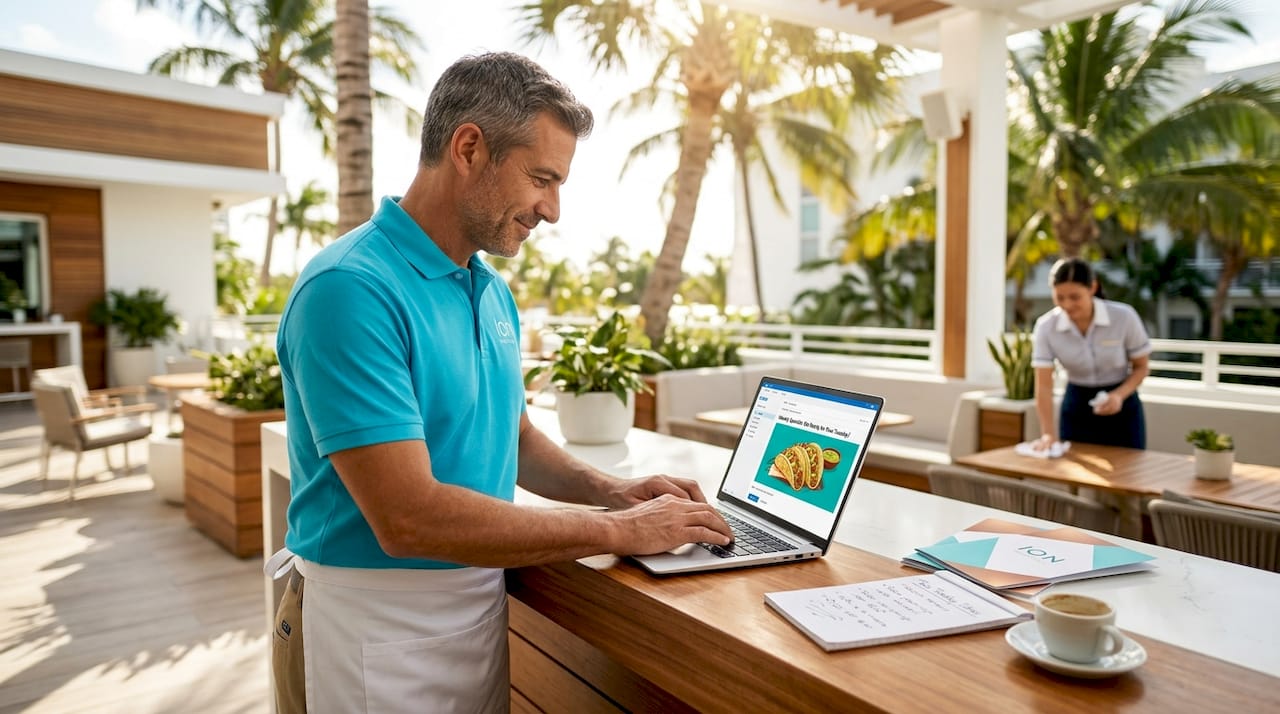
Weekly promotional emails built around recurring themes, like a 20% discount sent on the same day each week, maintain engagement without overloading your list. Talkin’ Tacos uses exactly this cadence: same day, same tone, same format each week with a fresh photo of that week’s special.
What makes recurring promos work:
- Predictable send day and time. Guests learn your rhythm. Tuesday at 10am becomes something they expect.
- A mouth-watering image. One strong photo of the dish on offer does more than a paragraph of description.
- Urgency without screaming. “Today only” or “Tonight’s special” creates real urgency without fake countdown pressure.
- A single reservation or order CTA. One button. That is it.
Slow nights are where these campaigns earn their money. A Wednesday dinner offer sent Tuesday afternoon can move the needle on a night that would otherwise be half-empty. Launching restaurant campaigns around predictable weekly themes gives you a content calendar that practically fills itself.
Pro Tip: Test two subject lines on your weekly promo by splitting your list 50/50. After three months you will know exactly what tone your audience responds to, and your open rates will climb.
4. Win-back and lifecycle email examples with discount ladders
Lapsed customers are your lowest-hanging fruit. They already know you. They already liked you. They just drifted. The right email at the right moment brings them back.
The most effective approach is a structured discount ladder, not a single desperate “We miss you” message. Here is what a well-built sequence looks like:
- Day 60 after last visit: A gentle “We haven’t seen you in a while” message with a modest incentive, around 10% off, no expiration pressure yet.
- Day 75: A follow-up that ups the offer to 15% off and adds a soft deadline: “This offer expires in 7 days.”
- Day 90: The final pull with a 20 to 30% discount and real urgency: “Last chance to reclaim your spot.”
Discount ladder sequencing outperforms one-off win-back blasts because it mirrors how real human decision-making works. People need multiple nudges, and escalating the incentive rewards those who respond later without immediately giving your best discount to everyone.
Automating guest lifecycle emails like these win-back sequences means you set them up once, and they run in the background, pulling back lapsed guests without any manual effort. Domino’s uses a multi-touch campaign structure combining initial discounts, loyalty enrollment, bonus offers, and VIP rewards to keep customers cycling back through multiple engagement touchpoints.
Pro Tip: Segment your win-back list by total spend before launching the sequence. Your high-value lapsed guests deserve a more personalized subject line and a stronger initial offer. Treat them like VIPs, because they were.
5. Event and seasonal email campaign examples
Seasonal restaurant email campaigns and event invitations are where the most money gets left on the table. A wine dinner, a holiday prix fixe, a cooking class: these are high-margin, high-excitement events that email is perfectly designed to sell.
The key is timing and specificity. Vague event announcements get ignored. Clear ones with a date, a menu preview, and a “Reserve Your Seat” button get clicks.
Here is what a winning event campaign structure looks like:
| Timing | Purpose | |
|---|---|---|
| Announcement | 14 days before event | Build excitement, introduce the concept, open reservations |
| Reminder | 7 days before event | Highlight remaining seats, add social proof or reviews |
| Last call | 2 to 3 days before event | Urgency push with “Only 8 seats left” language |
Fishwife’s local pop-up invitations nail this format. Their emails use a playful, community-driven tone, list the date and location upfront, and include a visual itinerary of what guests can expect. The result feels like an invitation from a friend, not a marketing blast.
For holiday events, lead times matter even more. Event marketing strategies for Thanksgiving, Valentine’s Day, and New Year’s Eve should start 3 to 4 weeks out. The earlier you claim space in your guests’ calendars, the less competition you face from every other restaurant in town.
For inspiration on how premium restaurants structure group dining invitations and seasonal menus, Els Pescadors offers a strong Barcelona venue example worth studying for its clarity and tone.
6. Comparing restaurant email campaign types at a glance
Different goals need different campaigns. Here is a fast-reference comparison of the core email types, what they are built for, and how to use them.
| Campaign type | Primary goal | Best timing | Segmentation tip | KPI to watch |
|---|---|---|---|---|
| Welcome sequence | First-visit retention | Within 1 hour of signup | New subscribers only | Open rate, second visit rate |
| Weekly promo | Drive traffic on slow nights | Same day each week | Geography and visit frequency | Click-through rate, reservations |
| Win-back series | Re-engage lapsed guests | 60, 75, and 90 days post-visit | By recency and spend level | Reactivation rate, revenue per send |
| Event invitation | Sell limited-seat events | 14 days out, reminder at 7 and 3 | Local guests, past event attendees | Reservations, ticket sales |
| Loyalty reward | Retain high-value guests | Triggered by milestone or frequency | Top spenders and frequent visitors | Repeat visit rate, average check size |
The average restaurant email campaign earns an open rate of 21.7% with a click-through rate of 2.1%. These benchmarks help you know when a campaign is underperforming and needs a subject line test or a new template. Track against these numbers and adjust. Keep an eye on restaurant marketing KPIs beyond just open rates to get the full picture of campaign performance.
My honest take on restaurant email strategy
I’ve watched hundreds of restaurant marketers chase the perfect single email when the real money is in the sequence. One email, no matter how good, rarely converts a cold or lapsed guest into a booking. What converts is a structured series where each email does a small job and passes the baton to the next.
What I’ve also learned is that the “bridge from inbox to table” breaks at the CTA more than anywhere else. I see restaurants send beautiful emails with no clear next step. No reservation button. No order link. Just a phone number buried in the footer. That is where you lose people. Behavior-triggered email timing capturing peak intent moments is only worth anything if the landing experience makes booking frictionless.
My biggest piece of advice: stop treating email as a broadcast channel and start treating it as a conversation. Welcome emails should feel personal. Win-back messages should acknowledge the gap. Event invitations should sound like they came from someone excited about the night. Mobile users skim fast. You have about four seconds to land your message before they scroll past. Put the most important thing first. Always.
— Doug
Let Ionhospitality handle your restaurant marketing
Running these campaigns takes more than a good template. It takes integrated strategy, consistent execution, and the kind of creative that actually makes guests stop scrolling and book a table.
At Ionhospitality, we build restaurant social media advertising and marketing systems that put more covers on your floor and more private events on your calendar, with zero commissions taken. Our team handles everything: content, targeting, campaign execution, and performance tracking. You focus on the food. We fill the seats. If you are ready to see what a real restaurant marketing strategy looks like in action, schedule a discovery call and let’s map out your next campaign together.
FAQ
What are the best types of restaurant email campaigns?
The most effective types are welcome sequences, weekly promotional offers, win-back series, event invitations, and loyalty rewards. Each one targets a specific stage in the guest lifecycle for maximum relevance.
How often should restaurants send marketing emails?
Weekly or biweekly is the right frequency for most restaurants. Sending more often risks unsubscribes; sending less often loses momentum and keeps guests from developing a habit of engaging with your emails.
What subject lines work best for restaurant emails?
Benefit-driven and urgency-based subject lines consistently outperform generic ones. Lines like “Your table is waiting tonight” or “Taco Tuesday: 20% off ends at close” drive higher open rates than vague announcements.
How do win-back email campaigns work for restaurants?
Win-back campaigns use a discount ladder sent at 60, 75, and 90 days after a guest’s last visit, with escalating offers that increase to 20 to 30% off. This approach re-engages lapsed customers without giving away your best discount immediately.
When should I send a welcome email to a new restaurant subscriber?
Send it within 1 hour of signup or their first reservation. That timing captures peak intent and produces the highest open and engagement rates of any email in your sequence.

Add a Comment