

TL;DR:
- Private event marketing emphasizes exclusivity and personalized outreach over broad visibility campaigns. Using Dark Social channels, segmented messaging, and tailored content boosts bookings and enhances guest experience. Measuring success relies on trackable referral links, conversion rates, and peer-to-peer sharing analytics.
Most event planners treat private event marketing like a quieter version of public event promotion. Same tools, lower volume. That assumption is costing you bookings. Defining private event marketing correctly means recognizing it as its own discipline, one built around exclusivity, personalization, and channels that traditional analytics can barely track. This guide breaks down the real definition, the tactics that actually work, how to measure what matters, and what the sharpest planners are doing differently in 2026 to fill their private dining rooms, corporate suites, and VIP experiences.
Table of Contents
- Key takeaways
- Defining private event marketing and what sets it apart
- Exclusive tactics that actually work for private event promotion
- Measuring private event marketing success
- Tailoring venue content for private event bookings
- Advanced personalization and 2026 trend adaptations
- My take: why most planners get this wrong
- How Ionhospitality helps you book more private events
- FAQ
Key takeaways
| Point | Details |
|---|---|
| Private event marketing is distinct | It prioritizes exclusivity and personalized outreach over broad visibility campaigns. |
| Dark Social drives real bookings | Nearly 32% of registrations flow through private channels like WhatsApp and Slack. |
| Segmentation outperforms blasting | Personalized, segmented messaging consistently produces higher conversion and lower abandonment. |
| Venue landing pages convert better | Dedicated pages for each event type outperform generic venue pages in both SEO and bookings. |
| Automation saves time without losing touch | Pre-built email sequences and landing pages let small teams promote effectively without manual effort per event. |
Defining private event marketing and what sets it apart
At its core, defining private event marketing means understanding the promotional strategy used to attract, convert, and retain guests or clients for events that are not open to the general public. The audience is curated. Access is controlled. And the entire marketing approach must reflect that.
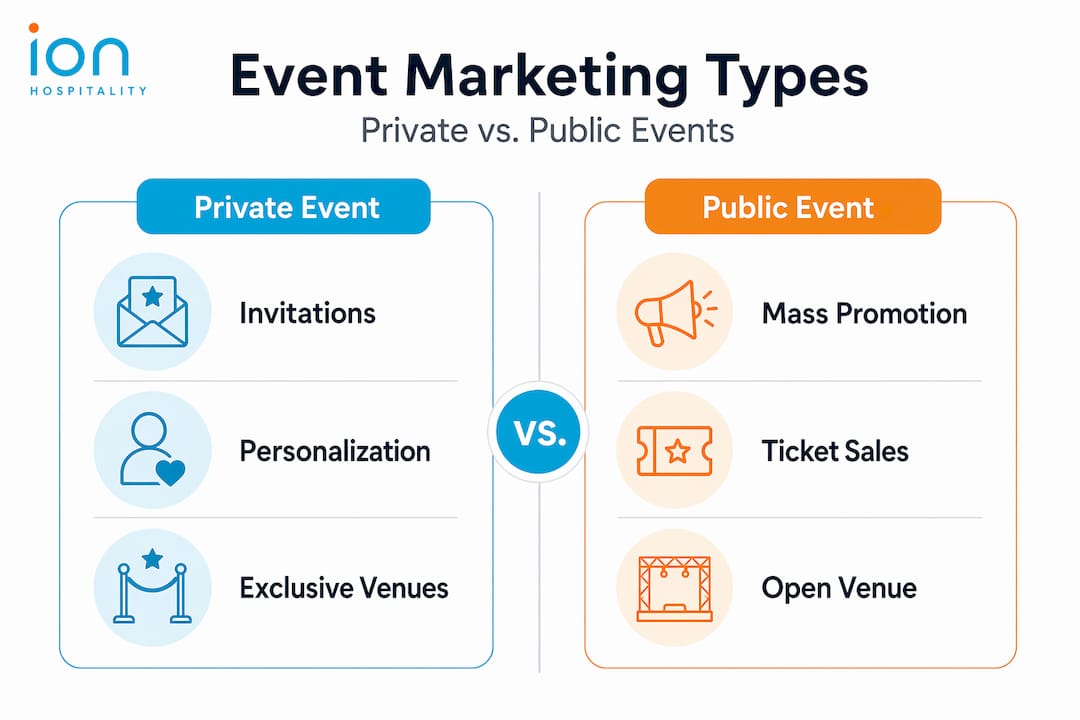
Public event marketing casts a wide net. It runs paid ads to cold audiences, posts broadly on social media, and measures success by ticket volume. Private event marketing works in the opposite direction. You already know, or can identify, who should be in the room. Your job is to reach exactly those people in a way that makes them feel the invitation was made specifically for them.
Here is what separates private event marketing from general event marketing strategies:
- Audience exclusivity The guest list is defined before promotion begins. Whether it is a 200-person corporate dinner or an intimate private tasting for 20 high-value clients, the audience is pre-segmented.
- Invitation-driven access Marketing materials include access mechanisms like invite codes, private RSVPs, or curated referral paths rather than public buy-now buttons.
- Venue selection as a signal ️ The space itself communicates exclusivity. A rooftop buyout, a private dining room, or a members-only club reinforces the event’s value before a guest even arrives.
- Channel selection Private event promotion happens in places most public campaigns ignore: personal email, direct messages, private Slack groups, and WhatsApp threads.
- Experience value over attendance volume The shift from visibility to value creation defines modern event marketing, and private events accelerate that shift because the metrics are depth-based, not scale-based.
Private events span a wide range of formats. Corporate events, luxury brand activations, social celebrations like milestone birthdays and weddings, VIP dinners, and invite-only product launches all fall under this umbrella. What they share is a deliberate boundary between who is inside and who is not. That boundary is both the marketing challenge and the marketing advantage.
Exclusive tactics that actually work for private event promotion
The biggest mistake planners make is applying mass-market tactics to private event promotion. Blanket email blasts and boosted Instagram posts work for concerts. They underperform when your audience is a list of 80 high-net-worth clients who expect to feel personally selected.
Here is how to market private events in a way that matches the exclusivity you are selling:
-
Use invite codes and pre-registration windows. Private invite codes sent before any public announcement increase conversion rates among affluent audiences significantly. The code is not just a technical mechanism. It is a signal that says, “You were chosen before anyone else knew about this.”
-
Personalize every message, even at scale. Merge fields are the floor, not the ceiling. Reference the recipient’s last event attendance, their preferred seating area, or the specific reason they are being invited. Audience segmentation is now non-negotiable for private event marketing success. Segment by relationship tier, spend history, or event type preference before you write a single word of copy.
-
Distribute through Dark Social channels. This is where private events actually spread. Dark Social refers to sharing that happens through channels traditional analytics cannot track: WhatsApp, private Slack groups, iMessage, and direct messages. 31.9% of event registrations come through peer-to-peer shares, and 32.6% flow through private messaging platforms. Your marketing strategy needs to make sharing in these channels frictionless.
-
Create ethical scarcity through VIP tiers. Capped guest counts, waitlists, and tiered access (think “founding member” tables vs. general private admission) all build desirability. Personalized printed invites and embossed VIP passes remain remarkably effective for high-net-worth audiences precisely because they are rare in a digital world.
-
Partner with private networks and concierge services. Luxury hotel concierge teams, corporate travel managers, and private member clubs have direct lines to exactly the audience you want. Forming relationships with these gatekeepers is one of the most underused tactics in how to market private events for premium audiences.
-
Build a bespoke RSVP experience. A generic Eventbrite link breaks the illusion of exclusivity immediately. Custom RSVP pages with the guest’s name pre-filled, a short personal message from the host, and clear visual branding match the experience the guest expects from the event itself.
Pro Tip: When you send a private invitation digitally, follow up with a physical touchpoint at least 10 days before the event. A handwritten note, a branded mailer, or even a simple gift box tied to the event theme converts fence-sitters and reinforces the premium feel you are selling.
Measuring private event marketing success
Measuring how to market private events is genuinely hard, and most planners underestimate why. When word-of-mouth through WhatsApp drives a third of your RSVPs, a standard UTM-tagged link tells you nothing. You need a smarter approach to attribution.

The good news is that trackable referral assets now exist specifically for private event contexts. Personalized referral links assigned to each invited guest let you see who is sharing your event, even when that sharing happens in private channels. Each guest gets their own link in the RSVP process. You track which links generated downstream registrations without exposing the guest list or violating anyone’s privacy.
Pro Tip: Don’t just track attendance numbers. Track invite-to-RSVP conversion rates by segment. If your corporate tier converts at 60% and your social tier at 20%, that gap tells you everything about where your message is landing and where it needs work.
Beyond referral tracking, here are the metrics that matter most for private event advertising:
- Invite-to-RSVP conversion rate by audience segment
- Time-to-RSVP as a proxy for how compelling the invite felt
- Peer referral rate tracked through personalized links
- No-show rate broken down by how each guest was originally reached
- Post-event testimonials and social proof generated per event
Peer referral links convert at nearly three times the rate of email in event marketing. That one data point should reshape how you think about your promotional budget. Investing in referral infrastructure pays more than spending on cold paid social for private events.
Automation also plays a role here. Zero-friction landing pages, pre-written 5-day email sequences, and scheduled social scripts eliminate the need to build a promotional campaign from scratch for every event. Set it up once, customize the key variables per event, and your small team runs multiple private event campaigns simultaneously without drowning in execution work.
Tailoring venue content for private event bookings
If you manage a venue and want more private bookings, generic venue pages are killing your conversion rate. Planners searching for private event spaces are not browsing. They are evaluating. Give them exactly what they need to make a decision.
Here is a comparison of how generic venue content performs against event-specific content:
| Content type | Generic venue page | Event-specific landing page |
|---|---|---|
| SEO targeting | Broad venue keywords | “Private dining room for corporate events” |
| Conversion focus | General inquiries | Specific event type booking |
| Social proof | General reviews | Photos and quotes from similar events |
| Call-to-action | “Contact us” | “Book your corporate dinner” |
| FAQ content | General hours and pricing | Catering, AV, guest count, parking |
Customized landing pages for each private event type dramatically improve lead capture and booking efficiency. A wedding planner and a corporate events manager are looking for completely different things. One page cannot serve both well.
Local SEO matters enormously here too. Local listings, schema markup, and event-specific pages directly increase booking visibility. A restaurant private dining page optimized for “private dining room downtown Chicago” outperforms a generic restaurant page every time.
Build relationships with the planners who repeat-book. Personalized outreach after each event, a brief follow-up with photos from the evening, and an early-access offer for next year’s holiday season turn a single booking into a recurring revenue stream. You can see how venues like Alma’s private dining package their private event offerings to make the decision easy for planners who are ready to book.
Advanced personalization and 2026 trend adaptations
The planners winning private event bookings in 2026 are not working harder. They are working in a smarter system. Here is what that system looks like:
- Automated promotional toolkits replace manual work. Pre-built landing pages, scheduled social content, and email sequences fire on a calendar without someone writing copy the night before the event. ️
- Segmented campaigns replace broadcast. Personalized segmentation leads to better engagement across every metric. Stop sending the same message to your birthday party leads and your corporate clients. They want different things. Speak to each group in their own language.
- Invite-only digital communities create ongoing demand. Private Facebook groups, Discord servers, or even curated email newsletters for past private event clients keep your venue top-of-mind between bookings.
- Experiential value over optics. ROI measurement shifts toward revenue generated, leads accelerated, and client retention. Planners who pitch private events on experience outcomes rather than headcount close larger deals.
- Personalized restaurant marketing strategies that worked for growing sales also apply to private events. The data you collect from regular diners tells you who your next private event client might already be.
The through-line across all of these trends is intentionality. Private event marketing is not accidental. Every touchpoint is designed, every message is targeted, and every channel choice is deliberate.
My take: why most planners get this wrong
I’ve watched planners approach private event marketing as an afterthought for years. They finalize the venue, confirm the catering, and then spend the last two weeks sending a few emails and hoping the right people show up. That is not a strategy. It is a prayer.
What I’ve learned from working with restaurants and venues to fill private events is this: the marketing system you build before the event determines the room’s energy on the night. When every guest in the room was personally invited, personally messaged, and given a reason to feel chosen, the atmosphere is completely different. That energy generates the testimonials and referrals that fill your next event automatically.
The exclusivity angle is not a luxury tactic reserved for five-star venues. A neighborhood restaurant can apply the exact same principles to a private tasting dinner for 25 regulars. The invite code, the personal message, the physical follow-up. These work at every price point.
What I’ve found is that the planners who treat private event marketing as a strategic practice see repeat bookings climb, referral rates increase, and no-show rates drop. The ones who treat it as an afterthought keep wondering why they have empty seats. The discipline is the differentiator.
— Doug
How Ionhospitality helps you book more private events
You now understand what separates effective private event marketing from generic promotion. The next question is execution. That is where Ionhospitality comes in.
Ionhospitality is a social media marketing and advertising agency built specifically for restaurants, and a huge part of what we do is help venues fill their private event calendars. From social media advertising campaigns that target the right audiences with zero commissions, to website builds with event-specific landing pages designed to convert planners into booked clients, we handle the full promotional picture for you. We create the content, run the campaigns, and build the systems that generate private event inquiries while you focus on running the room. Ready to see what that looks like for your venue? Book a discovery call with our team and let’s map out a private event marketing strategy built around your goals.
FAQ
What is private event marketing?
Private event marketing is the strategy of promoting events with controlled, invitation-based access to a curated audience rather than the general public. It relies on personalized outreach, exclusive channels, and experience-focused messaging rather than broad advertising.
How is private event marketing different from public event marketing?
Public event marketing focuses on reach and ticket volume through mass channels. Private event marketing prioritizes personalization, exclusivity, and depth of engagement with a pre-defined audience, often using invite codes, Dark Social, and tiered VIP access.
What channels work best for private event promotion?
Dark Social channels like WhatsApp, private Slack groups, and direct messages drive a significant share of private event registrations. Personalized email, referral links, and concierge partnerships also outperform broad paid social for private event advertising.
How do you measure the success of private event marketing?
Track invite-to-RSVP conversion rates by audience segment, peer referral rates through personalized links, time-to-RSVP, and post-event testimonials. Traditional analytics miss Dark Social traffic, so use trackable referral assets assigned to each invited guest.
Do automation tools work for private event marketing?
Yes. Pre-built landing pages, 5-day email sequences, and scheduled social scripts let small teams run multiple private event campaigns simultaneously without building each campaign manually from scratch.

Add a Comment