
TL;DR:
- Local partnership marketing involves collaborating with nearby non-competing businesses to share customers and strengthen community presence without paid advertising. Building genuine relationships through simple exchanges, mutual discounts, or joint events creates trust, reduces marketing costs, and fuels long-term growth. Regularly tracking results and maintaining clear expectations ensure sustainable success within a broader community marketing strategy.
Local partnership marketing is the practice of collaborating with nearby businesses to cross-promote, share customers, and strengthen your community presence. In the restaurant industry, this strategy goes by a few names: cooperative marketing, regional business alliances, or simply cross-promotion. Whatever you call it, the result is the same. You tap into a neighbor’s loyal customer base, they tap into yours, and both businesses grow without spending a dollar on paid ads. The most effective partnerships are not random. They are built on shared audiences, genuine community ties, and a clear plan for measuring results.
What is local partnership marketing for restaurants?
Local partnership marketing is a collaborative marketing strategy where two or more non-competing businesses in the same area share audiences, resources, and promotional efforts to drive mutual growth. For a restaurant owner, this means partnering with a local gym, boutique hotel, event venue, or bakery to send customers in each other’s direction. The key word is non-competing. You are not splitting the same pie. You are baking a bigger one together.
The Chili’s and Lizzo collaboration is one of the most cited examples of earned partnership done right. Lizzo was publicly a fan of Chili’s long before any formal deal existed. That pre-existing, authentic connection made the campaign feel real to consumers. The lesson for independent restaurant owners is the same: the best collaborative marketing partnerships start with genuine community alignment, not a pitch deck.
The benefits are concrete. You gain borrowed trust from your partner’s audience, reduce your marketing costs through shared efforts, and build a reputation as a community-rooted business. These are the foundations of neighborhood marketing initiatives that actually stick.
How to find and qualify the right local partners
The right partner is not the business with the most Instagram followers. It is the business whose customers are most likely to become your regulars. Use the identify, qualify, propose, test, review framework to vet every potential partner before committing time or resources.
Here is how each stage works in practice:
- Identify Walk your neighborhood. Note which businesses your customers already visit. A yoga studio two blocks away, a wine shop across the street, a florist near your patio. These are your starting candidates.
- Qualify ✅ Check that the business has 1 to 2 active marketing channels, such as an email list or an engaged social media account. A partner with zero marketing presence cannot send you customers. Also confirm their customer base overlaps with yours without directly competing.
- Propose Keep the first ask small. Suggest a simple card exchange or a mutual social media shoutout. A low-stakes proposal is easier to say yes to and builds trust faster.
- Test Run the collaboration for 30 to 60 days. Track how many customers mention the partner or redeem a cross-promotion offer.
- Review Sit down with your partner and look at the numbers. Did both sides benefit? If the exchange feels one-sided, adjust before resentment builds.
Partner size matters more than most restaurant owners realize. A partner with similar size and influence creates a more equitable exchange. If you have 500 email subscribers and your partner has 50,000, the relationship will feel unbalanced fast.
Pro Tip: Use Google Maps and local Facebook groups to research potential partners before you approach them. Search “[your neighborhood] + gym” or “[your city] + event venue” to find businesses with active local SEO presence. An active Google Business Profile signals they care about local visibility, which means they are more likely to take a partnership seriously.

What types of local business collaborations actually work?
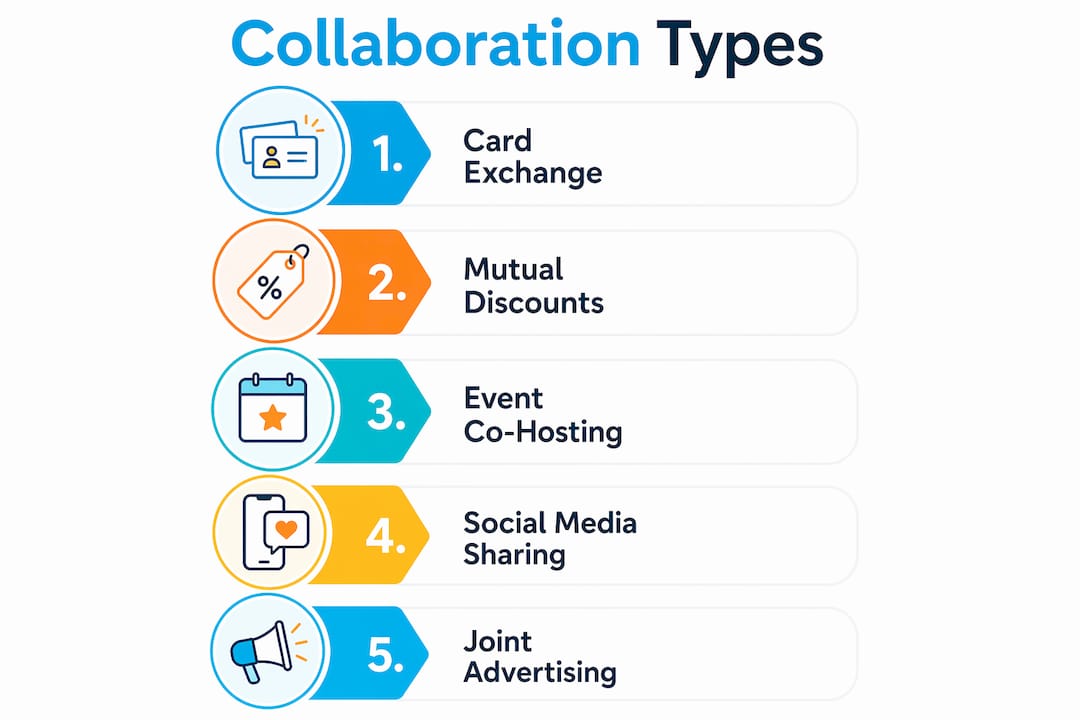
Not every collaboration requires a big budget or a formal contract. The spectrum runs from simple and free to structured and ongoing. Here is a breakdown of the four most common formats:
| Type | What it involves | Effort | Cost | Best for |
|---|---|---|---|---|
| Card exchange | Display each other’s business cards or flyers at the counter | Very low | Free | First-time partnerships |
| Mutual discounts | Offer a discount to each other’s customers with a code or card | Low | Minimal | Driving cross-visits |
| Joint events or pop-ups | Co-host a tasting, class, or seasonal event | Medium | Shared | Audience building |
| Referral partnership | Formal ongoing program with tracking and regular check-ins | High | Low to medium | Long-term growth |
Starting with simple cross-promotions like card exchanges is the recommended entry point before scaling to more complex formats. Gradually building the relationship reduces friction and creates the mutual trust needed for bigger commitments later.
Here is what each format looks like in a real restaurant context:
- Card exchange: Your brunch spot leaves cards for a nearby yoga studio. The studio leaves cards for you. Zero cost, zero risk, and customers who just finished a workout are already thinking about food.
- Mutual discounts: A local wine shop offers 10% off to customers who show a receipt from your restaurant. You offer a free dessert to customers who show a receipt from the wine shop. Both businesses incentivize a second visit.
- Joint events: Partner with a local florist for a Valentine’s Day dinner where guests get a complimentary floral arrangement. You split the promotion costs and both businesses reach new audiences.
- Referral partnership: A nearby boutique hotel formally recommends your restaurant to every guest at check-in. You track redemptions with a unique discount code and meet monthly to review results.
Borrowed trust is what makes these formats work. When a trusted local business recommends you, their customers arrive already warm. That is worth more than any paid ad targeting a cold audience.
How to maintain and measure partnerships over time
A partnership that starts strong can fall apart fast without structure. The two biggest killers are unnamed imbalance (one side getting more than the other) and vague expectations. Both are preventable.
Here are the practices that keep partnerships healthy and productive:
- Write it down. Written agreements clarifying contributions and expectations prevent confusion. Specify who creates the promotional content, who hosts the event, and who tracks the results. A simple one-page document is enough.
- Schedule quarterly check-ins. Monthly is even better for active partnerships. Review two buckets: business results (redemptions, new customers, revenue) and district impact (community visibility, social reach, event attendance).
- Track redemptions physically. Physical card exchanges yield better measurement than vague verbal agreements. Ask customers to bring in the partner’s card to redeem an offer. Count the cards. That is your data.
- Show public gratitude. Tag your partners in social posts. Mention them in your email newsletter. Public recognition costs nothing and strengthens the relationship.
- Adjust before you quit. If one partner is consistently sending more customers than the other, rebalance the offer before the frustration becomes a conversation you dread having.
Pro Tip: Create a simple one-page scorecard for each partnership. List the offer, the tracking method (card, code, or mention), and the monthly redemption count. Review it at every check-in. A scorecard turns a vague “is this working?” conversation into a productive strategy session.
For deeper guidance on tracking marketing results across all your campaigns, including partner-driven ones, Ionhospitality has a dedicated resource that walks you through the metrics that matter most.
How local partnerships fit into your broader community marketing strategy
A single partnership is a tactic. A network of partnerships is a strategy. The difference is the community flywheel.
The community flywheel framework operates in three stages: invite, participate, and amplify. You invite your community into an experience (a joint event, a seasonal pop-up, a neighborhood initiative). They participate and create memories tied to your brand. Then you amplify their stories through social media, email, and word of mouth. Each cycle builds on the last.
“Creating recurring community engagement rhythms, rather than one-off promotions, is the key to sustaining long-term local marketing success.” — HeyOrca, Community Flywheel Guide
This is where joint marketing campaigns shift from a nice-to-have to a growth engine. A restaurant that co-hosts a monthly wine pairing dinner with a local wine shop, sponsors a neighborhood 5K with a nearby gym, and runs a weekly “locals only” discount with a boutique hotel is not running three separate promotions. It is running one community flywheel that keeps spinning.
The most successful local partnerships are earned through public alignment and genuine community connections before formal deals are made. That means showing up at your partners’ events, tagging them organically, and building a reputation as a business that genuinely supports its neighbors. When the formal partnership comes, it feels natural to everyone, including the customers you are trying to reach.
Recurring collaborations also protect you from the volatility of algorithm changes and paid ad costs. A customer who discovers you through a trusted local partner is more likely to return, refer friends, and become a regular. That is the long-term payoff of community marketing strategies done right.
Key takeaways
Local partnership marketing works because it converts a neighbor’s trust into your foot traffic, at near-zero cost, when built on shared audiences and clear accountability.
| Point | Details |
|---|---|
| Start with simple formats | Card exchanges and mutual discounts are the lowest-friction entry points for new partnerships. |
| Qualify partners carefully | Choose businesses with active marketing channels and a customer base that overlaps with yours without competing. |
| Write down expectations | A one-page agreement covering contributions and tracking prevents unnamed imbalance and partnership failure. |
| Measure with physical tracking | Count redeemed cards or unique codes at every check-in to keep both sides accountable. |
| Build a community flywheel | Recurring collaborations compound over time and outperform one-off promotions for long-term growth. |
Why most restaurant partnerships fail before they start
I have seen restaurant owners approach local partnerships the same way they approach a Yelp ad. They want fast results, a clear ROI in 30 days, and minimal effort on their end. That mindset kills partnerships before they have a chance to work.
The restaurants I have watched build genuinely strong local networks all share one habit: they showed up for their partners before they asked for anything. They attended the gym’s grand opening. They posted about the wine shop’s new release. They sent customers to the florist without expecting a referral in return. By the time they proposed a formal collaboration, the answer was almost always yes. The relationship was already there.
The other mistake I see constantly is chasing the flashiest partner instead of the most aligned one. A restaurant owner gets excited about partnering with a high-profile local influencer or a trendy new concept, but the audiences do not actually overlap. The campaign runs, it looks great on Instagram, and then nothing changes at the door. Meanwhile, the yoga studio two blocks away with 800 loyal members and a weekly email newsletter is sitting there untapped.
Start small. Pick one partner. Run one offer for 60 days. Measure it honestly. Then decide if you want to expand. The restaurants that build the strongest community presence do it one genuine relationship at a time, not with a big launch announcement.
— Doug
Ready to turn your local partnerships into a full marketing engine?
Local partnerships are one piece of a bigger picture. The restaurants that see the most consistent growth combine community collaborations with a social media presence that keeps customers engaged between visits.
At Ionhospitality, we help restaurant owners build the kind of social media engagement that turns a first-time visitor into a regular and a regular into a vocal advocate. Our clients see up to 31% more bookings from social media alone. We handle the content, the strategy, and the execution. You focus on the food and the experience. If you want to see how a coordinated approach to restaurant brand awareness and local partnerships can work together for your specific location, book a discovery call with our team today.
FAQ
What is local partnership marketing for restaurants?
Local partnership marketing is a strategy where a restaurant collaborates with nearby non-competing businesses to share customers, co-promote offers, and build community presence. Common formats include card exchanges, mutual discounts, joint events, and formal referral programs.
How do I find the right local business partners?
Use the identify, qualify, propose, test, review framework. Look for businesses whose customers overlap with yours, confirm they have at least one active marketing channel like email or social media, and start with a low-stakes proposal like a card exchange before committing to anything larger.
How do I measure whether a local partnership is working?
Track physical redemptions using business cards, unique discount codes, or a simple tally at the register. Hold quarterly check-ins with your partner to review business results (new customers, redemptions) and community impact (social reach, event attendance).
What is the most common reason local partnerships fail?
Unnamed imbalance is the top cause of failure. One partner sends significantly more customers than the other, and without a written agreement or regular check-ins, the frustration builds until the partnership quietly dissolves. A one-page contribution agreement and monthly tracking prevent this.
How does local partnership marketing connect to social media?
Every joint event, mutual discount, and cross-promotion creates content. Tag your partners, share customer photos from collaborative events, and amplify each other’s posts. This turns a single partnership into ongoing social media fuel that keeps your restaurant visible between visits.

Add a Comment