

TL;DR:
- Social proof influences restaurant choices by reducing customer uncertainty through reviews and testimonials. Displaying targeted, recent reviews near decision points boosts conversions and revenue, while responding to reviews consistently enhances trust and local SEO. Owning and systematizing social proof on your website significantly separates successful restaurants from those that stagnate.
Social proof is defined as the actual or perceived evidence of other customers’ positive experiences that convinces potential diners to choose your restaurant over every other option on the block. It shows up as Google reviews, Yelp ratings, Instagram tags, and testimonials on your website. And it directly controls whether a stranger books a table or keeps scrolling. Understanding why restaurants need social proof is not a marketing theory exercise. It is the difference between a packed dining room and empty seats on a Friday night.
Why social proof drives restaurant customer decisions
Every potential guest goes through a moment of uncertainty before committing to a reservation or an online order. Social proof reduces that anxiety by signaling a safe choice based on what others have already done. That psychological shortcut is powerful, and it fires at specific moments in the customer journey.

The most critical moments are right before a guest takes action: clicking “Reserve a Table,” completing an online order, or submitting a private dining inquiry. Placing reviews and testimonials near those conversion points is not decoration. One case study found that reviews near a payment CTA increased monthly revenue by roughly A$6,145. That is what happens when you put the right evidence in front of a hesitant buyer at exactly the right second.
The context of the decision matters too. A couple choosing a date-night spot responds to reviews about ambiance and service. A corporate event planner researching private dining needs testimonials about event execution, capacity, and catering quality. Decision-relevant reviews address specific customer concerns rather than offering generic praise. “Great food!” does not close a $4,000 private event booking. “They handled our 60-person corporate dinner flawlessly and the catering team was on time” does.
Here is where most restaurants leave money on the table:
- ✅ Near reservation buttons: Short, specific reviews about the dining experience
- ✅ On catering and private events pages: Testimonials from past event hosts with names and photos
- ✅ On online ordering pages: Reviews mentioning delivery speed, portion size, or packaging quality
- ✅ On your homepage: Star ratings and review counts that establish instant credibility
Pro Tip: Include the reviewer’s first name and a real photo next to every testimonial you display. Authenticated customer reviews with real names and photos add significantly more trust than anonymous quotes.
What the data says about social proof and restaurant revenue
The numbers behind social proof are not soft marketing metrics. They are revenue figures.
A one-star Yelp rating increase correlates to a 5 to 9% revenue increase for independent restaurants in competitive markets, according to Harvard Business School research by Michael Luca. For a restaurant doing $1 million annually, that is up to $90,000 in additional revenue from a single star. That is not a rounding error. That is a full-time employee’s salary.
Review volume is just as important as star rating. Restaurants need 120 to 300 Google reviews to compete effectively in their local category, compared to the average local business’s 39 reviews. If your nearest competitor has 250 reviews and you have 40, Google’s local algorithm and every potential guest sees them as the safer, more established choice. Volume signals trust at scale.
Responding to reviews also moves the needle. Responding to 100% of reviews increases conversion rates by 16.4%. That number reflects both improved search ranking engagement and the direct impact on guests who read your responses before deciding. A thoughtful reply to a negative review tells every future reader that you care and that you fix problems. That is a competitive advantage most restaurants ignore.
| Social proof factor | Revenue or trust impact |
|---|---|
| One-star Yelp rating increase | 5–9% revenue increase (Harvard Business School) |
| Responding to 100% of reviews | 16.4% conversion rate increase |
| Reviews near a payment CTA | ~A$6,145/month revenue increase (case study) |
| Review volume benchmark | 120–300 Google reviews to compete locally |
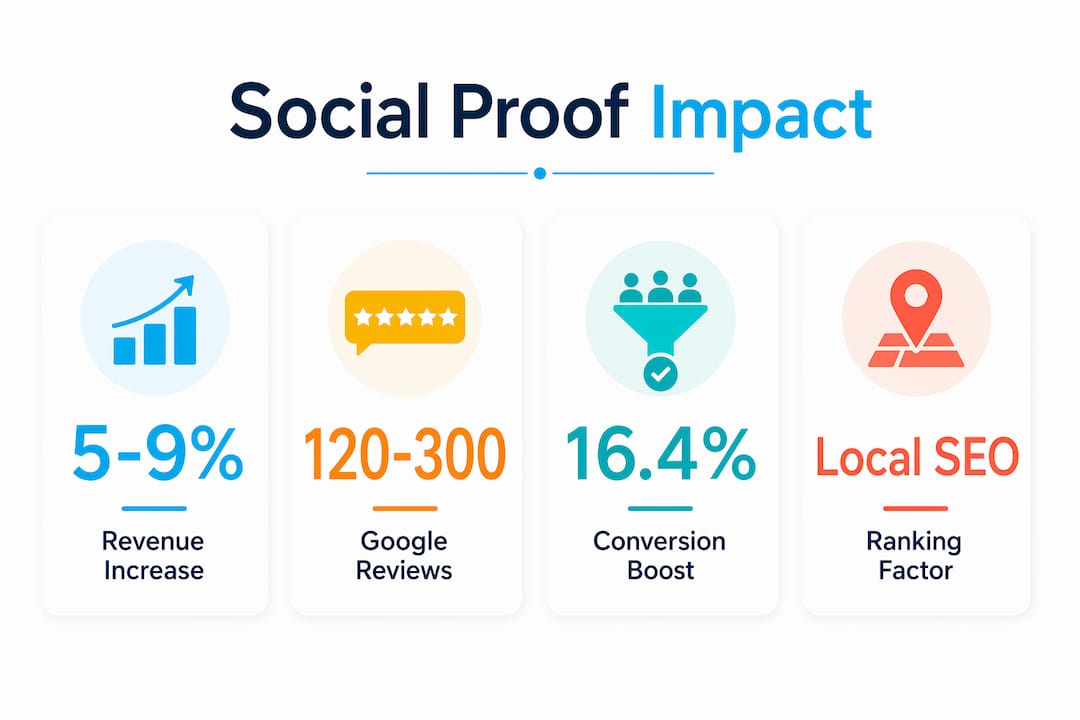
Social proof also feeds your local SEO. Google’s local pack rankings factor in review quantity, recency, and response rate. More reviews with consistent responses means better visibility in “best restaurants near me” searches. Your digital reputation is not separate from your marketing strategy. It is the foundation of it.
What types of social proof actually work for restaurants
Not all social proof is equal, and using the wrong type in the wrong context can actually hurt you.
User-generated reviews work best for consumer hospitality decisions, outperforming expert endorsements and certification badges in most restaurant contexts. A Michelin star matters for fine dining positioning. But for the average independent restaurant, 200 genuine Google reviews from real customers carry more persuasive weight than any award badge. The reason is reference-group closeness. Guests trust people who seem like them more than they trust critics or institutions.
Here is a practical breakdown of social proof types and where they perform best:
| Social proof type | Best use case | Watch out for |
|---|---|---|
| Google and Yelp star ratings | Homepage, Google Business Profile | Stale reviews lower perceived recency |
| Customer testimonials with photos | Private events and catering pages | Generic quotes reduce impact |
| User-generated social media content | Instagram, website gallery | Low-quality images hurt brand perception |
| Follower counts and live activity | Social media profiles | Only effective when counts are substantial |
| Expert endorsements or awards | Fine dining, press pages | Less persuasive for casual dining decisions |
Recency matters enormously. Recent, specific, and location-relevant reviews reduce customer uncertainty far more than older or vague ones. A review from three years ago about your old menu does not help a guest deciding tonight. Prioritize collecting fresh reviews consistently, not just during a one-time push.
One pitfall to avoid: the boomerang effect. Mismatched social proof can backfire. If you display a review praising your happy hour specials on a page targeting high-end private event clients, you signal the wrong positioning. Match the proof to the decision your guest is actually making.
How to collect, display, and own your social proof
Most restaurants make one critical mistake: they rely entirely on Yelp and Google to hold their social proof, then send potential guests to those third-party platforms to read it. That is handing your conversion funnel to someone else. Over 80% of restaurants fail to display third-party reviews on their own websites near decision points like reservations or orders. That is a massive missed opportunity.
Here is how to fix it:
-
Pull your best reviews onto your own website. Embed Google reviews or copy testimonials directly onto your reservation page, catering page, and homepage. Do not make guests leave your site to find out you are great.
-
Ask for specific reviews, not just stars. Train your front-of-house staff to ask guests to mention one specific thing they loved. “Could you mention the pasta in your review?” produces a useful, specific testimonial. A generic five-star rating with no text is worth far less.
-
Respond to every single review. Set a weekly calendar block to respond to all new reviews on Google, Yelp, and Facebook. Responses improve your ranking and show future guests you are engaged.
-
Use automation to stay current. Tools that send post-visit review request emails or SMS messages keep your review volume growing without manual effort. Consistency beats intensity every time.
-
Add social media counters and live activity signals. Large follower counts and visible real-time activity increase perceived credibility and urgency. If your Instagram has 8,000 followers, show that number on your website. It works.
-
Feature user-generated content in your gallery. Repost guest photos from Instagram and TikTok with permission. Real guest content is more persuasive than professional food photography because it signals authentic experiences.
Pro Tip: Build your restaurant’s online presence so that social proof appears at every stage of the guest journey, from the first Google search to the final booking confirmation page.
Key takeaways
Social proof is the single most underleveraged revenue driver in restaurant marketing, and owning it on your own website is what separates restaurants that grow from those that stagnate.
| Point | Details |
|---|---|
| Place proof at decision points | Reviews near reservation and ordering CTAs directly increase conversions and revenue. |
| Volume and recency both matter | Aim for 120 to 300 Google reviews and keep them current to compete locally. |
| Own your social proof | Display reviews on your own site instead of sending guests to third-party platforms. |
| Match proof to the decision | Use event testimonials for private dining pages and dining reviews for reservation pages. |
| Respond to every review | A 100% response rate increases conversion rates by 16.4% and improves search rankings. |
The uncomfortable truth about how restaurants handle reviews
I have worked with enough restaurant owners to know the pattern. You get a wave of great reviews after opening, you check them for a few months, and then life gets busy. The reviews slow down, the responses stop, and suddenly your Google profile looks like a ghost town compared to the new place that opened six blocks away.
Here is what I have learned: reviews are not a reputation marker. They are active sales tools. Every review on your reservation page is doing the same job your best server does when they describe the specials. It is reducing uncertainty and building desire. When you stop treating reviews as passive feedback and start treating them as conversion assets, everything changes.
The other mistake I see constantly is the over-reliance on Yelp and Google to do all the work. Those platforms are great for discovery. But once a guest lands on your website, you need to close them there. If your website has no reviews, no testimonials, and no social signals, you are asking people to trust a stranger. Nobody does that with a $200 dinner reservation.
The restaurants that win at social proof are not the ones with the most reviews. They are the ones who display the right reviews in the right places, respond consistently, and keep the content fresh. That is a system, not a one-time project. Build the system and it runs for you.
— Doug
How Ionhospitality helps you turn social proof into bookings
At Ionhospitality, we specialize in restaurant marketing that puts social proof to work where it counts most. We help you build a presence that converts browsers into guests and inquiries into booked private events, all without commissions eating into your revenue. From social media advertising that amplifies your best guest content to website development that places reviews right where guests make decisions, we handle the full picture. If you are ready to stop leaving bookings on the table, book a discovery call and let’s build your social proof engine together.
FAQ
Why do restaurants need social proof more than other businesses?
Dining is a high-uncertainty purchase. Guests cannot sample your food before committing, so they rely on other people’s experiences to reduce risk. Restaurants with strong social proof on Google, Yelp, and their own websites convert more browsers into paying guests.
How many Google reviews does a restaurant need to be competitive?
Restaurants typically need 120 to 300 Google reviews to compete effectively in their local category. The average local business has only 39 reviews, so reaching that benchmark puts you well ahead of most competitors.
Does responding to reviews actually help a restaurant’s business?
Yes. Responding to all reviews increases conversion rates by 16.4% and improves your local search ranking. It also signals to future guests that you are attentive and accountable, which builds trust before they ever walk through your door.
What is the best place to display reviews on a restaurant website?
The highest-impact placement is directly near your reservation button, online ordering page, and private events inquiry form. Reviews placed at these decision points reduce purchase anxiety and increase revenue by addressing hesitation right before a guest commits.
Can the wrong type of social proof hurt a restaurant?
Yes. Using mismatched social proof, such as casual dining reviews on a fine dining page, can create a boomerang effect that reduces trust. Match the type and tone of your testimonials to the specific decision your guest is making on each page.

Add a Comment