
TL;DR:
- Effective restaurant offers focus on targeted, data-driven promotions that increase check size and customer loyalty. Using bundles, spend thresholds, and precise timing while measuring results ensures profitability and prevents margin erosion. Segmenting guests and testing offers before scaling maximizes ROI and sustains long-term growth.
Crafting effective restaurant offers is the process of designing targeted, value-driven promotions that attract customers and drive profitable sales growth. Done right, a well-structured promotion increases your average check size, fills slow shifts, and turns first-time visitors into regulars. Done wrong, it quietly eats your margins. The difference comes down to three things: data, structure, and timing. This guide covers all three, with specific tools and frameworks U.S. restaurant operators can use right now.
How to craft restaurant offers that actually work
Before you write a single promotion, you need two things: the right data and the right channels. POS systems like Toast and Square are your starting point. They track visit frequency, average spend, popular menu items, and peak hours. That data tells you who to target, what to offer, and when to run it.
Your distribution channels matter just as much as the offer itself. Pre-launch goal clarity is what separates campaigns that move the needle from ones that just cost money. A goal like “boost Tuesday lunch sales by 15%” tells you exactly how to price the item and how long to run the promotion.
Here is what you need in place before launching any promotion:
- POS integration: Toast, Square, or similar systems to pull guest behavior data
- Email list: A direct channel you own, not rented from a third-party app
- Google Business Profile: Optimized and active for local search visibility
- Social media presence: Instagram and Facebook for organic and paid reach
- Website with online ordering: Direct order conversions outperform third-party platforms on margin
| Channel | Best Use | Cost Level |
|---|---|---|
| Loyalty offers, birthday deals | Low | |
| Google Business Profile | Local discovery, event promos | Free |
| Instagram/Facebook | Visual offers, limited-time deals | Low to medium |
| In-store signage | Upsell bundles, daily specials | Very low |
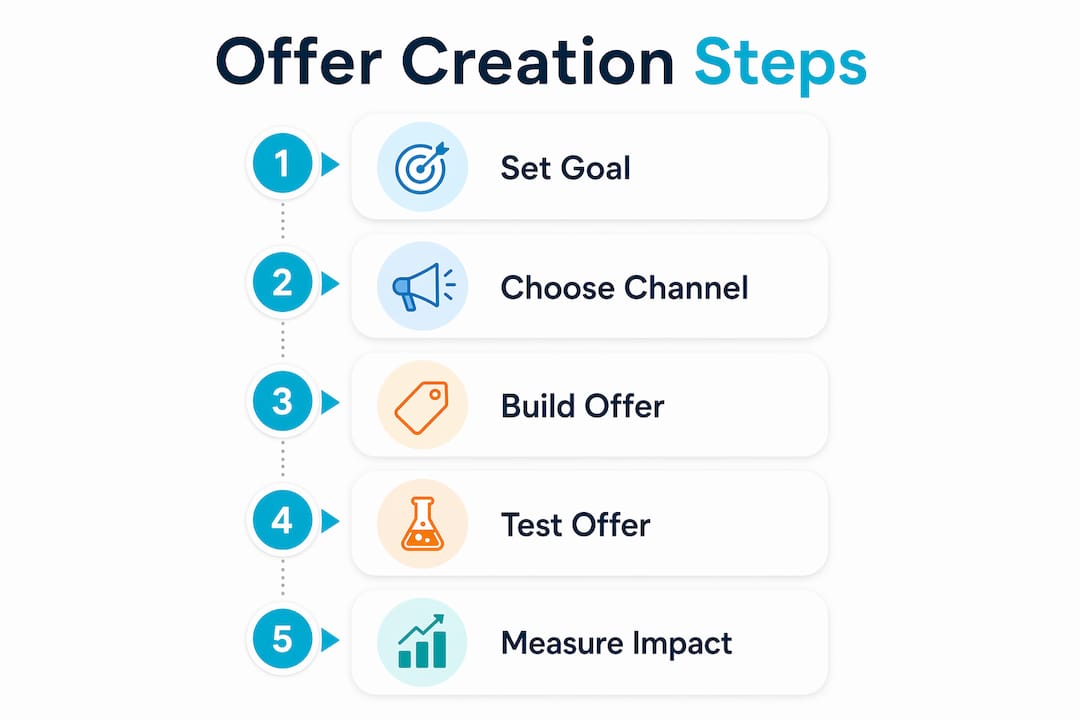
Set your goal first. Then pick your channel. Then build the offer around both.
How do you structure offers without killing your margins?
Most restaurant owners default to percentage discounts. That is the most dangerous move you can make. A 20% discount requires roughly 40% more gross profit volume just to break even. That math works against you almost every time.
The smarter play is bundle deals and spend thresholds. A “Dinner for Two” bundle at $45 that pairs an entree with a high-margin appetizer and a cocktail gives the guest perceived value while protecting your check average. You are not discounting. You are packaging.
Spend thresholds work the same way. “Spend $50, get a free dessert” pushes the average check up before the reward kicks in. The dessert costs you $2 in food cost. The guest spends $10 more than they planned. That is a net win.
Pro Tip: Always factor in labor and rent, not just food cost, when pricing any offer. Small pricing errors on offers scaled across hundreds of transactions can quietly destroy your monthly P&L.
| Offer Type | Margin Risk | Best For |
|---|---|---|
| Blanket % discount | High | Avoid unless clearing inventory |
| Bundle deal | Low | Increasing check size |
| Spend threshold | Low | Slow periods, new guests |
| Free item with purchase | Medium | Loyalty, repeat visits |
| BOGO (buy one, get one) | High | Use sparingly, high-margin items only |
Target your promotions at slow periods and new customers first. Running a deal on your busiest Saturday night does not grow revenue. It just discounts revenue you already had.
What are the best practices for urgency and timing? ⏰
Urgency is what turns a passive browser into a paying guest. Limited-time offers with clear start and end dates create that pressure. A 3-day offer generates rush traffic from your most engaged customers. A 2-week special pulls in more casual diners who need a longer window to act. Both work. You just need to match the duration to your goal.
Here is a proven sequence for launching a timed offer:
- Set exact dates. “Available March 3–March 10 only” beats “for a limited time” every single time.
- Write simple copy. Use language like “Limited Time! Only $12.99” with no fine print clutter.
- Sync across channels. Post on Instagram, send an email, and update your Google Business Profile on the same day.
- Brief your staff. Staff who know the offer details upsell add-ons and answer guest questions confidently, which lifts the average ticket.
- End it on time. Extending deals trains customers to wait for the next one.
Pro Tip: Limit promotions to 2–3 times per month maximum. Running deals too frequently teaches your guests to expect discounts, which erodes your full-price revenue over time.
Avoid stacking promotions. If you run a happy hour, a weekend special, and a loyalty reward simultaneously, guests get confused and your team gets overwhelmed. One clear offer at a time, with a defined window, performs better than three overlapping deals.
How to personalize restaurant offers for higher ROI
Generic offers attract generic customers. The guest who redeems a mass-discount coupon once and never returns is not your customer. They are a deal-seeker. Data-driven personalization connected to your POS is what turns promotions into loyalty drivers.
Here is how to segment your guest list for smarter targeting:
- Frequent visitors (4+ visits per month): Reward with exclusive access offers, not discounts. Think “first look at our new menu” or a complimentary upgrade.
- Lapsed guests (no visit in 60+ days): Send a win-back offer sized at 10–20% of their typical check. This keeps your cost-per-redemption in line with revenue potential.
- Birthday and anniversary guests: Send the offer 7–10 days before the occasion with a 7–14 day expiration window. Personalized birthday offers achieve roughly 47% redemption rates and lift overall redemptions 25–40%. That is not a small number.
- First-time visitors: Follow up within 72 hours with a “come back” offer tied to a specific item they ordered.
The personalized marketing approach that grows restaurant sales fast is built on this exact segmentation logic. You are not guessing what guests want. You are using what they already told you through their behavior.
Sizing matters too. An offer sized to 10–20% of a guest’s typical check keeps the economics balanced. Offering a $30 credit to a guest who spends $35 per visit is a losing trade. Offering a $7 dessert to a guest who spends $60 is a smart one.
How do you measure and scale restaurant offers?
Running a promotion without measuring it is the same as spending money with your eyes closed. The right method is a test-vs-control pilot. Run your offer at two or three locations while keeping one location at normal pricing. Compare visits, sales lift, and reorder rates across both groups.
This approach works. One casual dining franchisee used controlled pilot testing to validate incremental revenue before scaling. The result: 74% ROI, $3 million in incremental sales, and 2x visit frequency from existing guests. That is what proof-before-scale looks like.
Track these three KPIs for every offer you run:
| KPI | What It Measures | Target Benchmark |
|---|---|---|
| Redemption rate | Offer uptake vs. distribution | 15–30% for targeted offers |
| Sales lift | Revenue increase vs. baseline | Positive vs. control group |
| Reorder rate | Return visits within 30 days | 20%+ for loyalty offers |
If an offer does not show positive sales lift against your control group, do not scale it. Adjust the structure, the timing, or the target segment, then test again. Offers sized to guest behavior consistently deliver 3–5x ROI when the data is used correctly.
For a deeper look at how paid advertising amplifies your tested offers, the restaurant digital ads workflow at Ionhospitality breaks down the full scaling process.
Key takeaways
The most profitable restaurant offers are built on clear goals, guest data, and controlled testing, not blanket discounts.
| Point | Details |
|---|---|
| Set goals before building offers | Define a specific outcome like “fill Tuesday lunch” before choosing offer type or duration. |
| Protect margins with bundles | Use bundle deals and spend thresholds instead of percentage discounts to preserve profitability. |
| Time offers with precision | Set exact start and end dates; limit promotions to 2–3 times monthly to prevent deal fatigue. |
| Personalize by guest segment | Send birthday offers 7–10 days early and size win-back deals to 10–20% of typical guest spend. |
| Pilot before you scale | Run test-vs-control pilots to confirm real sales lift before rolling an offer out broadly. |
The uncomfortable truth about restaurant promotions
I have worked with enough restaurant owners to know the pattern. You run a slow Tuesday, panic, and throw a 20% off deal on Instagram. It gets some traction. You do it again the next week. Then every week. Six months later, your Tuesday guests expect a discount and your full-price revenue has quietly collapsed.
The restaurants that win with promotions treat every offer like an experiment with a hypothesis. “If I send a personalized win-back offer to guests who haven’t visited in 60 days, I expect a 20% redemption rate and a positive sales lift.” Then they measure it. Then they adjust.
The creativity part is fun. The measurement part is where most operators check out. That is exactly where the money is. I have seen operators double their return on promotional spend simply by shifting from mass discounts to segmented, timed offers built on POS data. The offer itself was not dramatically different. The targeting was.
One more thing: do not ignore your overhead when pricing offers. Food cost is only part of the equation. Labor, rent, and utilities are all in the room when a guest sits down. Promotions become profitable when they are thoughtfully targeted, sized, and timed. That sentence should be on the wall of every restaurant office in America.
— Doug
Ready to turn your offers into a real growth engine?
Creating great promotions is one piece of the puzzle. Getting them in front of the right people at the right time is where most restaurants leave money on the table.
Ionhospitality specializes in social media advertising for restaurants, running targeted campaigns that put your best offers directly in front of hungry local guests, with zero commissions. We handle the creative, the targeting, and the optimization so you can focus on running your kitchen. If you want more covers, more online orders, and more private event bookings, we can build the system that makes it happen.
Build your online presence to make sure every offer you run converts at the highest possible rate.
FAQ
What is the best type of offer for a restaurant?
Bundle deals and spend thresholds outperform blanket percentage discounts because they protect margins while increasing the average check size. A 20% discount requires roughly 40% more gross profit volume just to break even.
How often should restaurants run promotions?
Limit promotions to 2–3 times per month. Running deals more frequently trains customers to expect discounts and erodes your full-price revenue over time.
How do personalized restaurant offers work?
Personalized offers use POS data to segment guests by visit frequency, spend, and behavior. Birthday offers sent 7–10 days before the occasion with a 7–14 day expiration window achieve roughly 47% redemption rates.
How do you measure whether a restaurant offer is working?
Run a test-vs-control pilot across locations and track three KPIs: redemption rate, sales lift versus baseline, and reorder rate within 30 days. Only scale offers that show positive incremental results.
What should you avoid when creating restaurant promotions?
Avoid blanket percentage discounts, stacking multiple simultaneous deals, and pricing offers without factoring in labor and rent costs. Small pricing errors scaled across hundreds of transactions can cause significant profit loss.

Add a Comment