
TL;DR:
- Short vertical videos generate 300% more engagement than static photos for restaurants.
- Building a consistent online presence with video, customer content, and local ads drives lasting growth.
- Focusing on community and steady engagement offers more reliable long-term success than chasing viral fame.
Short vertical videos generate 300% more engagement than static food photos on social media. Yet most restaurant owners are still posting the same flat menu shots and expecting results. If your tables aren’t filling up the way you want, your online presence might be the problem. The good news? You don’t need a film crew or a massive budget to fix it. You need a smarter strategy. This guide breaks down exactly how to build a restaurant online presence that drives real foot traffic, more online orders, and packed private events.
Table of Contents
- Why your restaurant needs a strong online presence
- Content strategies that boost restaurant engagement
- Leveraging social ads and local targeting for maximum reach
- Building influence and sustainable community
- The real key to lasting restaurant online presence
- Scale your restaurant online presence with expert support
- Frequently asked questions
Key Takeaways
| Point | Details |
|---|---|
| Video drives engagement | Short videos outperform photos by a large margin and should be your primary content format. |
| Local targeting boosts ROI | Ads focused on nearby customers deliver high returns for restaurant marketing. |
| User content builds trust | Reposting customer photos increases authenticity and encourages social sharing. |
| Micro-influencers win | Smaller influencers provide more genuine reach than chasing viral celebrities. |
| Community over virality | Long-term customer relationships matter more than quick spikes in attention. |
Why your restaurant needs a strong online presence
Your online presence is the first impression most new customers get of your restaurant. Before they ever taste your food, they’ve already scrolled your Instagram, read your Google reviews, and checked your website. That first digital impression either earns their visit or sends them to your competitor down the street.
But here’s what a lot of owners get wrong: online presence isn’t just about posting your menu or sharing a photo of tonight’s special. It’s the full picture. It includes your review responses, your engagement with comments, your stories, your reels, and how consistently you show up across platforms. Think of it as your brand awareness guide in action, every single day.
When you build a real online presence, you get:
- ✅ More customer discovery via search and social feeds
- ✅ Higher trust from new guests who see an active, engaged profile
- ✅ More bookings for private events and catering
- ✅ Repeat visits driven by community and loyalty
- ✅ Word-of-mouth amplification that works while you sleep
Here’s a quick look at how different content types stack up in terms of engagement:
| Content type | Average engagement rate | Reach potential |
|---|---|---|
| Short vertical video (Reels/TikTok) | 4.5% | Very high |
| Stories (polls, Q&A) | 2.8% | Medium-high |
| Carousel posts | 2.1% | Medium |
| Static photos | 1.2% | Low-medium |
| Text-only posts | 0.5% | Low |
The numbers don’t lie. Video wins. Every time.
One of the fastest ways to build trust without extra content creation? Repost what your customers are already sharing. UGC reposts boost trust by 92%, which means your guests’ phone videos of your dishes are more persuasive than anything your marketing team produces.
“Your guests are already your best marketers. Give them a reason to post, then amplify what they create.”
Pro Tip: Set up a branded hashtag for your restaurant and ask your team to remind guests to use it. Then repost the best content weekly. It’s free, authentic, and wildly effective.
Content strategies that boost restaurant engagement
Now that you know why online presence matters, let’s dig into proven content tactics that drive real engagement.
Consistency is the engine. You can’t post once a week and expect momentum. Post 3 to 5 times per week and lean heavily on short vertical videos. That format alone outperforms photos by 300%. Aim for an engagement rate of at least 2 to 3% across your posts. If you’re below that, your content strategy needs a reset.
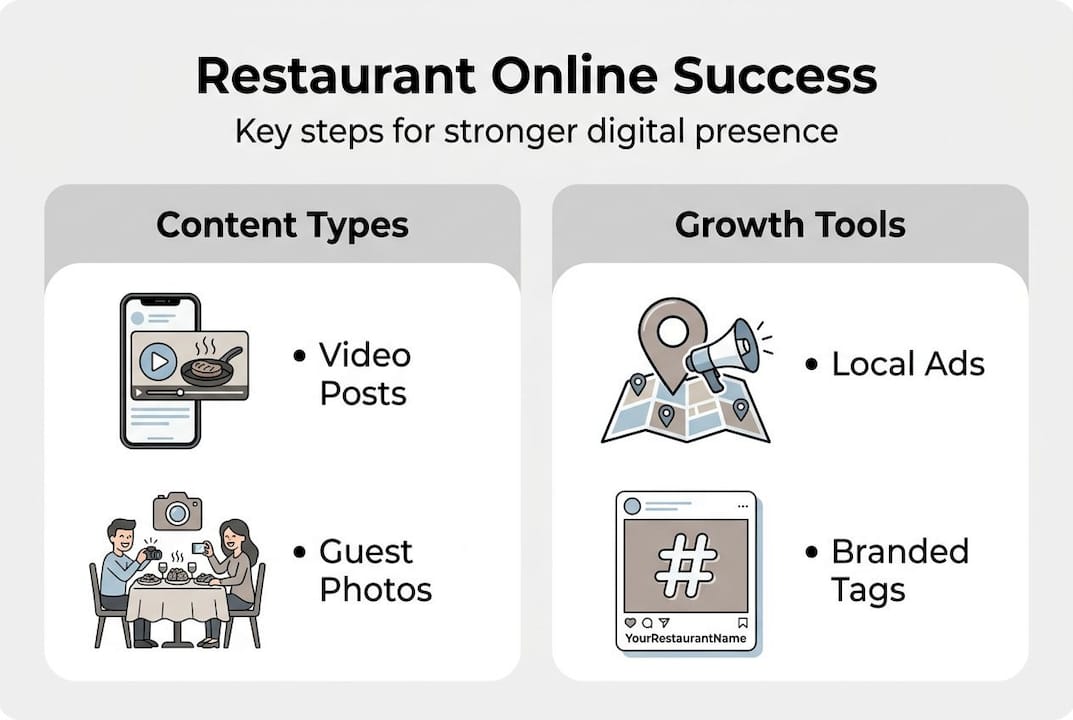
Here’s a comparison of content formats to help you prioritize:
| Format | Best use case | Engagement boost |
|---|---|---|
| Short Reels (15-30 sec) | Behind-the-scenes, food prep | Very high |
| Stories with polls | Daily specials, feedback | High |
| Carousel posts | Menu spotlights, event recaps | Medium |
| Static photos | Ambiance, team highlights | Low-medium |
Need social campaign ideas that actually convert? Start with these steps:
- Identify your scroll-stopping moment. What’s visually dramatic about your restaurant? A cheese pull, a sizzling platter, a bartender flipping a cocktail shaker. That’s your hook.
- Film vertically, always. Shoot in 9:16 format for Reels and TikTok. Horizontal video gets skipped.
- Add captions. Most people watch with sound off. Text overlays keep them watching.
- Post at peak times. Tuesday through Thursday between 11am and 1pm, and again from 6pm to 8pm, tends to perform well for restaurants.
- Engage within the first 30 minutes. Reply to every comment right after posting. This signals to the algorithm that your post is worth pushing.
- Repurpose across platforms. One Reel can become an Instagram Story, a TikTok, and a Facebook post. Work smarter.
For deeper content creation tips, check out our full breakdown of what’s working right now. And if you want done-for-you production, our content creation guide walks through how we handle it for restaurants across the country.
Leveraging social ads and local targeting for maximum reach
Once you have compelling content, amplifying your reach via local ads is the next step.
Organic reach is great, but it has limits. Paid social ads let you get in front of people who’ve never heard of you but live two miles away and are actively looking for dinner options. Social ads ROI averages 4:1, and targeted local ads within a 5 to 10 mile radius consistently deliver strong returns for restaurants.
Here’s how to set up a local campaign that works:
- 📍 Choose your platform. Facebook and Instagram ads are the strongest for restaurants. Google Local ads work well for search intent.
- 🎯 Set your radius. Target a 5 to 10 mile radius around your location. Tighten it for urban areas.
- 👥 Define your audience. Use interest targeting (foodies, date nights, local events) plus lookalike audiences based on your existing customers.
- 🎥 Lead with video. Short clips of your food or atmosphere outperform static images in paid placements.
- 💰 Start small. A $10 to $20 per day budget is enough to test before scaling.
- 📊 Track everything. Use unique promo codes in each ad so you know exactly which campaign drove the reservation or order.
Pro Tip: Test carousel ads featuring 3 to 5 of your best dishes against a single video ad. Carousel formats often generate higher click rates because they invite curiosity and scrolling.
Once someone visits your site or engages with your ad, don’t let them go cold. Retargeting ad strategies allow you to follow up with warm audiences who already showed interest. These people convert at a much higher rate than cold traffic. Pair retargeting with monitoring online trends to stay ahead of what your local market is searching for. Our social ad services are built specifically for restaurants that want results without wasting budget on guesswork.
Building influence and sustainable community
Beyond advertising, lasting success means cultivating community relationships.
Viral moments are exciting. But they’re also unpredictable and short-lived. The restaurants that grow steadily year over year aren’t the ones that went viral once. They’re the ones that show up consistently, engage genuinely, and build real relationships with their local audience.
Micro-influencers, those with 5K to 50K followers, are one of the most underused tools in restaurant marketing. They have tight-knit, highly engaged audiences who trust their recommendations. A local food blogger with 12,000 followers will drive more actual reservations than a celebrity with a million followers who has no connection to your neighborhood.
Here’s how to build an influencer program that actually works:
- Search locally first. Use Instagram location tags and hashtags to find food creators already posting in your area.
- Reach out personally. A genuine DM beats a generic email every time. Mention a specific post of theirs you liked.
- Offer a real experience. Invite them for a complimentary tasting, not just a free appetizer. Make it memorable.
- Set clear expectations. Agree on deliverables upfront: one Reel, two Stories, a tagged post. Keep it simple.
- Track the results. Use a unique promo code or booking link for each influencer so you can measure actual impact.
- Build ongoing relationships. The best influencer partnerships aren’t one-time deals. Invite them back for seasonal events and new menu launches.
“Prioritize sustainable community over virality. The restaurants that last are the ones that earn loyalty, not just clicks.”
Research on internet restaurant lifecycles shows that restaurants riding viral waves often face serious instability once the buzz fades. Staffing surges, supply chain pressure, and inconsistent guest experiences can damage a brand that wasn’t built on a solid foundation. For proven crowd marketing tips and strategies to attract new restaurant customers consistently, focus on community first.
The real key to lasting restaurant online presence
Here’s the honest truth most marketing agencies won’t tell you: chasing viral content is the least reliable growth strategy for a restaurant.
We’ve worked on digital campaigns across dozens of restaurants, and the pattern is always the same. The owners who obsess over going viral get a spike, maybe a big weekend, and then a painful drop-off. The owners who focus on showing up consistently, replying to every comment, reposting customer content, and building a recognizable local identity? They compound. Month over month, their engagement grows, their community deepens, and their revenue stabilizes.
Think of community-driven content as the compound interest of marketing. It doesn’t feel dramatic at first. But six months in, you have a loyal audience that fills your tables on a Tuesday without a single paid ad.
Research confirms this. Internet-famous restaurants surge quickly but face lifecycle turmoil that can destabilize operations and damage long-term brand equity. The smarter play is always sustainable community.
Our restaurant marketing guide goes deeper on this. But the takeaway is simple: focus on conversations, not just impressions. Loyalty, not just likes.
Pro Tip: Spend 15 minutes every day engaging with your followers’ content. Comment, like, and respond. That small habit builds more goodwill than any boosted post.
Scale your restaurant online presence with expert support
You now have a clear roadmap: show up consistently, lead with video, run smart local ads, and build real community. But knowing the strategy and executing it are two very different things.
At ION Hospitality, we do all of this for you, with zero commissions. From running restaurant social media campaigns that drive real foot traffic to building your restaurant brand awareness month over month, we handle the content, the ads, and the strategy. Our social media ad services are built specifically for restaurants that want more customers, more event bookings, and more online orders without the guesswork. Let’s build something that lasts.
Frequently asked questions
How often should my restaurant post on social media?
Aim to post 3 to 5 times per week for best results, with a strong lean toward short vertical video over static photos.
What types of content work best for U.S. restaurant audiences?
Short vertical videos and authentic user-generated content consistently drive the highest engagement, with UGC boosting trust by 92% compared to brand-only posts.
How can I measure ROI for paid social ads?
Use unique promo codes tied to each campaign, track reservations and online orders, and target a minimum 4:1 return on your ad spend.
Is it better to pursue viral fame or build a steady online community?
Build the community. Internet-famous restaurants often surge fast but face serious instability, while consistent community building delivers reliable, long-term growth.
Recommended
- Boost Restaurant Brand Awareness: A Step-by-Step Guide
- Smart strategies to attract new restaurant customers in 2026
- Content Creation for Restaurants: Drive 40% More Bookings
- Unlock restaurant growth: why monitoring online trends matters
- What Makes a Restaurant Listing Stand Out in a Competitive Market | PepperLot Blog

Add a Comment