

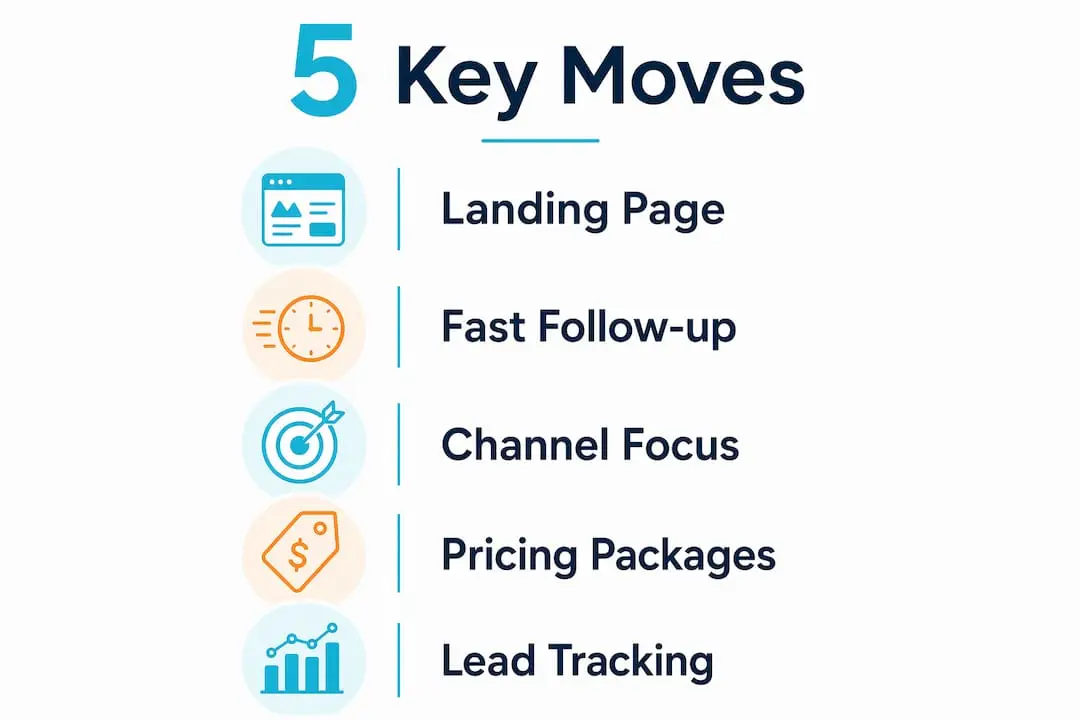
If you want to know how to generate catering leads starting this week, here are the five moves that actually work: (1) optimize your Google Business Profile and lock in consistent NAP across every directory; (2) publish a dedicated catering landing page with a lean, four-field inquiry form; (3) set up an instant-response playbook and reply to every inquiry inside the hour; (4) run your highest-ROI channels first — local SEO, targeted social ads, LinkedIn outreach to corporate buyers, and venue referral partnerships; (5) instrument a simple CRM to track lead source, quote time, and close rate.
Your 5-point checklist for this week:
- ✅ Claim and fully complete your Google Business Profile (photos, catering category, service area)
- ✅ Build or update a dedicated catering landing page with a four-field form
- ✅ Write and save two email reply templates + one phone script
- ✅ Identify five corporate prospects on LinkedIn and send personalized first-touch messages
- ✅ Set up a free CRM (HubSpot, Zoho, or similar) and log every inbound lead with its source
CUFinder confirms that the first caterer to reply with a clear menu and price frequently wins the booking. Speed and structure are your two biggest competitive advantages — and both cost almost nothing to fix.
Table of Contents
- How to generate catering leads with a high-converting landing page
- Speed wins: the follow-up playbook that closes more bookings
- Which channels reliably bring in catering leads?
- Pricing and packages that shorten the buyer’s decision
- The sales playbook: scripts, timelines, and outreach cadence
- How to track catering leads and measure what’s working
- Compliance and permitting for corporate and specialized catering events
- Key Takeaways
- The real talk on catering lead generation
- Ionhospitality fills your catering calendar with done-for-you marketing
- Sources and further reading
How to generate catering leads with a high-converting landing page
A dedicated catering landing page with a lean, four-field inquiry form is the single fastest conversion lift you can make. One page, one goal, one form. That’s it.
The page structure that works:
- Headline that matches search intent: “Corporate Catering in [City] — Request a Quote”
- Three package thumbnails (drop-off box lunch, plated corporate lunch, buffet/banquet) with per-person pricing visible
- Trust signals above the fold: client logos, event photos, a short testimonial
- A persistent CTA button that opens the form — visible without scrolling
The form itself should ask for exactly four things: headcount, event date, location, and contact email or phone. Excessive form fields drive abandonment — every extra question you add costs you a lead. Capture the minimum up front and qualify the rest on a sales call.
Pro Tip: Build separate page variants for corporate buyers and wedding clients. Corporate buyers scan for minimums, per-person price, and setup logistics. Wedding clients want photos, menu variety, and social proof. Same food, different pitch.
For restaurants that need a professionally built, high-converting page, Ionhospitality’s website development service handles the full build — landing page, booking flow, and SEO integration.
Speed wins: the follow-up playbook that closes more bookings
Reply inside the hour during business hours. That single habit separates the caterers who fill their calendar from the ones who wonder why leads go cold.
LeadsuiteNow documents that following a proposal with a phone call within 48 hours materially raises close rates compared to email-only sequences. Here’s the exact cadence to build:
- Inquiry received → automated email confirmation fires within 5 minutes (set this up in your CRM or form tool)
- Within 1 hour → personal reply email with a one-page menu snapshot and starting price
- Within 24 hours → proposal delivered with per-person pricing, minimums, and deposit terms
- Within 48 hours → phone call to walk through the proposal and answer questions
- Day 5 → value-add follow-up email (a seasonal menu update or a client testimonial)
- Day 10 → final check-in or polite breakup message
Sample initial reply (email):
Pro Tip: Assign one person to own catering inquiry response. When “everyone” is responsible, no one replies in time. One owner, one SLA, one accountability.
Corporate leads typically run a buying cycle of a few months. Wedding leads generally span a longer buying cycle. Speed at the first touch compresses both — it signals professionalism and keeps you top of mind before a competitor gets there.
Which channels reliably bring in catering leads?
Prioritize in this order: local visibility first, direct corporate outreach second, venue partnerships third, paid ads fourth.

| Channel | Cost Tier | Lead Quality | Best Use Case |
|---|---|---|---|
| Google Business Profile + local SEO | Low | High intent, transactional | “Catering near me” searches |
| LinkedIn outreach | Low | High value, corporate | HR, office managers, executive assistants |
| Venue/partner referrals | Low | High trust, warm | Wedding planners, event spaces |
| Email to past customers | Very low | Repeat, high retention | Reorder campaigns, seasonal pushes |
| Targeted social ads (Meta/Instagram) | Medium | Mid-funnel, brand awareness | Visual food content, event promos |
| Google Ads (search) | Medium–High | High intent | Event planners searching by service |
Cynthia Concierge recommends 100% accurate business information, real photos, and targeted service pages as the foundation for local search visibility. Fill every field in your Google Business Profile — service area, catering category, menu link, and fresh photos monthly.
For LinkedIn, LeadsuiteNow’s research shows that personalized messages targeting HR managers, office managers, and executive assistants by company detail achieve meaningful reply rates. Keep the first message short: lead with a specific detail about their company, not a pitch.
Referrals and direct outreach — including sample platters dropped at target offices — remain among the highest-quality, lowest-friction lead sources for repeat catering business, as well as fruitful vendor relationships emphasized in event bakery tips.
Pro Tip: Every marketplace order (ezCater, Grubhub catering) is an acquisition opportunity. Capture the buyer’s direct contact and move them to your owned email list. Marketplace dependency is expensive; your own list is free.
Pricing and packages that shorten the buyer’s decision
Simplified, tiered packages with clear per-person pricing flip the buyer’s question from “should I hire a caterer?” to “which package fits my event?” That shift alone shortens your sales cycle.
Three package templates to start with:
- Drop-Off Box Lunch — from $18/person, 10-person minimum, includes sandwich, side, cookie, and drink
- ️ Plated Corporate Lunch — from $32/person, 20-person minimum, includes two entrée choices, salad, dessert, and setup
- Buffet/Banquet — from $48/person, 30-person minimum, full spread with staffed service, setup, and breakdown
Clear per-person pricing and minimums lead to faster decisions and fewer back-and-forth quote revisions. Publish the starting price publicly — hiding it adds friction and loses you leads before they even inquire.
Proposal checklist every quote should include:
- Per-person price and minimum headcount
- Taxes, service fees, and gratuity (stated separately)
- Setup and breakdown responsibilities
- Deposit amount and due date
- Cancellation and rescheduling terms
- Digital acceptance link (DocuSign, PandaDoc, or similar)
Pro Tip: For corporate accounts on a 2–6 month buying cycle, offer a one-off trial drop-off at a discounted rate with a reorder incentive attached. Getting the product in front of the decision-maker converts faster than any email sequence.
For more catering package ideas built specifically for restaurants, Ionhospitality has templates ready to adapt.
The sales playbook: scripts, timelines, and outreach cadence
Use a five-touch, multi-channel cadence for corporate prospects. Target the right roles: executive assistants, office managers, and HR coordinators control most corporate catering budgets.
5-touch cadence:
- Email (Day 1): Lead with value — a relevant menu or a seasonal offer tied to their industry
- LinkedIn (Day 3): Short, personalized connection message referencing their company
- Email (Day 7): Follow up with a case example or a client testimonial
- Phone (Day 10): Brief qualifying call — ask about their next scheduled team event
- Breakup email (Day 14): “I’ll stop reaching out, but we’re here when you’re ready”
Corporate account timeline (8–12 weeks to first recurring order):
- Weeks 1–2: First outreach, trial drop-off arranged
- Weeks 3–4: Trial delivery, feedback collected
- Weeks 5–6: Proposal for recurring program sent
- Weeks 7–8: Contract signed, deposit received
- Weeks 9–12: First recurring orders delivered, reorder incentive activated
Wedding leads run longer — expect a 6–18 month window from first inquiry to event date, with a tasting step at the midpoint. A sequenced, multi-touch cadence targeted to the right buyer roles consistently outperforms broad-reach marketing alone.
How to track catering leads and measure what’s working
Track five KPIs and nothing else to start. More metrics create noise; these five create decisions.
| KPI | Formula | Target |
|---|---|---|
| Lead-to-quote time | Time from inquiry to proposal sent | Under 24 hours |
| Quote-to-close rate | Closed bookings ÷ proposals sent | Aim to steadily improve over time |
| Average order value | Total catering revenue ÷ bookings | Track monthly trend |
| Lead source ROI | Revenue per channel ÷ cost per channel | Positive for each active channel |
| Response SLA compliance | % of inquiries replied to within 1 hour | Strive for high compliance |
Set up your CRM with four fields on every lead record: source, inquiry date, proposal date, and outcome. HubSpot’s free tier handles this for most small catering teams. Weekly, review inbound volume and SLA compliance. Monthly, compare channel ROI. Quarterly, segment your closed bookings to identify your highest-value customer profiles — then build your next outreach list from that profile.
Pro Tip: Shortening lead-to-quote time is the cheapest lever you have. Cut it from 48 hours to under 24 and your close rate will climb without spending a dollar more on ads. Ionhospitality’s guide on increasing catering sales walks through template-driven approaches that reduce quote turnaround time significantly.
Compliance and permitting for corporate and specialized catering events
Before you chase a lead, confirm you can legally fulfill it. Compliance gaps kill booked events and damage your reputation fast.
Key areas to verify before quoting corporate or specialized events:
- Food handler certifications: Every state requires current food handler or food manager certifications for catering staff. Confirm your team’s credentials are current with your state health department.
- Catering license and health permits: Most states require a separate catering license or permit beyond your restaurant license. Check with your local health department before operating off-site.
- Liquor licensing: If your catering package includes alcohol, verify whether your existing license covers off-premise service or whether you need a separate catering liquor permit.
- Venue-specific insurance: Many corporate venues and event spaces require a certificate of liability insurance naming them as an additional insured. Have a standard COI ready to send with every proposal.
- Allergen disclosure: Federal and state regulations require accurate allergen information. Build a standard allergen disclosure into every catering proposal.
- Sales tax on catering services: Catering is taxable in most U.S. states, but the rules vary by state and by what’s included (food only vs. food plus service). Confirm your state’s rules with a tax professional.
Addressing compliance in your proposal checklist signals professionalism to corporate buyers and removes a common objection before it surfaces.
Key Takeaways
The fastest way to generate catering leads is to combine a lean, high-converting landing page with a sub-hour response time, targeted corporate outreach, and a CRM that tracks every lead from source to close.
| Point | Details |
|---|---|
| Speed is your cheapest advantage | Reply inside the hour — the first caterer with a menu and price usually wins the booking. |
| Lean forms convert better | Ask only for headcount, date, location, and contact; extra fields drive abandonment. |
| Corporate outreach needs a cadence | Use a 5-touch, role-targeted sequence; corporate buying cycles run 2–6 months. |
| Track five KPIs, not fifteen | Lead-to-quote time, quote-to-close rate, AOV, channel ROI, and SLA compliance drive decisions. |
| Ionhospitality builds the full system | From landing pages and social ads to outreach campaigns, Ionhospitality runs done-for-you catering lead generation for restaurants. |
Your 30-day action plan:
- Week 1 (Foundation): Complete Google Business Profile, publish catering landing page, save reply templates, set up CRM
- Week 2 (Outreach): Launch LinkedIn outreach to 10 corporate prospects, email past customers with a seasonal offer, contact two local venues about referral partnerships
- Week 3 (Optimization): Review SLA compliance, A/B test form placement, send proposal follow-up calls to all open quotes
- Week 4 (Scale): Launch a targeted Meta or Google Ads campaign, analyze channel ROI, identify top customer profile and build a new prospect list from it
The real talk on catering lead generation
Most restaurant owners treat catering marketing like a broadcast — post something, wait for inquiries. That’s the wrong model. Catering sales is a contact sport. The operators who fill their catering calendar are the ones running a repeatable outreach system, not just hoping the phone rings.
The piece of advice I’d push hardest: fix your response time before you spend a dollar on ads. You can have the best Google Ads campaign in your city, but if a competitor replies in 20 minutes and you reply the next morning, you’ve already lost the booking. Speed is free. Use it.
The second underrated move is the trial drop-off. Delivering a branded sampler to a target office gets your food in front of the decision-maker before any sales pitch. That one tactic converts cold corporate prospects into recurring accounts faster than any email sequence I’ve seen work. Pair it with a reorder incentive and you’ve built a pipeline that compounds.
Finally, don’t skip the compliance section. Corporate event planners and HR managers ask for COIs and allergen disclosures routinely. Having those documents ready to attach to a proposal is a signal that you operate professionally — and it removes a friction point that kills deals at the finish line.
Ionhospitality fills your catering calendar with done-for-you marketing
More catering bookings without the guesswork of managing ads, landing pages, and outreach yourself — that’s what Ionhospitality delivers for full-service restaurants across the U.S.
Ionhospitality builds and runs the complete catering lead generation system for you: geo-targeted social media advertising, high-converting catering landing pages, LinkedIn and social outreach campaigns, and content that drives repeat inquiries — all with zero commissions on your bookings. You keep every dollar you earn.
What’s included when you work with us:
- Scroll-stopping social ad campaigns targeting corporate buyers and event planners in your market
- High-converting catering landing pages with lean inquiry forms and SEO built in
- Email and outreach sequences to past customers and new corporate prospects
- CRM setup and reporting so you always know which channel is driving revenue
Ready to stop leaving catering revenue on the table? Book a discovery call and we’ll map out exactly which channels and assets will generate the most catering leads for your restaurant.
Sources and further reading
“The first caterer to reply with a menu and price frequently secures the booking — speed is a low-cost competitive advantage that most restaurants underuse.” — CUFinder, Lead Generation for Catering: Book More Events
Core sources used in this guide:
- CUFinder — Lead Generation for Catering: Book More Events — form abandonment benchmarks, speed-of-response guidance, and lean form templates
- LeadsuiteNow — Catering Company Lead Generation: B2B and Event Strategies for USA 2026 — phone follow-up close rate data, LinkedIn outreach benchmarks, and corporate buyer cadence
- FirstSales.io — Lead Generation for Catering: Free Sales Guide — multi-touch cadence structure, daily outreach routines, and KPI tracking
- Cynthia Concierge — Catering Lead Generation: 9 Channels That Actually Work — local SEO fundamentals, NAP accuracy, and photo/testimonial guidance
- CateringRewards — How to Find Catering Clients: What Actually Works — referral programs, sample platter tactics, and direct outreach to office managers
- Ionhospitality — Increasing Catering Sales Tips That Fill Your Calendar — template-driven approaches for landing pages, email sequences, and promotional calendars
- Ionhospitality — How to Develop Catering Packages That Book Fast — per-person pricing templates and package design guidance for restaurants.

Add a Comment