

Developing catering packages the right way comes down to three things: a tiered menu structure, pricing built from true costs, and a presentation that makes clients say yes without a dozen back-and-forth emails. Get those three right, and your catering program stops being a side hustle and starts being a real revenue engine.
The industry-standard approach organizes offerings into three tiers: Essential, Signature, and Premium. Each tier anchors client expectations upward, simplifies decisions, and protects your margins. According to the Curate 2025 Catering Industry Report, catering now accounts for 11% of total food service revenue, with the U.S. catering market projected to grow at 6.2% annually through 2032. That growth means the operators who build structured packages now will capture the lion’s share of new bookings.
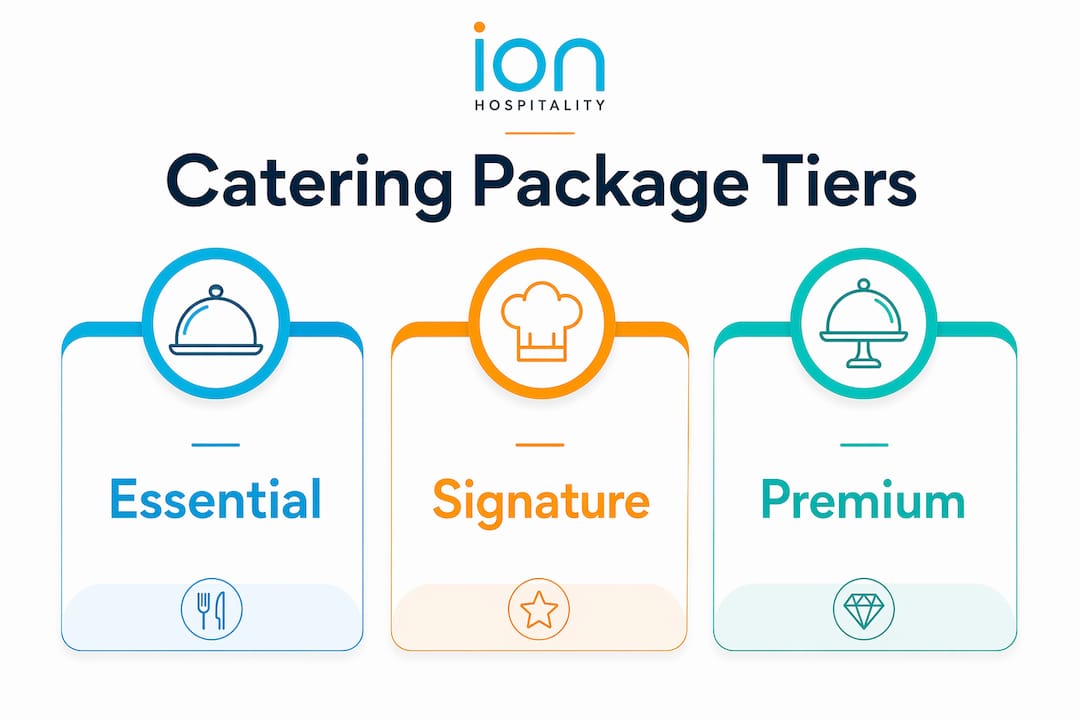
How to develop catering packages: the core framework
Start here before you touch a single menu item. A catering package is a sales document first and a food list second. Every decision you make, from format to pricing to presentation, should make it easier for a client to say yes.
The essential components of any catering package:
- Tiered structure: Build three tiers (Essential, Signature, Premium) so clients compare packages, not individual prices
- True-cost pricing: Include food, labor, packaging, delivery, and overhead in every per-person price
- Menu categories: Lead with proteins, then sides, then desserts and beverages
- Dietary labels: Mark vegan, gluten-free, and halal options visibly on every menu
- Professional packaging: Containers and presentation communicate quality before the first bite
- Clear minimums: State guest minimums and lead times upfront so clients self-qualify
- Controlled customization: Offer defined upgrades and add-ons, not unlimited substitutions
This framework reduces client decision fatigue, speeds up booking, and keeps your kitchen running predictably. Build it once, and it works for every event type you serve.
Why your catering menu can’t just be your restaurant menu
This is where most restaurant operators get tripped up. Your dine-in menu and your catering menu serve completely different purposes, and treating them as the same document costs you money on both sides.
A restaurant menu is designed for individual guests making real-time choices at a table. A catering menu is designed for one decision-maker ordering on behalf of a group, often days or weeks in advance, without a server to guide them. The format, portion sizing, and overhead costs are fundamentally different, which means the pricing model has to be different too.
Key differences between catering and restaurant menus:
- Portions: Catering portions are standardized by headcount tier (10, 25, 50, 100 guests), not by individual plate
- Pricing model: Catering uses per-person bundled pricing; restaurant menus price by individual item
- Overhead: Catering adds labor for packing, transport, setup, and breakdown that table service never touches
- Decision-maker: One person orders for the whole group, so clarity and package structure matter far more
- Lead time: Catering orders need advance notice requirements listed explicitly
- Dietary expectations: Group orders require visible allergen and dietary labels as a baseline, not an afterthought
- Minimum orders: Catering menus need stated guest minimums to protect your margins on small orders
Build a standalone catering menu. Don’t bury it on the last page of your dine-in menu or hide it in a PDF that requires a phone call to access. Clients who can’t find your catering options in 30 seconds will book someone else.
Which catering format fits your operation?
Format selection shapes everything downstream: your menu structure, your labor costs, your pricing, and which events you can realistically serve. Pick the wrong format and you’ll either underprice the labor or overpromise on execution.
Here’s how the four main formats break down:
- Drop-off catering: Food arrives packaged and ready to serve. Lowest labor cost per cover, fastest turnaround, ideal for corporate lunches and office meetings. Margins are strong when packaging is efficient.
- Buffet: Guests serve themselves from shared stations. Buffets and stations yield higher margins than plated service because labor per cover drops significantly, and you can upsell add-ons like bar packages or dessert stations.
- Plated service: Each guest receives an individually plated course. Highest labor cost, best fit for formal events like galas or wedding receptions. Price accordingly.
- Food stations: Interactive setups (taco bars, pasta stations, carving stations) that combine the energy of buffet with premium perceived value. Great for corporate events and social gatherings where experience matters.
Pro Tip: Offer two formats, not four. Operators who try to serve every format often execute none of them well. Pick the two that match your kitchen’s strengths and your most common event types, then build your packages around those.
Most successful catering programs start with drop-off and buffet, then add stations once volume justifies the staffing. Format also drives your pricing floor: a drop-off event can sustain a 55% food cost target, while full plated service with staffing demands tighter margins to stay profitable.
How to structure your catering menu categories, dietary options, and portions
A well-organized menu does the selling for you. Clients who can scan your menu and immediately understand what they’re getting, how much it costs, and whether it works for their group will book faster and with fewer questions.
Recommended menu category order:
- Proteins (lead here, always)
- Starches and grains
- Vegetables and salads
- Bread and accompaniments
- Desserts
- Beverages
Keep your core menu to 8–15 items across 3–5 packages. That range gives clients real choices without triggering decision paralysis. If you’re listing 30 or 40 individual items, restructure around packages immediately.
Dietary accommodations best practices:
- Use simple, consistent labels: V (vegetarian), VE (vegan), GF (gluten-free), H (halal)
- Collect dietary counts at booking, not the day of the event
- Offer at least one plant-based protein option in every tier
- Note allergen information availability at the bottom of the menu
- Use separate serving utensils for allergen-sensitive items and state that in your menu
Sample portion sizing by event scale:
| Event Size | Protein per Person | Sides per Person | Dessert per Person |
|---|---|---|---|
| 10–25 guests | 6–8 oz | 4–5 oz each (2 sides) | 1 individual serving |
| 25–50 guests | 5 oz | 4 oz each (2–3 sides) | 1 individual serving |
| 50–100 guests | 5–6 oz | 3–4 oz each (3 sides) | Shared platter option |
| 100+ guests | 4–5 oz | 3 oz each (3 sides) | Shared platter option |
A practical rule for buffets: plan for roughly 1.25 servings per person to account for bigger appetites and seconds. For a group of 50, that means prepping for 63 servings. Build that buffer into your cost calculations before you set the per-person price.
Pricing catering packages to protect your margins
Pricing is where most operators leave money on the table, and it usually comes down to one mistake: calculating food cost only, then wondering why the numbers don’t work at the end of the month.

Your true cost per person includes food, labor (prep, packing, transport, setup, breakdown), packaging materials, delivery, and a proportional share of overhead. A dish that costs $3 in raw ingredients often lands at $5–$6 once you add a prep cook’s time, the container, the napkins, and your share of facility rent. Price from that real number, not the food cost alone.
Cost components to include in every package price:
- Food cost (ingredients at true yield, not theoretical)
- Labor (prep time, packing, transport, setup, and breakdown)
- Packaging (containers, labels, utensils, napkins)
- Delivery (fuel, driver time, vehicle wear)
- Overhead allocation (rent, utilities, insurance, marketing)
- Target profit margin
Once you have your true cost, work backward to set pricing. A 55% food cost target for drop-off events and 60% for plated service are solid benchmarks. If your true cost per person is $12, your drop-off price should be $20 or higher to leave room for profit, overhead absorption, and contingencies.
Use the star/workhorse/loss-leader system to audit every item on your menu. This classification separates high-margin crowd-pleasers (stars) from reliable steady performers (workhorses) from low-margin must-haves that justify premium pricing on the rest (loss leaders). Put loss leaders at the bottom of your menu. Lead with your stars.
Per-person pricing with set minimums lets clients self-qualify and book faster. “Office Lunch Package, $22 per person, minimum 15 guests” tells a client everything they need in one line. That clarity cuts your back-and-forth in half and speeds up the booking cycle.
Common pricing mistakes to avoid:
- Quoting per-item instead of per-person for packages
- Forgetting to factor packaging into the cost per cover
- Offering unlimited substitutions without charging for them
- Setting no minimum order, then losing money on small jobs
- Underpricing the Premium tier because it feels “too expensive”
Packaging and presenting your catering packages professionally
Your packaging is the first thing a client sees when the food arrives. It either confirms that they made the right choice or makes them wonder if they overpaid. Get it right and you get referrals. Get it wrong and you get a one-star review about “sad containers.”

Sustainable packaging is now required by roughly one-third of corporate clients as a company policy, making eco-conscious materials a competitive differentiator, not just a nice touch. Compostable and reusable packaging also ranks as a top trend in the National Restaurant Association’s 2026 forecast. Your containers, labels, and presentation should communicate the same quality as your food. For a deeper look at how packaging choices affect brand perception, the restaurant packaging branding guide from Ionhospitality covers the full range of options.
Presentation best practices:
- Use consistent, branded labels on every container with item name and dietary info
- Choose packaging that keeps food at the right temperature through transport
- Include printed or digital menu cards so guests know what they’re eating
- Invest in quality containers for Premium tier orders; disposables are fine for Essential
- Photograph your best setups and use those images in your digital menu
Clients prefer digital, shareable menus with clear pricing, dietary filters, and booking capabilities over static PDFs. A digital menu is always current, easy to browse on a phone, and can route straight to a quote request without the client downloading anything. Build a dedicated catering section on your website, not a buried page or an emailed PDF that goes out of date. The role of online menus in restaurant sales is significant: a well-designed digital menu sells without a salesperson explaining it.
Waste reduction and inventory management for catering operations
Catering waste is a margin killer, and it’s almost entirely preventable with the right systems. The difference between a profitable catering program and a break-even one often comes down to how precisely you prep.
Standardized prep lists and precise portion sizing reduce waste and improve kitchen efficiency across every event size. For every package you offer, create a master prep list that specifies exact quantities per headcount tier: 10, 25, 50, and 100 guests. This eliminates guesswork, speeds up kitchen prep, and keeps output consistent whether your head chef or a line cook is assembling the order.
Actionable waste management tips:
- Build prep lists for each package at each headcount tier before you take your first order
- Track historical event data to forecast demand by event type and season
- Standardize substitution options within packages so swaps don’t require custom prep
- Partner with suppliers who offer flexible order quantities to avoid over-purchasing
- ️ Confirm final headcounts 48 hours before the event and adjust prep quantities accordingly
- ♻️ Repurpose surplus ingredients across your dine-in menu to minimize write-offs
- Monitor inventory turnover by item and cut low-performers from your package offerings
Forecasting is where operators who’ve been running catering for a year or more have a real edge. If your corporate lunch packages consistently run at 95% consumption for groups of 25, you know exactly how much to prep. Build that data from day one by tracking actual consumption against your prep quantities after every event.
How tiered catering packages reduce decision fatigue and drive more bookings
Here’s the psychology behind why tiered packages work so well. When you hand a client a list of 50 individual items to mix and match, they feel overwhelmed and tend to minimize cost. When you present three carefully curated packages, they feel confident making a choice. They compare across packages, not across individual prices.
The three-tier Good-Better-Best model is the most effective structure for private event catering because it’s intuitive and it anchors client expectations upward. Clients typically gravitate toward the middle Signature tier, which balances customization and price, delivering optimal profitability for caterers. Structure your tiers so the middle option is where you make your best margin.
Sample three-tier structure:
- Essential ($22/person): Three protein options, two sides, bread, bottled water. Simple, fast, efficient. No substitutions.
- Signature ($32/person): Four protein options, three sides, salad, dessert, beverage service. Limited substitutions; upgrade to premium proteins for +$3/person.
- Premium ($42/person): Five entrée options, premium sides, passed canapés, dessert table, full beverage service, branded packaging, complimentary consultation.
How to structure customization within tiers:
- Essential: No substitutions. Fast, predictable, maximum kitchen efficiency.
- Signature: Limited substitutions plus defined upgrade add-ons (premium protein +$3/person, upgraded dessert +$4/person).
- Premium: Fully customizable with a chef consultation included.
Avoid unlimited substitutions at any tier. Every open-ended modification adds labor, slows prep, and erodes your margin. Treat modifications as explicit upgrade charges, not free accommodations. Clients who understand the upgrade structure spend more, not less, because they see a clear path to getting exactly what they want.
Limit your total package count to 3–4 tiers. Too few limits your reach across different budgets; too many overwhelms clients and defeats the purpose of packaging in the first place. For more catering package ideas organized by event type, Ionhospitality has a full breakdown covering corporate lunches, social events, and seasonal packages. You can also explore how menu diversity affects client satisfaction and repeat bookings across different event formats.
Legal, regulatory, and contract considerations for catering packages
Getting the food right is only part of the job. The contract and legal side of catering protects your revenue and your reputation when things don’t go as planned.
Every catering engagement needs a written agreement that covers the basics: event date, guest count, menu selection, per-person price, total contract value, deposit amount, and cancellation terms. Guest count changes are one of the most common sources of conflict in catering, so your contract should specify a final headcount deadline (typically 48–72 hours before the event) and a policy for increases versus decreases.
Key contract and compliance elements:
- Deposit and payment schedule: Require a non-refundable deposit (typically 25–50% of the total) at booking, with the balance due before or on the event date
- Cancellation policy: Define refund terms by how far in advance the client cancels; protect your prep costs
- Guest count minimums and maximums: State the minimum guest count for each package and any capacity limits
- Allergen liability: Include a clause requiring clients to disclose all dietary restrictions and allergens at booking
- Food safety compliance: Confirm your catering operation holds the required permits and follows local health department regulations for off-site food service
- Delivery and setup terms: Specify delivery radius, setup time, and whether breakdown is included
- Force majeure: Include a clause covering cancellations due to events outside either party’s control
Food safety regulations for off-site catering vary by state and county. Most jurisdictions require a separate catering license or an extension of your existing food service permit. Check with your local health department before you take your first off-site order. Operating without the right permits exposes you to fines and, more importantly, to liability if a guest gets sick.
How to market your catering packages and get more bookings
Building great packages is step one. Getting them in front of the right clients is where the revenue actually happens. Your existing dine-in guests are your warmest catering leads: every person who has eaten your food is a potential client for their next office lunch or private event.
Add a catering section to your website with your full package menu, per-person pricing, minimums, and a simple inquiry form. Include a catering insert with every takeout order. Post your packages on social media with real photos of your setups, not stock images. For corporate accounts, direct outreach to local offices and event planners consistently outperforms passive marketing. The catering marketing guide from Ionhospitality covers the full funnel from awareness to booking.
Marketing channels that drive catering bookings:
- Social media posts featuring your catering setups and event photos
- Email campaigns to your existing customer list before peak event seasons (september through december, january through march)
- Direct outreach to local HR managers, office managers, and event planners
- A dedicated catering page on your website with SEO-optimized package descriptions
- Catering inserts in every takeout and delivery order
- ⭐ Referral incentives for clients who book repeat events or refer new clients
Seasonal timing matters. Corporate catering peaks in the fall and early spring. Social events peak in summer and around the holidays. Build seasonal packages (holiday party packages, summer cookout packages) and promote them six to eight weeks before the season starts. Operators who get more catering orders consistently do so by marketing proactively, not reactively.
Ready to sell more catering packages? Ionhospitality can help
You’ve built the packages. Now you need clients to find them, trust them, and book them. That’s exactly what Ionhospitality does for restaurants across the country.
Ionhospitality is a social media marketing and advertising agency built specifically for restaurants. We create viral word of mouth that fills seats, drives online orders, and books private events and catering packages, all done for you with 0% commissions. If you’re ready to turn your catering program into a consistent revenue stream, book a discovery call and let’s build your marketing plan together.
Key Takeaways
Developing profitable catering packages requires a tiered structure, true-cost pricing, and a digital presentation that lets clients book without friction.
| Point | Details |
|---|---|
| Use a three-tier structure | Essential, Signature, and Premium packages anchor expectations and speed up client decisions. |
| Price from true cost | Include food, labor, packaging, delivery, and overhead before setting any per-person price. |
| Limit customization | Treat substitutions as paid upgrades, not free accommodations, to protect margins and kitchen flow. |
| Go digital with your menu | Shareable digital menus with pricing, dietary filters, and booking links outperform static PDFs. |
| Market before the season | Promote seasonal packages 6–8 weeks early to capture corporate and social event bookings at peak times. |

Add a Comment