

TL;DR:
- Restaurant reviews reflect diners’ experiences but are often biased toward extreme opinions and may lack accuracy. Combining online reviews with official health inspection data provides a more complete picture of restaurant quality and safety.
Restaurant user reviews are evaluations shared by diners that directly shape where millions of Americans choose to eat every week. These are not professional critiques. They are firsthand accounts of food quality, service speed, and atmosphere posted publicly on review platforms. Understanding how they work, where they fall short, and how to pair them with official health inspection data gives you a real edge at the table. This guide breaks down the full picture so you can make dining decisions you feel confident about.
How do restaurant user reviews work?
Restaurant user reviews are the primary form of user-generated restaurant ratings in the United States. They appear on general-purpose review platforms, food-focused apps, and search engine business profiles. Most follow a standard format: a star rating from 1 to 5, a written comment, and sometimes photos of dishes or the dining room.

Yelp remains the most widely used platform for local restaurant reviews in the US as of 2026. That dominance reflects how deeply diners trust peer opinions over advertising. The contrast with traditional feedback methods is stark. Email surveys yield only a 2–3% response rate, which means the feedback restaurants collect through formal channels barely scratches the surface of actual guest sentiment.
Here is how the typical review ecosystem breaks down:
- ⭐ Star ratings: Quick, at-a-glance signals that aggregate into an overall score
- Written comments: The most useful part, where diners describe specific dishes, wait times, and staff interactions
- Photos: Visual proof that helps you judge portion size, plating, and cleanliness before you arrive
- Recency signals: Newer reviews carry more weight because menus, staff, and ownership change
Pro Tip: Sort reviews by “most recent” rather than “most helpful” when researching a restaurant. A glowing review from three years ago may not reflect the kitchen you will actually experience tonight.
The platforms hosting these reviews do not verify that reviewers actually visited the restaurant. That gap matters, and you will want to keep it in mind as you read.
What are the strengths and limits of online diner reviews?
Online diner reviews are genuinely useful, but they carry structural biases that most people never think about. The biggest one is the extremes problem.
Online reviews skew heavily toward extreme experiences. A diner who had a perfectly fine meal, nothing spectacular, nothing terrible, almost never writes a review. The people who post are usually either thrilled or furious. That means the middle 70% of dining experiences are largely absent from public feedback, which skews your perception of what a restaurant is actually like on a typical Tuesday night.
This creates what researchers call survivor bias in review data. The reviews that survive and get read are not representative of the full range of guest experiences. Patterns reveal more than star averages alone, which is why reading 20 reviews beats reading one five-star and one one-star in isolation.
Watch out for these specific limitations:
- Fake or incentivized reviews: Some restaurants solicit positive reviews in exchange for discounts, which inflates scores
- Competitor attacks: Negative reviews are sometimes posted by rivals, not real diners
- Context collapse: A bad experience during a restaurant’s opening week may not reflect its current quality
- Recency gaps: A restaurant that changed ownership six months ago may still carry the old owner’s ratings
Pro Tip: When a restaurant has hundreds of reviews, filter for three-star ratings. Those middle-ground reviewers tend to be the most balanced and specific about what works and what does not.
The silent majority is the real blind spot. Most guests who had a decent experience simply paid and left. Their opinions never appear online, which means the public record is always incomplete.
How do official food safety inspections complement user reviews?
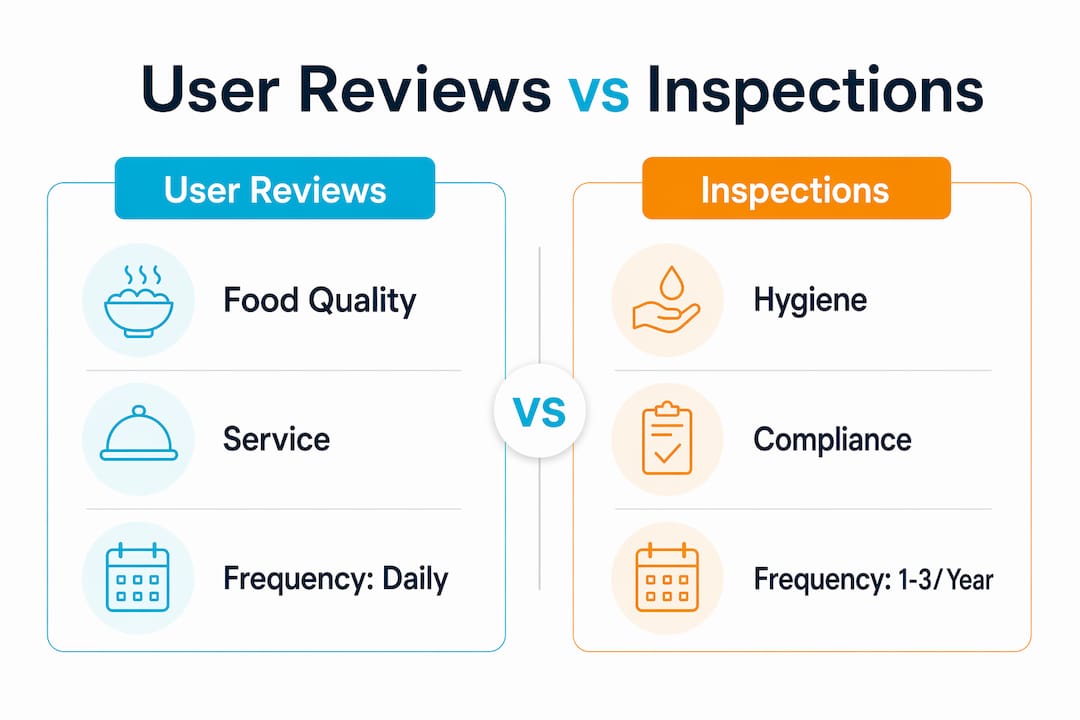
Food safety inspections are objective, standardized evaluations conducted by government health departments. They measure compliance with food safety codes, not food quality or service warmth. That distinction matters enormously when you are trying to build a complete picture of a restaurant.
Food establishments are inspected 1–3 times per year on average, depending on the jurisdiction and the restaurant’s risk category. Many health departments publish these results in searchable online databases, giving you direct access to the same data inspectors record. Rating scales range from 0–5 or 0–100 points depending on the system used, and the numbers mean very different things across jurisdictions.
Here is a quick reference for reading inspection data alongside user reviews:
| Data Type | What It Measures | How Often Updated | Where to Find It |
|---|---|---|---|
| User reviews | Food, service, atmosphere, value | Continuously | Review platforms, search profiles |
| Health inspection score | Food safety code compliance | 1–3 times per year | Local health department websites |
| Critical violations | Risks directly linked to foodborne illness | Per inspection | Inspection report detail pages |
| Minor violations | Administrative or low-risk infractions | Per inspection | Inspection report detail pages |
A single violation does not necessarily indicate poor hygiene. Critical violations, those directly linked to foodborne illness risks like improper food storage temperatures or cross-contamination, are the ones that should raise your concern. Minor infractions like a missing label on a container carry far less weight.
Inspection reports are snapshots of a single day. A restaurant that failed an inspection in march may have corrected every issue by april. Always check the date of the report and look for follow-up inspections when they are available. Pairing this data with recent diner reviews gives you a much more complete picture than either source alone.
How to use eating establishment ratings without getting misled
Reading reviews critically is a skill. Most diners scan the star average and the most recent comment, then make a decision. That approach leaves a lot of useful signal on the table.
-
Read for repeated themes, not isolated complaints. If 15 reviews mention slow service on weekends, that is a pattern. If one review mentions a rude server, that is an anecdote. Patterns are reliable. Anecdotes are not.
-
Cross-reference with inspection data. Check your local health department’s online database before trying a new spot. A restaurant with strong user reviews but a recent critical violation deserves a second look.
-
Weigh recency heavily. A restaurant’s score from two years ago reflects a different kitchen, possibly a different owner. Filter by the last 90 days when you can.
-
Speak up during your meal. Engaging management onsite resolves issues before they become permanent negative reviews. If something is wrong with your dish, say so. Most restaurants want to fix it immediately.
-
Use private feedback channels when available. Some restaurants offer QR codes at the table that route your feedback directly to management. Private feedback tools catch dissatisfaction early, turning a bad moment into a resolved one rather than a one-star post. This benefits you as much as the restaurant.
-
Ignore reviews without specifics. “Amazing food, great vibe” tells you nothing. “The duck confit was perfectly crispy and the server remembered my allergy without being reminded” tells you a great deal.
The goal is not to find a restaurant with a perfect score. The goal is to find one where the evidence, across multiple sources, points consistently in the right direction. You can also explore restaurant customer retention strategies to understand how the best restaurants keep guests coming back, which often signals a place worth trying.
Key Takeaways
The most effective way to use restaurant feedback is to combine user-generated reviews with official inspection data and read both with a critical eye.
| Point | Details |
|---|---|
| Reviews skew to extremes | The middle majority of diners rarely post, so star averages are often distorted. |
| Patterns beat star ratings | Repeated mentions across reviews reveal the real dining experience. |
| Inspections fill the safety gap | Health department scores measure food safety compliance, not food quality. |
| Critical violations matter most | Focus on violations linked to foodborne illness, not minor administrative faults. |
| Onsite feedback resolves issues faster | Speaking to management during your meal prevents problems from becoming public complaints. |
Why I stopped trusting star ratings alone
I have spent years watching how diners interact with online reviews, and the pattern that stands out most is this: people treat a 4.2-star average like a guarantee. It is not. It is a statistical artifact built from a self-selected group of people who felt strongly enough to type something out.
The reviews that changed my own dining decisions were never the five-star raves. They were the three-star reviews from someone who clearly loved food, knew what they were talking about, and gave a fair account of both the hits and the misses. Those reviewers are rare, but they are worth hunting for.
What I have also noticed is that restaurants with strong digital reputation management practices tend to produce better dining experiences overall. When a restaurant actively monitors and responds to feedback, it signals that the ownership cares about consistency. That care shows up in the kitchen.
My honest advice: use star ratings to filter out the obvious misses, then read the written reviews to find the truth. And always, always check the health inspection score before your first visit to a new place. It takes 30 seconds and it tells you something no diner review ever will.
— Doug
How Ionhospitality helps restaurants earn better reviews
Restaurants that actively manage their online presence collect better feedback and attract more loyal diners. Ionhospitality works with restaurants across the US to build the kind of social media presence and reputation that turns first-time visitors into regulars.

Through social media advertising and targeted online campaigns, Ionhospitality helps restaurants reach the right diners, encourage authentic feedback, and respond to reviews in ways that build trust. The result is a stronger public profile, more repeat visits, and a review record that actually reflects what the restaurant delivers. If your restaurant is ready to take control of how diners find and talk about you, book a discovery call with the Ionhospitality team today.
FAQ
What are restaurant user reviews?
Restaurant user reviews are firsthand accounts posted publicly by diners, typically including a star rating and written comments about food, service, and atmosphere. They appear on review platforms and search engine business profiles.
Are online restaurant reviews reliable?
Online reviews are useful but biased toward extreme experiences. Reading for repeated patterns across many reviews is more reliable than relying on a single rating or star average.
How do food safety inspections differ from user reviews?
Food safety inspections are conducted by government health departments and measure compliance with food safety codes. User reviews reflect subjective diner opinions on quality and service, not safety compliance.
How often are restaurants inspected?
Most food establishments are inspected 1–3 times per year depending on the jurisdiction, and many health departments publish results in searchable online databases.
What should I focus on in an inspection report?
Focus on critical violations directly linked to foodborne illness risks. Minor infractions carry less weight, and a single violation does not automatically mean a restaurant is unsafe.

Add a Comment