

TL;DR:
- Social selling builds trust by creating genuine relationships with prospects on social media platforms. It relies on four key components: professional presence, content authority, targeted outreach, and relationship management. Success is measured through socially sourced leads, influenced pipeline, and faster conversion rates over time.
Social selling is defined as the practice of using social media platforms to build one-to-one relationships with prospects, creating trust and credibility before any direct sales conversation begins. Unlike social media marketing, which broadcasts messages to broad audiences, or paid advertising, which targets users with placements, social selling focuses on familiarity and trust built through genuine interaction over time. The approach sits strategically between marketing awareness and traditional direct selling, making it one of the most misunderstood yet powerful tools in a modern sales professional’s toolkit. Platforms like LinkedIn lead the way for B2B applications, while Twitter and Facebook play supporting roles depending on your industry and audience.
What are the four core components of social selling?
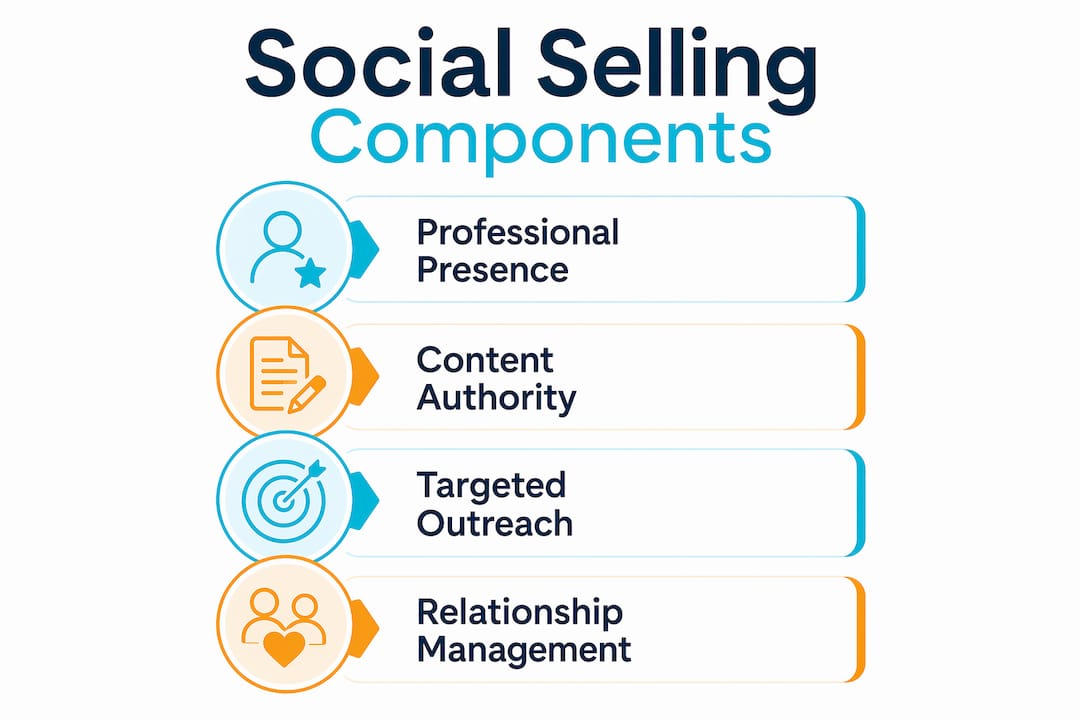
Social selling success depends on four components working together: professional presence, content authority, targeted outreach, and relationship management. Teams that execute all four generate consistent pipeline. Teams that skip even one see results drop off fast. Here is what each component actually means in practice.
1. Professional presence
Your social media profile is your sales landing page. A buyer who sees your name in a comment or a connection request will check your profile before responding. A thin bio, no photo, and zero activity signals that you are not worth their time. Fill every section, write a headline that speaks to your buyer’s problems, and post consistently enough that your profile looks alive.

2. Content authority
Posting educational content positions you as a credible voice in your field. You do not need to publish daily. You need to publish content that your ideal buyer finds genuinely useful. Think short posts that answer common questions, share a counterintuitive insight, or break down a process your buyers struggle with. Content authority is what makes a cold connection request feel warm.
3. Targeted outreach
Social selling is distinct from cold outreach because every touchpoint is personalized and informed by context. You identify ideal prospects by job title, company size, or recent activity, then engage with their content before sending a connection request. That sequence matters. Commenting on a post before connecting is the difference between a 40% acceptance rate and a 10% one.
4. Relationship management
Tracking who engaged with your content, who accepted your connection, and who opened your message is not optional. Without a system, warm leads go cold. Most sales professionals use a CRM to log every social touchpoint so follow-up happens on time and with context.
Pro Tip: Map your four components into a weekly calendar. Block time for posting, prospecting, outreach, and inbox triage. Treating them as one vague activity called “social media” is why most people see no results.
How does social selling work in practice to build trust?
Effective social selling engages prospects during their research phase with value-first outreach rather than cold pitching. Buyers spend significant time researching solutions before they ever talk to a salesperson. The seller who shows up with useful content during that research phase earns a massive trust advantage over the one who sends a cold pitch the moment a connection is accepted.
Here is what that looks like across platforms:
- LinkedIn: Comment on a prospect’s post with a genuine, specific observation. Then connect. Then share a piece of content relevant to a challenge they mentioned. Only after that sequence does a direct message make sense.
- Twitter/X: Engage in industry conversations by replying to threads where your ideal buyers are active. Consistent, smart replies build name recognition before any direct outreach.
- Facebook Groups: Join groups where your buyers gather and answer questions publicly. Your profile becomes a resource, not a pitch machine.
The most common pitfall is skipping the relationship-building steps and going straight to a sales pitch in the first message. That approach destroys trust instantly and burns a warm lead. The second most common mistake is slow response. When a prospect comments on your post or replies to your message, delays of hours reduce conversion chances significantly. Speed signals that you are attentive and worth working with.
Pro Tip: Set a phone notification for every comment or message reply on your key platforms. Responding within 30 minutes to a warm signal is one of the highest-ROI habits in social selling.
Another pitfall worth naming: blast messaging. Sending the same connection message to 200 people at once is not social selling. It is spam with a LinkedIn wrapper. Personalization is not optional. Reference something specific about the person’s work, their recent post, or their company. That specificity is what separates a reply from a delete.
How can sales teams measure social selling success and ROI?
Measuring social selling ROI requires tracking socially sourced leads, social influence on pipeline, and conversion rate improvements compared to accounts with no social touchpoints. That three-part framework is the foundation of honest attribution. Without it, you are measuring activity instead of impact.
The key metrics to track fall into three categories:
| Metric Category | What to Track | Why It Matters |
|---|---|---|
| Pipeline sourced | Leads where first touch was social | Shows direct revenue contribution |
| Pipeline influenced | Deals where social was one of multiple touches | Captures assisted conversions |
| Conversion rate | Social-touched vs. non-social accounts | Proves lift from social engagement |
| Deal velocity | Time from first social touch to close | Reveals efficiency gains |
| Cost inputs | Rep time, content costs, paid amplification | Enables honest ROI calculation |
The attribution challenge is real. Most deals involve multiple touches across email, phone, social, and events. A single-touch attribution model that credits only the last action will undercount social selling’s contribution. Multi-touch attribution, which distributes credit across every touchpoint, gives a more accurate picture. Moving beyond single-touch attribution to segment social-touched versus non-social accounts is the credible way to evaluate impact.
Every social interaction needs to live in your CRM. If a prospect comments on your post and you reply, log it. If they accept your connection and you send a follow-up message, log it. That data is what makes your ROI case defensible when leadership asks for proof.
Pro Tip: Run a 90-day cohort comparison. Pull two groups of similar accounts: one where reps made social contact, one where they did not. Compare close rates and deal size. That comparison is more persuasive than any vanity metric.
What are the best practices for a successful social selling program?
Social selling requires treating posting and engagement as integrated steps alongside targeted outreach and CRM management, not isolated activities. The programs that fail treat social selling as a side project. The ones that win build it into the sales process as a defined workflow.
Here are the practices that separate high-performing programs from the rest:
- Build a content calendar for your reps. Reps should not be left to figure out what to post. Give them a weekly content theme, two or three post formats that work, and a simple approval process. Consistency beats brilliance every time.
- Use employee advocacy. When your whole team shares and engages with company content, your reach multiplies without paid spend. A restaurant brand with 10 employees each sharing a post reaches 10 times the organic audience. The same math applies to any sales team.
- Automate the right things. Scheduling posts, tracking engagement, and logging CRM notes can be automated. The actual conversation cannot. Automation tools must be balanced with authentic human interactions for maximum success. Automate the logistics. Keep the conversations human.
- Prioritize quality over volume. Sending 500 generic connection requests is not a social selling strategy. Sending 50 personalized ones with relevant follow-up content is. The math on conversion rates always favors quality.
- Respond fast to engagement signals. A prospect who likes your post or replies to your message is raising their hand. Treat that signal with urgency. A same-day response keeps the conversation alive.
Social selling’s impact is strongest in B2B and complex sales with high deal sizes, where long-term relationship-building directly influences outcomes. That does not mean it has no place in shorter sales cycles. It means the ROI is most obvious and most measurable in high-value deals.
Pro Tip: Assign a “social selling score” to each rep based on profile completeness, weekly posts, and response time. Review it monthly. What gets measured gets done.
Key Takeaways
Social selling is the most effective way to build warm pipeline from social media because it combines professional credibility, targeted outreach, and relationship management into a repeatable system.
| Point | Details |
|---|---|
| Four components drive results | Professional presence, content authority, targeted outreach, and relationship management must all work together. |
| Engage before pitching | Comment, connect, and share value before sending any direct sales message to a prospect. |
| Speed wins warm leads | Responding to engagement signals within hours keeps conversations alive and conversion rates high. |
| Measure three ways | Track socially sourced leads, influenced pipeline, and conversion lift versus non-social accounts. |
| Automate logistics, not conversations | Use tools to schedule and track, but keep every direct interaction personal and specific. |
What I’ve learned after years of watching social selling succeed and fail
Social selling works. That is not a debatable point. What is debatable is whether most sales teams are actually doing it or just doing social media activity and calling it selling.
The biggest mistake I see is confusing output with outcome. Posting three times a week and sending 100 connection requests is output. A prospect replying to your message, booking a call, and entering your pipeline is an outcome. The gap between those two things is where most programs fall apart. Reps get credit for activity. They should get credit for conversations.
The second thing I have noticed is that social selling bridges marketing and sales in a way that most organizations have not fully figured out yet. Marketing creates content. Sales uses it. But the handoff is usually broken. The reps who win at social selling are the ones who take ownership of their own content presence instead of waiting for marketing to hand them something to post.
AI tools are changing the workflow fast. Reps can now use AI to draft personalized outreach messages, identify intent signals, and summarize a prospect’s recent activity before reaching out. That is genuinely useful. But the moment a buyer senses they are talking to a template, the trust evaporates. The technology is a research assistant, not a replacement for a real conversation.
The restaurants and businesses I see winning with social media are the ones treating every comment, every DM, and every tagged post as a relationship signal worth responding to. That instinct, applied consistently, is social selling at its best.
— Doug
How Ionhospitality can support your social selling strategy
Organic social selling builds trust. Paid social amplifies it. The two work best together, and that is exactly where Ionhospitality comes in.
Ionhospitality is a social media marketing and advertising agency built specifically for restaurants. We help you get more customers in seats, drive online orders, and fill private events with zero commissions. Our social media advertising services are designed to put your brand in front of the right buyers at the right moment, so your organic relationship-building efforts convert faster. If you want to see how paid social can work alongside your social selling strategy, book a discovery call and we will map it out together.
FAQ
What is social selling in simple terms?
Social selling is the practice of using social media to build relationships with potential buyers before making a sales pitch. It focuses on trust and credibility rather than immediate deal closing.
How is social selling different from social media marketing?
Social selling focuses on one-to-one relationships rather than broadcasting content to a broad audience. Marketing builds awareness at scale; social selling converts that awareness into individual conversations and pipeline.
Which platform is best for social selling?
LinkedIn is the leading platform for B2B social selling because of its professional networking features and buyer concentration. Twitter and Facebook contribute depending on your industry and audience.
How do I measure whether social selling is working?
Track three things: leads where the first touch was social, deals where social was one of multiple touches, and conversion rates for social-touched accounts versus accounts with no social contact.
How long does social selling take to produce results?
Social selling is a long-term credibility-building practice, not a quick-close tactic. Most programs see measurable pipeline impact within 60–90 days of consistent, structured execution across all four components.

Add a Comment