

TL;DR:
- Geo-targeting allows restaurants to deliver ads based on customers’ location, increasing marketing efficiency and foot traffic. Using precise radii, audience layering, and automation optimizes campaigns, especially for nearby consumers during key times. Combining geo-targeting with loyalty data and digital wallets further improves long-term customer engagement and ROI.
Geo-targeting for restaurants is defined as the practice of delivering ads and promotions to potential customers based on their physical location, making every marketing dollar work harder for your specific neighborhood. The role of geo targeting for restaurants goes far beyond simply showing ads to people nearby. Searches for “restaurants near me” have grown over 300% in the last five years, and 90% of guests research a location online before walking through your door. That number tells you exactly where the battle for new customers is being fought. If your marketing does not reach people at the right place and the right time, a competitor’s will.
How does geo-targeting specifically work for restaurants?
Geo-targeting uses three core signals to determine where a person is: GPS data from their phone, their IP address, and nearby Wi-Fi networks. Ad platforms like Meta and Google combine these signals to place your ads in front of people who are physically close enough to visit. The industry term for the tightest version of this tactic is geofencing, which draws a virtual boundary around a specific location and triggers ads when someone enters or exits that zone.
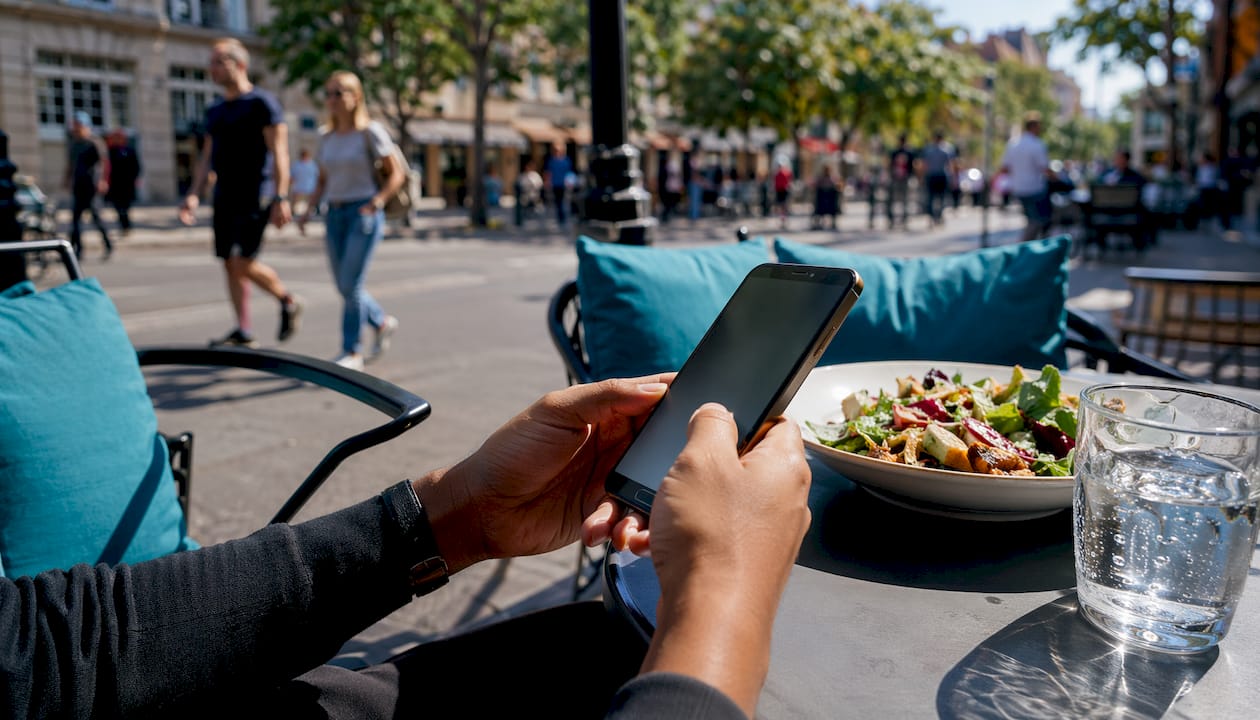
Getting the radius right is the single most important setup decision you will make. Optimal geo radii vary by location type: 3–4 km for urban restaurants, 5–8 km for suburban spots, and up to 10–15 km for destination dining. Broader targeting feels efficient on paper but kills conversion rates in practice.
Here is what a well-structured geo-targeting setup looks like:
- Define your core zone. Start with the tightest radius that covers your realistic customer base. Urban operators should begin at 3 km and expand only with data.
- Layer your audience. Within that zone, filter by age, income bracket, dining interests, and past online behavior. Location alone is not enough.
- Optimize your Google Business Profile first. A fully optimized profile generates 2.7x more website clicks, 1.7x more driving direction requests, and up to 70% more map visibility. Your paid geo-targeting campaigns amplify what your profile already does organically.
- Match your ads to dayparts. Lunch ads should run from 10:30 AM to 12:30 PM. Dinner ads should start around 4:00 PM. Showing a dinner special at 9:00 AM wastes impressions.
- Use competitive geofencing. Place a geofence around a nearby competitor and serve your ads to people who just walked into their location.
Pro Tip: Never target an entire city. City-wide targeting sounds like more reach, but it floods your budget with people who live 20 minutes away and will never make a spontaneous visit. Tight zones convert. Wide zones drain budgets.
What are the measurable benefits of geo-targeting for restaurants?
The geo targeting benefits for restaurants are direct and measurable. Geo-targeted campaigns produce an average 22% visit lift in pilot restaurant programs. That means for every 100 customers who would have visited anyway, geo-targeting brings in an additional 22. Competitive geofencing pushes that number even higher, with a 35% visit lift recorded in geoconquesting campaigns.
Geo-targeting is fundamentally a shift toward empathy. It meets customers with contextually relevant suggestions based on their location and time of day. A lunch special served to someone two blocks away at 11:45 AM is not an ad. It is a useful suggestion that happens to drive revenue.
Budget efficiency is the second major win. When you narrow your audience to people within a realistic travel distance, you stop paying for impressions from people who will never visit. Your cost per acquisition drops because every dollar targets a qualified prospect, not a random user across town.
The third benefit is personalization at scale. Integrating geo-targeting with loyalty app data lets you serve dynamic offers based on a customer’s past behavior. A guest who orders pasta every Friday night can receive a Friday pasta promotion when they enter your neighborhood. That level of relevance is what separates high-performing restaurant marketing strategies from generic broadcast advertising.
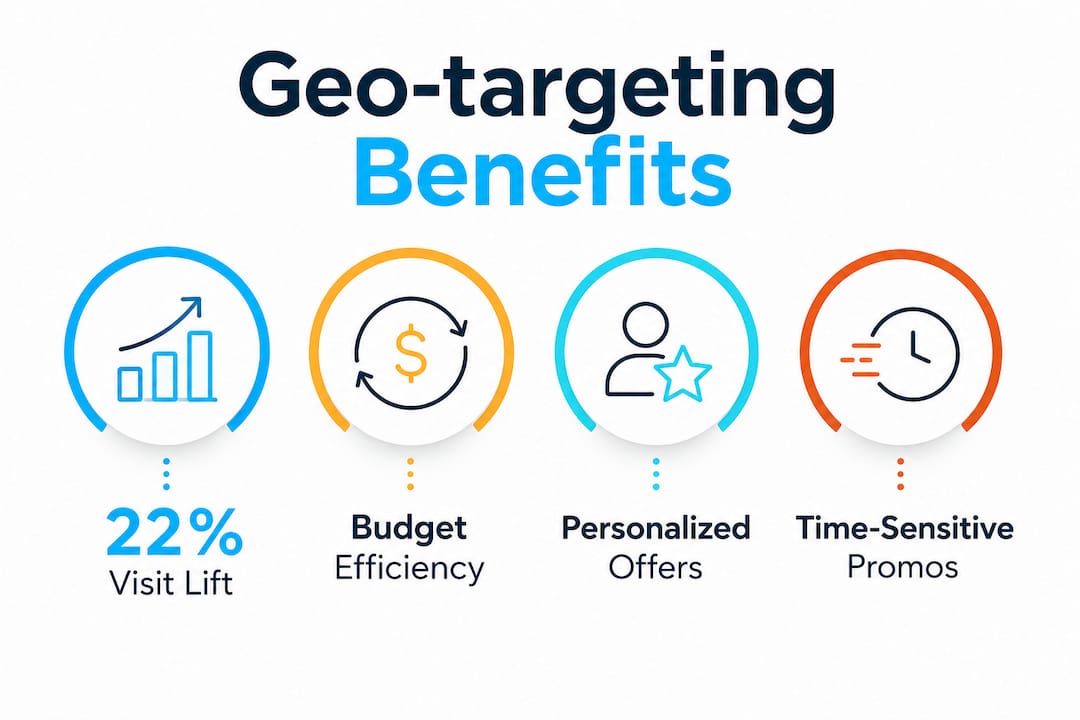
Time-sensitive offers also perform significantly better with geo-targeting. A happy hour promotion served to someone within walking distance at 4:30 PM converts at a completely different rate than the same ad shown to someone across the city at noon. Location plus timing equals intent. And local sourcing stories tied to neighborhood identity can amplify that intent further by connecting your brand to the community around you.
How can restaurants scale geo-targeting through automation and technology?
Manual geo-targeted campaign management breaks down fast. A single-location operator can manage it by hand, but the moment you add a second or third location, the workload multiplies. You end up with inconsistent radius settings, outdated menu items in ads, and daypart schedules that nobody updated after the seasonal menu changed.
Automation solves this. Syncing menu items, daypart schedules, and location data with your ad platforms eliminates manual errors and expands your testing capacity. Instead of running one version of an ad, you can test five simultaneously across different zones and let the data pick the winner.
Here is a practical four-step process for scaling geo-targeting with automation:
- Connect your data sources. Link your point-of-sale system, menu management platform, and ad accounts so that price changes and menu updates push automatically to your live ads.
- Build daypart rules. Set automated rules that activate breakfast, lunch, and dinner creatives based on time of day. No manual switching required.
- Create location-specific ad sets. Each restaurant location gets its own geo-zone, audience layer, and creative. Automation keeps them all current without a team member managing each one individually.
- Set up conversion zone tracking. Define a physical zone around your restaurant and track how many people who saw your ad later entered that zone. This is your proof of performance.
Pro Tip: Automation does not replace strategy. It executes strategy faster and at greater scale. Set your targeting logic correctly first, then automate. Automating a bad strategy just wastes budget faster.
Tracking your campaign results becomes far more manageable when automation handles the data flow. You spend less time updating spreadsheets and more time reading results and making decisions. Multi-location quick-service restaurants that adopt automated geo-targeting consistently report lower cost per visit and faster campaign iteration cycles.
What are the key pitfalls to avoid with geo-targeting?
The biggest mistake restaurant owners make with geo-targeting is setting the radius too wide. Each 2 km added beyond the core conversion zone significantly dilutes audience relevance, increases cost per thousand impressions, and wastes budget on people who are unlikely to visit. This is not a minor inefficiency. It is the difference between a campaign that pays for itself and one that drains your marketing budget with nothing to show.
Here are the critical pitfalls to watch for:
- Radius creep. Start tight and expand only when data supports it. Never expand because it “feels” like more reach.
- ️ Ignoring the “creepy” line. Consumer sensitivity to location-based marketing is real. Ads that feel like surveillance push customers away. Offers that feel helpful pull them in. The difference is usually relevance and timing.
- Skipping attribution. Running geo-targeted ads without conversion zone tracking means you cannot prove what worked. Attribution via conversion zones and control groups lets you measure actual visit lift scientifically.
- Treating competitive geofencing as a stunt. Geofencing a competitor’s location works best as an ongoing tactic synchronized with your daypart strategy, not a one-time experiment.
- Missing the retention layer. Paid ads that trigger digital wallet pass installs give you long-term push notification access to that customer. This spreads your customer acquisition cost across many future visits instead of charging it all to the first one.
The most effective restaurant owners treat geo-targeting as one layer of a larger system. It works alongside local SEO, loyalty programs, and push notifications. No single tactic wins alone. The importance of location in dining extends beyond the physical address. It shapes every digital touchpoint a potential customer encounters before they decide where to eat.
Key Takeaways
Geo-targeting works for restaurants because it combines location precision, audience layering, and time-sensitive offers to turn nearby consumers into paying guests.
| Point | Details |
|---|---|
| Set the right radius | Use 3–4 km for urban, 5–8 km for suburban, and up to 15 km for destination restaurants. |
| Optimize your Google Business Profile | A complete profile drives 2.7x more clicks and 70% more map visibility before paid ads even run. |
| Measure visit lift, not just clicks | Use conversion zones and control groups to prove actual foot traffic from your campaigns. |
| Automate at scale | Sync menu, daypart, and location data with your ad platforms to reduce errors and expand testing. |
| Integrate with retention tools | Combine geo-targeted ads with loyalty data and digital wallet passes to lower long-term acquisition costs. |
Why geo-targeting is the sharpest tool in your local marketing kit
I have watched restaurant owners pour money into broad social media campaigns that reach thousands of people who will never set foot in their dining room. The shift to geo-targeting is not just a tactical upgrade. It is a completely different way of thinking about who you are actually talking to.
What I find most underused is competitive geofencing. Smaller restaurants especially avoid it because it sounds aggressive. But it is not aggressive. It is smart. When someone is already standing outside a competitor’s door, they are in a dining mindset. That is the exact moment your ad has the highest chance of changing their decision. Pair that with a daypart-specific offer and you have a genuinely powerful play.
The future I see coming is predictive geo-targeting, where platforms use behavioral patterns to anticipate when a customer is likely to be near your location before they even leave home. Combined with digital wallet integration and loyalty data, that creates a marketing system that feels less like advertising and more like a well-timed recommendation from a friend. Restaurants that build these systems now will have a significant advantage when that capability becomes standard. Test your radius settings monthly. Measure visit lift every campaign. Refine your audience layers based on what the data shows. The restaurants winning locally in 2026 are not outspending their competitors. They are out-targeting them.
— Doug
Geo-targeted ads, done right for your restaurant
Running geo-targeted campaigns without the right setup is one of the fastest ways to burn through a marketing budget. Ionhospitality specializes in social media advertising for restaurants, with expert campaign setup that covers proper radius configuration, audience layering, daypart scheduling, and creative that actually stops the scroll.
Every campaign Ionhospitality builds is designed to put more guests in your seats and more private event bookings on your calendar, with zero commissions taken from your revenue. If you want to see exactly how a geo-targeted campaign would work for your specific location, book a discovery call and get a clear picture of what is possible.
FAQ
What is geo-targeting in restaurant marketing?
Geo-targeting is the practice of serving ads to potential customers based on their physical location. Restaurants use it to reach people within a realistic travel distance at the moment they are most likely to decide where to eat.
What radius should a restaurant use for geo-targeting?
Urban restaurants perform best with a 3–4 km radius, suburban locations with 5–8 km, and destination restaurants with up to 10–15 km. Expanding beyond your core conversion zone dilutes audience quality and raises costs.
How does geo-targeting increase foot traffic?
Geo-targeted campaigns produce an average 22% visit lift, with competitive geofencing campaigns reaching a 35% lift. The combination of location precision and time-sensitive offers converts nearby consumers into actual visits.
What is competitive geofencing for restaurants?
Competitive geofencing places a virtual boundary around a competitor’s location and serves your ads to people who enter that zone. It works best as an ongoing tactic synchronized with daypart-specific offers rather than a one-time campaign.
How do I measure whether my geo-targeting is working?
Use conversion zone tracking to measure how many people who saw your ad later entered your restaurant. Comparing a test group against a control group gives you a scientifically valid measure of actual visit lift from your campaigns.

Add a Comment