

TL;DR:
- Paid media allows restaurants to target specific audiences and generate immediate customer actions efficiently. Combining paid and organic strategies strengthens brand reach, with paid ads capturing demand and organic content building trust. Success depends on proper budget allocation, high-quality creative content, and accurate measurement using metrics like MER and CPA.
Paid media is defined as any advertising where you pay to place your message directly in front of a targeted audience to drive measurable customer action. For restaurant owners, that means filling seats, booking private events, and generating online orders on demand. Unlike owned media (your website or Instagram page) or earned media (press coverage and word of mouth), paid media gives you immediate, controlled reach. You set the audience, the budget, and the message. Paid and organic media work best together, with paid ads delivering fast reach while organic content builds the trust that makes those ads convert.
What is paid media and why does it matter for restaurants?
Paid media is the umbrella term for all advertising you buy. Search ads, social ads, display ads, and retargeting all fall under it. The industry also calls this paid advertising or paid acquisition. Understanding paid advertising starts with knowing it is the fastest way to put your restaurant in front of hungry, local customers who are ready to book or order right now.
The core advantage over organic channels is speed and control. You can launch a campaign today and see reservations tomorrow. You can pause it instantly if something is not working. Organic growth through SEO or social posting takes months to build momentum. Paid media fills that gap while your organic presence grows.
Restaurant owners often underestimate how much control paid media gives them over who sees their ads. You can target by ZIP code, age, dining interest, income level, and even past website behavior. That precision means less wasted spend and more qualified customers walking through your door.
Paid ads provide immediate reach while organic content builds the trust that improves paid ad conversion over time. The two are not competing strategies. They are partners.
What are the main types of paid media channels for restaurants?
Different paid channels serve different roles in your marketing funnel. Choosing the right mix depends on whether you want to capture demand that already exists or create new demand among people who have not heard of you yet.
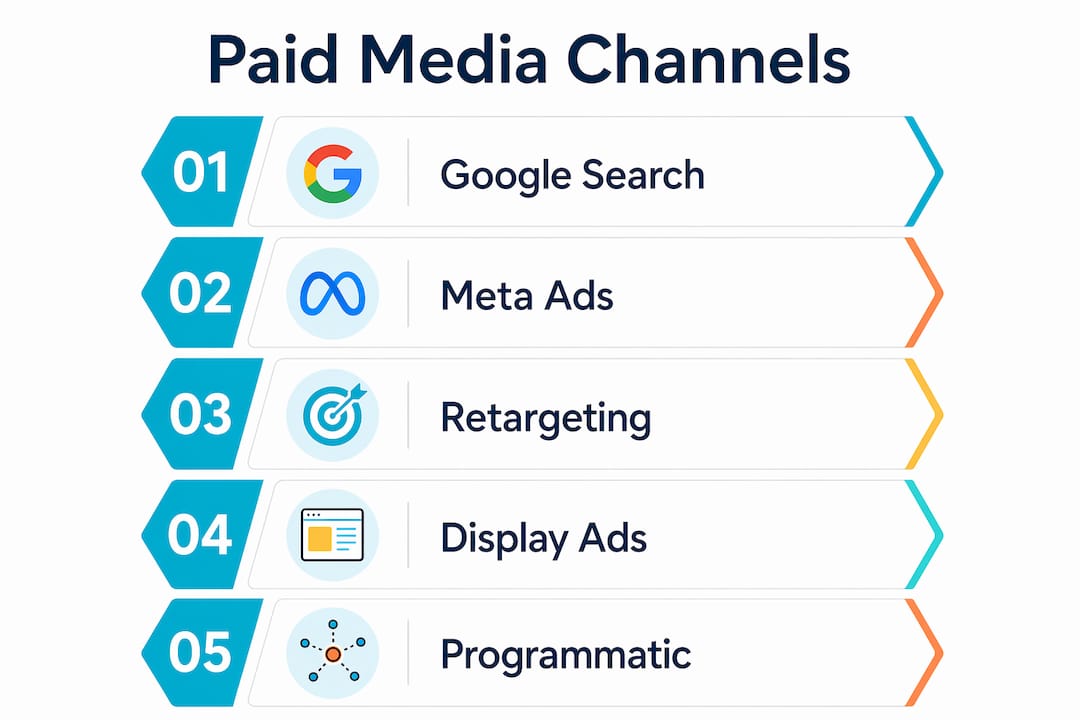
Google Search captures purchase intent by showing your ad when someone types “Italian restaurant near me” or “private dining Chicago.” These are high-intent diners ready to act. Search ads convert well because you are meeting the customer at the exact moment they are looking for you.
Meta (Facebook and Instagram) paid social ads work differently. They build awareness and desire among people who were not actively searching for a restaurant. A scroll-stopping video of your signature dish or a packed Saturday night can make someone decide they need to visit you this weekend. Paid social is where you create demand, not just capture it.
| Channel | Funnel stage | Best for restaurants |
|---|---|---|
| Google Search | Bottom (intent) | Capturing diners ready to book now |
| Meta/Instagram ads | Top and middle | Building awareness and desire |
| Display/programmatic | Top | Broad local reach and brand visibility |
| Retargeting | Bottom | Re-engaging website visitors who did not book |
Retargeting converts at up to 3x the rate of cold audience ads because it targets people who already showed interest. If someone visited your reservations page but did not complete a booking, a retargeting ad can bring them back. For restaurants, this is one of the highest-return tactics available.
Display and programmatic ads cast a wider net. They are useful for building local brand recognition, especially before a grand opening, a seasonal menu launch, or a major event promotion.
How do restaurants plan and budget for paid media campaigns?
Budgeting is where most restaurant owners make their first mistake. They either spend too little to see results or spread their budget across too many channels at once. A clear framework fixes both problems.
The 70/20/10 budget allocation framework is the industry standard for paid media spend. Here is how it works for a restaurant:
- 70% to proven channels. Put the majority of your budget into what is already working. If Meta ads are driving reservations, keep funding them.
- 20% to growth channels. Test a channel that shows promise but has not been fully proven for your location or concept. Google Search or retargeting often fits here.
- 10% to new experiments. Try something new: a different ad format, a new audience segment, or a short video series. This is your learning budget.
Three metrics tell you whether your campaigns are working: Return on Ad Spend (ROAS), Cost Per Acquisition (CPA), and Media Efficiency Ratio (MER). A 3:1 ROAS is a common baseline, meaning you earn $3 in revenue for every $1 spent. In 2026, many restaurants need to push higher than that to stay profitable given rising ad costs.
Your CPA should stay below your contribution margin per new customer. If your average first-time diner spends $60 and your food cost is 30%, your contribution is $42. Paying $50 to acquire that customer is a losing trade.
Quality Scores above 7 reduce your cost per click and improve your ad rank in Google Search. A higher Quality Score means Google rewards you with cheaper, better-positioned ads. You earn a high score by matching your ad copy tightly to your keywords and sending traffic to a relevant, fast-loading landing page.
Pro Tip: Start new campaigns with manual bidding until you collect at least 50 conversions per week. Switching to automated bidding strategies like Target ROAS too early, before you have enough data, leads to poor results and wasted spend.
Why does creative quality determine your paid media results?
Creative is the single biggest variable in paid media performance. Bidding algorithms have become so advanced that they largely manage themselves. Creative volume, not bidding, determines ad performance in 2026. That is a fundamental shift from how paid media worked even three years ago.
What does great restaurant ad creative look like? Here are the non-negotiables:
- Video first. Short-form video (Reels, Stories, TikTok-style clips) outperforms static images on every major social platform. Show your food being plated, your bar being stocked, your dining room filling up on a Friday night.
- Design for silent viewing. Most social video plays without sound. Use text overlays and visual storytelling so your message lands even on mute.
- Refresh constantly. Creative must be refreshed every 7–14 days to maintain performance. Creative fatigue occurs 3–5 times faster in 2026 than in previous years.
- Match the offer to the landing page. If your ad promotes a $49 prix fixe dinner, the landing page must show that exact offer. Mismatches kill conversions.
- Use AI tools for volume. AI-assisted creative production helps you generate more ad variations faster without hiring a full production team.
Meta’s Advantage+ campaigns have shifted the optimization focus almost entirely to creative. The platform now handles audience targeting automatically. Your job is to feed it a steady supply of fresh, high-quality content and let the algorithm find the right people.
Pro Tip: Run at least 3–5 creative variations per campaign at launch. This gives the algorithm enough material to test and find the top performer faster, which lowers your cost per result.
For restaurants, the best-performing creative tends to feature real food, real staff, and real atmosphere. Polished stock-photo ads feel fake. A 15-second clip of your chef pulling a wood-fired pizza out of the oven will outperform a designed graphic every time. You can read more about social media ads for restaurants to see what formats drive the most bookings.
How do you measure paid media success as a restaurant owner?
Measurement is where paid media gets confusing fast. Platform dashboards show you impressive numbers, but those numbers are often misleading. Platform-reported ROAS can overstate results by 15–30% due to privacy changes and attribution gaps. That means the number your ad dashboard shows you may not reflect what is actually happening in your business.
The fix is to use Media Efficiency Ratio (MER). MER equals total revenue divided by total ad spend. It is a ground-truth metric that does not depend on platform tracking. If your restaurant did $50,000 in revenue last month and spent $5,000 on ads, your MER is 10. Track this number monthly and watch the trend.
Here is the optimization loop that works for restaurants:
- Plan. Set your MER target, choose your channels, and define your creative brief.
- Create. Produce 3–5 ad variations per campaign with fresh video and clear offers.
- Launch. Start with manual bidding and a controlled daily budget.
- Read. Check MER weekly, not daily. Daily swings are noise. Weekly trends are signal.
- Iterate. Kill underperforming ads, scale winners, and refresh creative every 7–14 days.
Optimizing vanity metrics like impressions or clicks instead of revenue is the most common ROI mistake in paid advertising. Clicks do not pay your staff. Reservations do. Build your reporting around contribution margin and customer acquisition cost payback, not reach or engagement rate.
First-party data is your most valuable targeting asset. Email lists, reservation data, and loyalty program members all feed better ad targeting. As privacy restrictions tighten, restaurants that collect and use first-party data will have a clear advantage over those relying solely on platform audiences. Pairing paid campaigns with organic growth strategies also strengthens your first-party data over time.
Key Takeaways
Paid media is the fastest way for restaurants to drive bookings, but only when you pair the right channels with fresh creative, honest measurement, and a budget framework built around contribution margin.
| Point | Details |
|---|---|
| Use the 70/20/10 framework | Allocate 70% to proven channels, 20% to growth, and 10% to new tests. |
| Measure MER, not platform ROAS | Platform ROAS overstates results by up to 30%; use total revenue divided by total spend. |
| Refresh creative every 7–14 days | Creative fatigue hits 3–5x faster in 2026, so constant fresh content is non-negotiable. |
| Match search and social roles | Google Search captures ready-to-book diners; Meta builds desire in new audiences. |
| Retargeting is your highest-ROI tactic | Retargeting converts at up to 3x the rate of cold audience campaigns. |
What I have learned running paid media for restaurants
I have seen restaurant owners make the same mistake over and over: they launch ads before fixing what the ad sends people to. A great ad pointing to a slow website or a confusing reservations page is money in the trash. Fix your conversion fundamentals first. Then scale your ad spend.
The other thing I push back on hard is the obsession with follower counts and impressions. Those numbers feel good. They do not pay rent. I have worked with restaurants that had 50,000 Instagram followers and empty dining rooms on Tuesday nights. The metric that matters is how many new customers walked in because of your ad. Everything else is noise.
Paid and organic are not either/or choices. The restaurants that win long-term run paid ads to drive immediate bookings while building organic content that keeps their brand top of mind between campaigns. Paid and organic media converging is not a trend. It is the new baseline. The restaurants treating them as separate budgets with separate teams are leaving money on the table.
Creative fatigue is real and it is faster than most owners expect. If you are running the same ad for more than two weeks, your cost per result is climbing and you probably do not realize it. Build a content calendar that feeds your paid campaigns with fresh clips every week. That discipline separates restaurants that scale from those that plateau.
— Doug
How Ionhospitality helps restaurants run paid social ads that fill seats
Running paid media well takes time, creative output, and constant optimization. Most restaurant owners do not have a spare 20 hours a week to manage campaigns, refresh creative, and read the data correctly.
Ionhospitality specializes in restaurant social media advertising built specifically for food and beverage operators. We build campaigns that target your local audience, produce scroll-stopping video creative, and optimize toward real bookings, not vanity metrics. Every campaign runs with 0% commissions on your revenue. If you want to see what a paid social strategy built for your restaurant looks like, book a discovery call and we will map it out together.
FAQ
What is paid media in simple terms?
Paid media is any advertising you pay for to reach a specific audience. For restaurants, that includes Google Search ads, Facebook and Instagram ads, and retargeting campaigns.
How much should a restaurant spend on paid media?
Budget depends on your revenue goals and contribution margin, but the 70/20/10 framework gives you a clear starting structure. Start small, prove what works, then scale the channels that drive real bookings.
What is the difference between paid media and organic media?
Paid media delivers immediate, targeted reach in exchange for ad spend. Organic media, like SEO and social posting, builds reach over time at no direct cost but takes months to show results.
Why does creative matter more than targeting in 2026?
AI-powered platforms like Meta now handle audience targeting automatically. The main variable you control is creative quality and volume. Fresh, high-performing video ads are the top driver of paid media results.
What metrics should restaurant owners track in paid media?
Track Media Efficiency Ratio (total revenue divided by total ad spend), Cost Per Acquisition, and contribution margin per customer. Avoid optimizing for impressions or clicks alone, since those do not directly reflect revenue.

Add a Comment