
TL;DR:
- Restaurant lead generation involves attracting new customers through digital visibility and outreach strategies. Building a strong online presence with optimized profiles, reviews, and targeted messaging converts casual diners into repeat guests. Proactive B2B efforts also unlock high-margin corporate and private event revenue.
Restaurant lead generation is the process of attracting and converting potential diners and event clients into paying customers through digital visibility, reputation management, and targeted outreach. Most restaurant owners focus on foot traffic and word of mouth alone. That leaves a massive gap in their customer pipeline. The restaurants winning right now combine local SEO, social proof, email and SMS campaigns, and proactive B2B outreach into one connected system. This article breaks down exactly how to build that system, channel by channel.
What is restaurant lead generation and why does it matter?
Restaurant lead generation is the practice of identifying, attracting, and converting people who have never visited your restaurant into paying customers. The industry term for this broader process is “customer acquisition,” and it covers every touchpoint from a Google search to a first reservation. 76% of consumers read online reviews before choosing a restaurant. That single stat tells you the entire game: your digital reputation is your first sales pitch, before anyone walks through the door.
Acquiring a new customer costs 5 to 7 times more than retaining an existing one. That means your lead generation workflow needs two tracks: one to bring in new guests and one to keep them coming back. Restaurants that treat these as separate problems end up spending too much on ads and too little on loyalty. The most effective operators build both tracks simultaneously.
How to optimize your online presence for restaurant lead generation
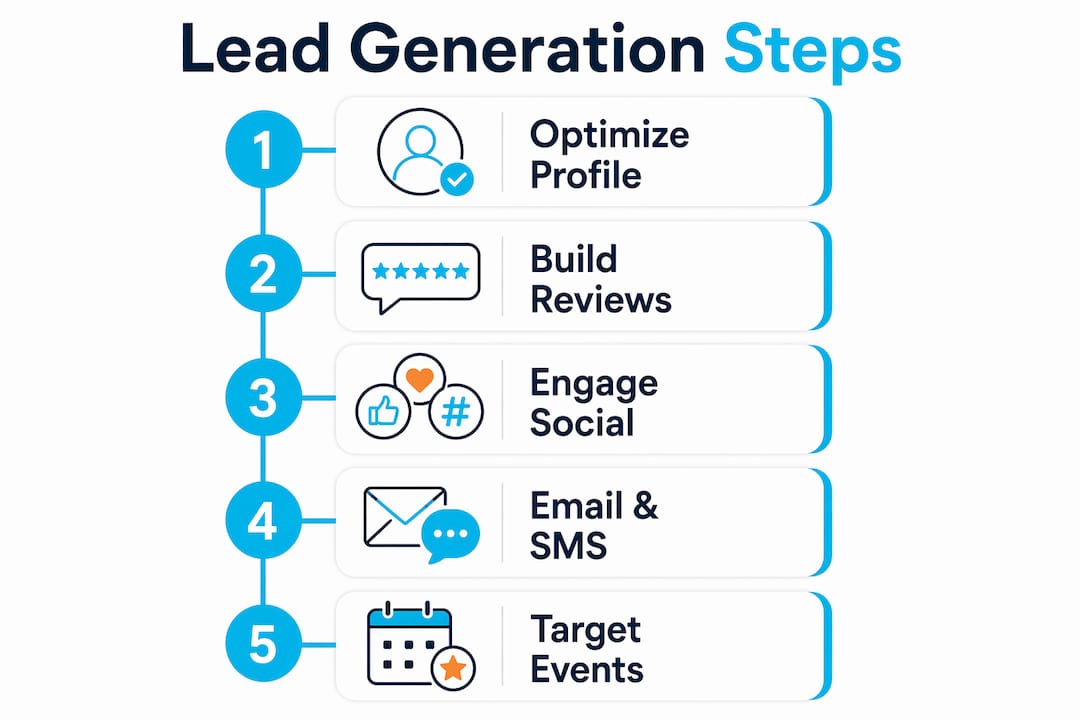
Your Google Business Profile is the single highest-ROI channel for local restaurant customer acquisition. A fully optimized profile drives more reservation clicks than an incomplete one, and it costs nothing to set up. Start here before spending a dollar on paid ads.
Here is what to optimize on your Google Business Profile right now:
- ✅ Hours: Keep them accurate, including holiday hours. Wrong hours kill trust instantly.
- ✅ Photos: Upload high-quality images of your food, interior, and team. Profiles with photos get significantly more direction requests and website clicks.
- ✅ Menu: Link your full, current menu. Diners decide before they arrive.
- ✅ Q&A section: Seed it with your most common questions and answer them yourself.
- ✅ Posts: Use Google Posts to promote specials, events, and seasonal menus weekly.
Local SEO builds on your Google Business Profile by targeting the keywords your neighborhood uses to find food. Phrases like “best tacos in [your city]” or “private dining [your neighborhood]” are high-intent searches. Consistent citations across Yelp, TripAdvisor, and Apple Maps reinforce your local authority. Learn more about targeting local diners with these digital approaches.
Your website is where leads either convert or leave. Over 70% of restaurant searches happen on mobile devices. That means your site must load fast, display cleanly on a phone, and put your phone number, reservation button, and online order link within one thumb-tap. A one-second delay in load time drops conversion rates by 7%. Speed is not optional.
Pro Tip: Add Restaurant Schema markup to your website code. This structured data tells Google your hours, menu, price range, and star ratings. It produces rich snippets in search results that increase click-through rates significantly, and most restaurant websites skip it entirely.
How do reviews and social media content convert new diners?
Social proof is the fastest trust signal you have. BrightLocal’s 2024 Local Consumer Review Survey found that 76% of consumers regularly read reviews when choosing a restaurant. Star ratings and review volume directly affect whether someone clicks your listing or scrolls past it.
Here is a repeatable system for building your review base:
- Ask at the right moment. Train your staff to request a review right after a guest expresses satisfaction, not at the end of every meal.
- Send a follow-up text. If you captured a phone number at booking, send a brief SMS within two hours of the visit with a direct link to your Google review page.
- Respond to every review. Reply to positive reviews with a personal touch. Respond to negative ones within 24 hours with a calm, solution-focused message. Online reviews drive SMB revenue in measurable ways, and your response rate signals professionalism to future diners.
- Display reviews on your website. Embed your Google or Yelp rating on your homepage. Social proof on your own site reduces bounce rates.
Social media works differently than most restaurant owners expect. Platforms like TikTok and Instagram are not direct booking engines. They are demand generators.
Social media content drives brand searches that lead to reservations through Google Business Profile. Judge your social media performance by how many people search your restaurant name after seeing a post, not by likes or direct bookings.
Short-form video is the most effective format right now. A 15-second clip of a sizzling dish, a packed weekend brunch, or a bartender crafting an over-the-top cocktail can reach thousands of local viewers organically. Social media engagement directly connects to 31% more bookings when done consistently. Micro-influencer partnerships, where a local food creator with 5,000 to 50,000 followers posts about your restaurant, generate user-generated content that feels authentic and reaches a highly targeted local audience.
How email and SMS marketing drive repeat visits and loyalty
Email and SMS loyalty programs deliver the highest ROI for converting first-time diners into repeat customers. Welcome sequences and time-sensitive SMS campaigns drive strong return rates, with SMS open rates above 90%. That is a channel you cannot ignore.
The first step is capturing contact information at every touchpoint:
- Reservation systems: Collect email and phone at booking. Most platforms do this automatically.
- Point of sale: Offer a loyalty sign-up on the receipt or tablet at checkout.
- Wi-Fi login: Gate your guest Wi-Fi with an email capture form.
- Online ordering: Require an account or email for order confirmation.
Once you have a list, automate the basics. A welcome sequence for new subscribers should include a first-visit offer, a brief story about your restaurant, and a link to your menu. Keep it to two or three emails over the first week. After that, segment your list by behavior. Guests who visited once get a “we miss you” campaign. Regulars get early access to events and seasonal menus.
SMS works best for time-sensitive offers. A text sent at 11:00 AM on a Tuesday promoting a lunch special drives same-day traffic. Email works better for storytelling, event announcements, and longer promotions. Use both together for maximum impact. Restaurant email campaigns that combine a strong subject line with a single clear offer consistently outperform generic newsletters.
Pro Tip: Use your reservation or POS data to trigger reactivation campaigns. If a guest has not visited in 60 days, send a personalized SMS with a small incentive. “We haven’t seen you in a while, [first name]. Here’s 15% off your next visit” converts at a rate that justifies the discount every time.
How to generate B2B leads for corporate and private events
Corporate catering and private events are the highest-margin revenue your restaurant can generate. They also require a completely different lead generation approach. Consumer diners find you through Google and Instagram. Corporate event planners need to be found by you.
Direct outreach to corporate event planners converts at 3–8% into recurring catering relationships. That is a meaningful return on a few hours of prospecting per week.
The B2B lead generation workflow looks like this:
| Stage | Consumer funnel | Corporate and event funnel |
|---|---|---|
| Discovery | Google search, social media | Direct email, LinkedIn outreach |
| Trust signal | Reviews, photos | Case studies, capacity info, menus |
| Conversion point | Reservation button, online order | Inquiry form, phone call |
| Follow-up | Automated email sequence | Personalized proposal |
To build your corporate prospect list, search LinkedIn for office managers, executive assistants, and HR managers at companies within two miles of your restaurant. These are the people who book team lunches, holiday parties, and client dinners. A short, personalized email with your private dining menu, capacity details, and one or two testimonials from past events gets responses.
Your website needs a dedicated private event landing page with an inquiry form, room photos, capacity information, and sample menus. A generic contact page loses these leads. A purpose-built page with rich visuals and clear next steps converts them. Check out these private event promotion strategies for a deeper breakdown of what works.
Key Takeaways
Effective restaurant lead generation requires a layered system: Google Business Profile optimization, social proof, email and SMS retention, and proactive B2B outreach working together.
| Point | Details |
|---|---|
| Google Business Profile first | Optimize your profile completely before investing in paid advertising channels. |
| Reviews drive decisions | 76% of consumers read reviews before choosing a restaurant, making reputation management non-negotiable. |
| Email and SMS retain customers | Welcome sequences and segmented campaigns convert first-time diners into regulars visiting 4–6 times per year. |
| B2B outreach unlocks high-margin revenue | Direct prospecting to corporate planners converts at 3–8% into recurring catering relationships. |
| Website speed and mobile design matter | A one-second load delay drops conversions by 7%, and over 70% of restaurant searches happen on mobile. |
What I’ve learned about restaurant lead generation after years in the trenches
Most restaurant owners I talk to want to start with paid social ads. I get it. Ads feel like a fast answer. But every time we skip the foundation, the ads underperform and the owner loses confidence in digital marketing altogether.
The real sequence is this: fix your Google Business Profile, build your review base to at least 50 recent reviews, then run ads. When someone sees your ad and searches your name, they need to find a profile that closes the sale for you. A thin profile with 12 reviews and blurry photos undoes everything the ad just built.
The other thing I see constantly is restaurants measuring social media by likes. Likes do not pay rent. The metric that matters is how many people searched your restaurant name this week compared to last week. That is the signal that your content is working. If your brand searches are flat, your content is not converting attention into intent.
The restaurants I have seen grow the fastest are the ones that treat their email and SMS list like a real asset. They grow it every week, they segment it, and they send offers that feel personal. A list of 2,000 engaged local diners is worth more than 20,000 Instagram followers who never visit.
One more thing: do not sleep on corporate and event business. One recurring corporate lunch account can be worth $3,000 to $5,000 per month. That is a revenue stream most restaurants leave on the table because they never send the first email.
— Doug
Ionhospitality helps you turn strategy into real customers
Ionhospitality is a social media marketing and advertising agency built specifically for restaurants. We handle everything from social media advertising and content creation to private event promotion and website development, all with zero commissions on your bookings.
If you are ready to build a real customer acquisition system, not just run a few ads and hope for the best, we want to talk. Our team works exclusively with restaurant owners and managers across the United States. We know what moves the needle and what wastes your budget. Schedule a discovery call and let us map out a lead generation plan built around your restaurant’s specific goals, market, and revenue targets.
FAQ
What is restaurant lead generation?
Restaurant lead generation is the process of attracting and converting potential diners and event clients into paying customers through digital marketing, reputation management, and outreach. It covers every channel from Google search to direct email prospecting.
What is the best channel for restaurant customer acquisition?
Google Business Profile is the single highest-ROI channel for local restaurant lead generation. A fully optimized profile drives more reservation clicks and direction requests than any other free tool available.
How do email and SMS campaigns help increase restaurant customers?
Email and SMS loyalty programs convert first-time diners into repeat customers by delivering personalized offers, welcome sequences, and time-sensitive promotions. SMS open rates exceed 90%, making it the fastest channel for same-day traffic.
How do I generate leads for private events and corporate catering?
Direct outreach to corporate event planners via LinkedIn and email converts at 3–8% into recurring catering relationships. Pair outreach with a dedicated private dining landing page that includes an inquiry form, capacity details, and sample menus.
How much should a restaurant spend on lead generation?
Restaurants perform best with a marketing budget of 3–6% of monthly revenue, prioritized toward Google Business Profile optimization and email retention before investing in paid advertising.

Add a Comment