

TL;DR:
- Digital menus increase restaurant sales by 20 to 40 percent through features like upselling prompts and food photography. They also improve operational efficiency by speeding up table turnover and reducing printing costs. Effective digital menus rely on design, data analytics, and continuous updates to maximize revenue and customer engagement.
Online menus are defined as any digital interface, including QR code pages, mobile apps, website menus, and kiosk screens, that lets customers browse and order food without a printed card. The role of online menus goes far beyond convenience. Restaurants using digital menus report a 20–40% increase in average order value, driven by upselling prompts and food photography. The National Restaurant Association tracks digital ordering as one of the fastest-growing operational shifts in U.S. food service. If you run a restaurant and you are not treating your digital menu as a revenue tool, you are leaving real money on the table.
How do online menus increase customer engagement and sales?
Digital menus change the entire ordering dynamic. When customers browse at their own pace, without a server hovering nearby, they spend more time on the menu. That extra browsing time translates directly into larger orders.
Here is what makes digital menus so effective at driving engagement:
- ️ High-quality food photography increases order value by 15–30%. A photo of your short rib pasta sells it better than any description alone.
- Detailed item descriptions with allergen info and modifier options reduce back-and-forth with servers, cutting ordering errors significantly.
- ⬆️ Smart upsell prompts (“Add truffle fries for $3?”) appear at the exact moment a customer is already committed to ordering. These upselling techniques convert at a much higher rate than verbal suggestions.
- ⏱️ Faster order processing means fewer mistakes and faster table turns, which keeps customers happy and your floor moving.
The self-paced experience also removes the social pressure of deciding quickly. Customers who feel relaxed order more. That is not a theory. It is a consistent pattern across full-service and fast-casual formats.
Pro Tip: Add a “Most Popular” or “Chef’s Favorite” badge to three or four high-margin items on your digital menu. Customers default to social proof when they are unsure, and that badge costs you nothing to add.
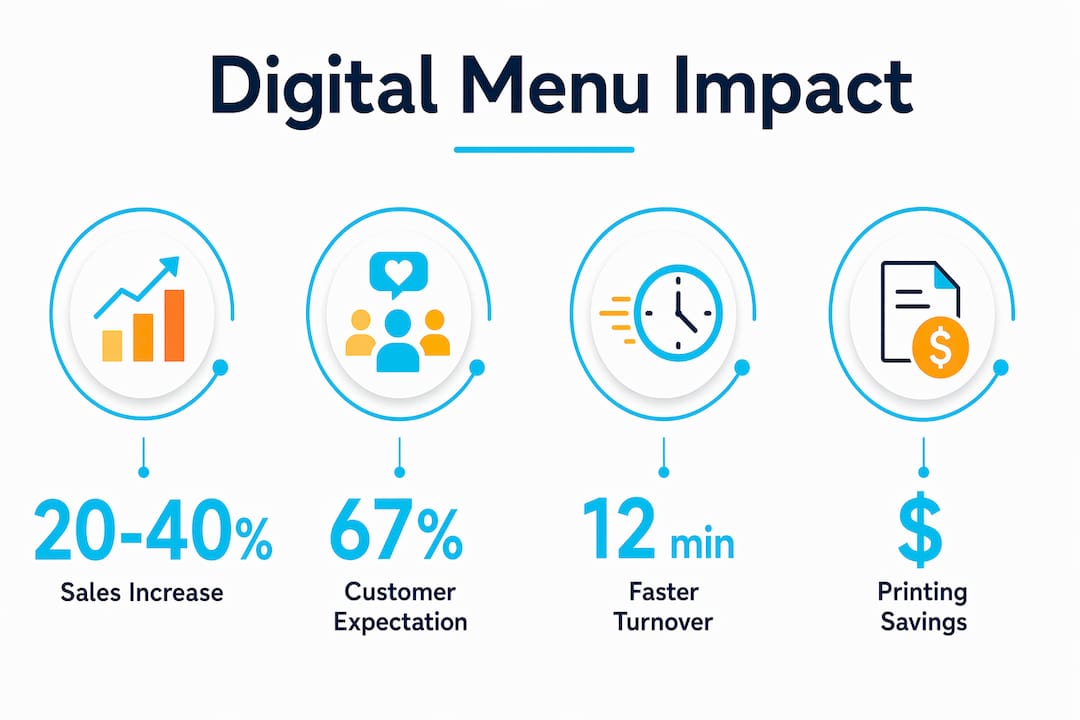
67% of customers now expect digital or QR code menus as standard in full-service restaurants. That expectation is not going away. Meeting it is the baseline. Exceeding it is where you win.
What are the operational and financial advantages of digital menus?
The financial case for digital menus is concrete. The biggest gains come from three areas: table turnover, printing costs, and upsell revenue.

| Advantage | Impact |
|---|---|
| Faster table turnover | QR-based ordering cuts turnover time by 12 minutes, adding meaningful seating capacity per shift |
| Upsell conversion | Digital menu boards improve upsell rates by 10–15% within 90 days of implementation |
| Average check size | Upsell improvements drive a 3–8% increase in average check size |
| Printing cost savings | Typical restaurants save $800–$1,200 annually by eliminating print reprints |
| Update speed | Price changes go live in under 5 seconds versus weeks for printed menus |
A 12-minute reduction in table turnover time sounds small. Across a 50-seat restaurant running two dinner seatings, that adds up to multiple additional covers per night, every night.
The printing cost savings are real but secondary. The bigger win is agility. When your food cost on a dish spikes, you update the price in seconds. When you run out of the salmon, you pull it from the menu before a single customer orders it and gets disappointed. That kind of real-time control is impossible with print.
Independent operators benefit just as much as major chains here. You do not need a large tech budget to run a QR-based digital menu. The advantages of online ordering extend to restaurants of every size, and the cost of entry is lower than most owners expect.
Online menu design best practices that maximize revenue
A digital menu is only as good as its design. A cluttered, poorly organized digital menu performs worse than a well-designed print menu. Curation is everything.
Follow these design principles to get the most out of your digital menu:
- Use real photography, not stock images. Customers can tell the difference. Authentic photos of your actual dishes build trust and drive orders.
- Limit your menu to your best performers. Fewer choices reduce decision fatigue. Feature your highest-margin and most-ordered items prominently at the top of each category.
- ️ Write clear modifier options. If a dish comes with a choice of two sides, show both options clearly. Ambiguity causes customers to abandon the order or call a server, which defeats the purpose.
- Use timed promotions. Digital menus let you show a happy hour special only between 4 p.m. and 6 p.m. That kind of precision is impossible with print.
- Design for mobile first. Most customers accessing your menu via QR code are on a phone. If the layout breaks on a small screen, you lose the sale.
Pro Tip: Apply menu engineering principles to your digital layout. Place your highest-margin items in the top-right position of each category section. Eye-tracking research on both print and digital menus consistently shows that position gets the most attention.
Menu clutter reduces effectiveness in digital formats just as it does in print. The restaurants that see the biggest revenue lifts from digital menus are the ones that treat curation as an ongoing discipline, not a one-time setup task.
The hybrid approach works best for most full-service restaurants. Keep a physical menu available for guests who prefer it. Use the digital menu to handle ordering, upselling, and real-time updates. That combination protects your brand ambiance while capturing all the operational benefits.
How to use digital menu analytics to keep improving
Your digital menu generates data that a printed menu never could. That data is one of the most underused assets in restaurant management.
Here is a practical four-step process for turning menu analytics into revenue:
-
Track item views versus orders. If 200 customers view your lamb chops but only 10 order them, the problem is either the price, the description, or the photo. Test one variable at a time and measure the change.
-
Analyze modifier popularity. If 80% of customers who order your burger choose the bacon add-on, that tells you bacon is a draw. Feature it in the item description and consider making it a default option with an opt-out.
-
Identify peak ordering times. Digital menus capture timestamps on every order. Use that data to schedule your highest-margin promotions during your busiest windows, not your slowest ones.
-
Refine pricing based on conversion data. Item-level data helps adjust pricing and promotions with precision. If a dish converts well at $18 but drops off at $22, you have a clear price ceiling.
Your digital menu also functions as a customer acquisition channel. A well-structured online menu page on your website, with proper item descriptions and schema markup, shows up in Google searches for local food queries. That is free visibility that a printed menu will never generate. Staying current on online ordering trends helps you understand where customer behavior is heading so your menu stays ahead of it.
Key Takeaways
A well-executed digital menu is the single highest-return operational upgrade most U.S. restaurants can make in 2026, combining revenue growth, cost reduction, and customer data in one channel.
| Point | Details |
|---|---|
| Revenue lift is immediate | Digital menus drive a 20–40% average order value increase through photography and upsell prompts. |
| Table turnover improves fast | QR-based ordering cuts turnover time by 12 minutes, adding covers without adding seats. |
| Design determines results | Curation, mobile-first layout, and high-quality photos separate high-performing menus from average ones. |
| Analytics drive ongoing gains | Tracking views versus orders and modifier data lets you refine pricing and promotions with real evidence. |
| Hybrid beats digital-only | Combining digital ordering with physical menus protects brand experience while capturing all efficiency gains. |
Why most restaurants are still getting digital menus wrong
I have worked with enough restaurant owners to know the most common mistake: uploading a PDF of your printed menu and calling it a digital menu. That is not a digital menu. It is a scanned piece of paper on a phone screen. It has no upsell prompts, no analytics, no real-time update capability, and no photography. It delivers none of the revenue benefits we have covered here.
The second mistake I see constantly is treating the digital menu as a one-time project. You set it up, and then you ignore it for 18 months. Meanwhile, your food costs change, items go in and out of season, and your highest-margin dishes are buried under items you barely sell. The agility of a digital menu is only valuable if you actually use it.
The third thing I want to challenge is the fear that digital menus make your restaurant feel cold or impersonal. They do not. Digital menus free your staff from reading off specials and taking orders so they can focus on genuine hospitality. Your servers become hosts, not order-takers. That is a better experience for the guest, not a worse one.
The restaurants I see winning with digital menus treat them as living tools. They update them weekly. They test new photos. They watch the data. They run timed promotions. The technology is simple. The discipline is what separates the operators who see a 30% order value lift from the ones who see nothing.
— Doug
How Ionhospitality helps restaurants get more from their digital presence
Your digital menu is only part of the picture. Getting customers to your restaurant, and to your online ordering page, requires a marketing engine that runs consistently.
Ionhospitality specializes in social media advertising for restaurants across the U.S., building the kind of visibility that fills seats and drives online orders without charging you a commission on every sale. We create content that stops the scroll, puts your food in front of the right local audience, and turns followers into regulars. If you want a clear plan for connecting your digital menu strategy to real customer growth, book a discovery call and we will map it out with you.
FAQ
What is the role of online menus in a restaurant?
Online menus serve as both a customer-facing ordering tool and a revenue management channel. They drive higher average order values through photography, upselling, and self-paced browsing.
How much can a digital menu increase sales?
Restaurants report a 20–40% increase in average order value after adopting digital menus, with upsell conversion rates improving by 10–15% within 90 days.
What makes a digital menu effective?
High-quality food photography, a curated item list, clear modifier options, and mobile-first design are the core features that separate high-performing digital menus from average ones.
Do customers actually prefer digital menus?
67% of customers now expect digital or QR code menus as standard in full-service restaurants, making digital access a baseline expectation rather than a differentiator.
Is a PDF menu the same as a digital menu?
A PDF menu is not a functional digital menu. It lacks upsell prompts, analytics, real-time update capability, and the interactive features that generate measurable revenue gains.

Add a Comment