

TL;DR:
- Social referral marketing leverages existing customers to share incentivized offers through social media channels, increasing new customer acquisition. It results in higher conversion, spending, and retention rates at lower costs compared to paid advertising. Successful implementation requires thoughtful incentives, timing, tracking, and community-building to maximize long-term growth.
Social referral marketing is defined as a strategy where existing customers share incentivized referrals through their social media networks to drive new customer acquisition for your restaurant. Unlike traditional word of mouth, which travels one person at a time, social referral marketing multiplies reach by pushing personal recommendations across Instagram, Facebook, TikTok, and beyond. The industry term you’ll see in academic and trade sources is “referral marketing,” but the social media layer is what separates this from a simple loyalty punch card. According to HubSpot, referred customers generate five times more sales than paid media. That single stat explains why every serious restaurant marketer needs a referral program built for social channels.
What is social referral marketing and why does it work?
Social referral marketing works because trust travels faster than advertising. When a regular at your restaurant shares a discount code with 400 Instagram followers, that post carries more credibility than any paid ad you could run. Personal recommendations convert at a rate paid media simply cannot match.
The numbers back this up clearly:
- Referred customers convert 30% more often than customers acquired through traditional channels.
- Referred customers also spend 25% more on average and buy 18% faster.
- Referred customers retain at 2.1x the rate of paid social customers and generate 30–45% more revenue in year two.
That retention number is the one most restaurant owners miss. You’re not just filling a seat once. You’re acquiring a customer who comes back more often, spends more per visit, and then refers others. The compounding effect is real.
Cost efficiency is the other major advantage. Referral strategies reduce customer acquisition costs by an average of 13%, and incentives as low as $20 can drive results. Compare that to paid social ads, where customer acquisition costs in the restaurant space can run $21 to $377 per new guest. Referrals are not just effective. They are the most cost-efficient acquisition channel available to you.
Pro Tip: Treat your referral program as a community-building tool, not a one-time coupon drop. Customers who feel like insiders refer more often and with more enthusiasm than those who just received a discount.
“Referral marketing amplifies brand sentiment and is ineffective without a quality underlying product or service that naturally encourages sharing.” — Referral Rock
The takeaway here is direct: your food and experience have to be worth sharing. No referral program fixes a bad product. But when your restaurant already delivers, a social referral strategy turns happy guests into a growth engine.
How does social referral marketing differ from other channels?
Not all referrals are the same, and mixing up the categories leads to wasted budget and muddled tracking. Here is how the main types break down for restaurant marketers.

Direct referrals versus social media referrals differ primarily in reach and trust per share. A direct referral happens when a guest tells a friend face to face or via text. A social media referral happens when that same guest posts a referral link or code publicly. Direct referrals carry higher trust per interaction. Social referrals carry far greater volume and visibility.
Influencer marketing and affiliate marketing are often confused with referral marketing, but the distinction matters for your ROI tracking. Influencers are paid creators promoting your brand to their audience. Affiliates earn commissions on sales they drive. Neither requires the promoter to be an actual customer. True referral marketing requires genuine customer advocacy. That authenticity is exactly what makes it more persuasive.
| Channel | Who Promotes | Trust Level | Reach | Best For Restaurants |
|---|---|---|---|---|
| Direct Referral | Existing customer | Very high | Low (1 to 1) | Private events, loyal regulars |
| Social Referral | Existing customer via social | High | Medium to high | New guest acquisition |
| Influencer Marketing | Paid creator | Medium | Very high | Brand awareness campaigns |
| Affiliate Marketing | Commission partner | Low to medium | Variable | Online ordering growth |
| Social Proof (reviews) | Any customer | High | Medium | Conversion on Google, Yelp |
Social proof, like Google reviews and Yelp ratings, is related but distinct. Reviews build credibility for prospects already considering your restaurant. Referrals actively recruit new prospects who were not looking yet. Both matter, and you can read more about why social proof wins guests in a dedicated breakdown.
The key tradeoff: social referrals reach more people but deliver slightly less trust per share than a direct personal recommendation. The solution is to make your referral messages feel personal, not promotional.
How to implement a social referral strategy for your restaurant
A referral program that sits on your website and does nothing is not a strategy. Here is how to build one that actually drives covers and bookings.
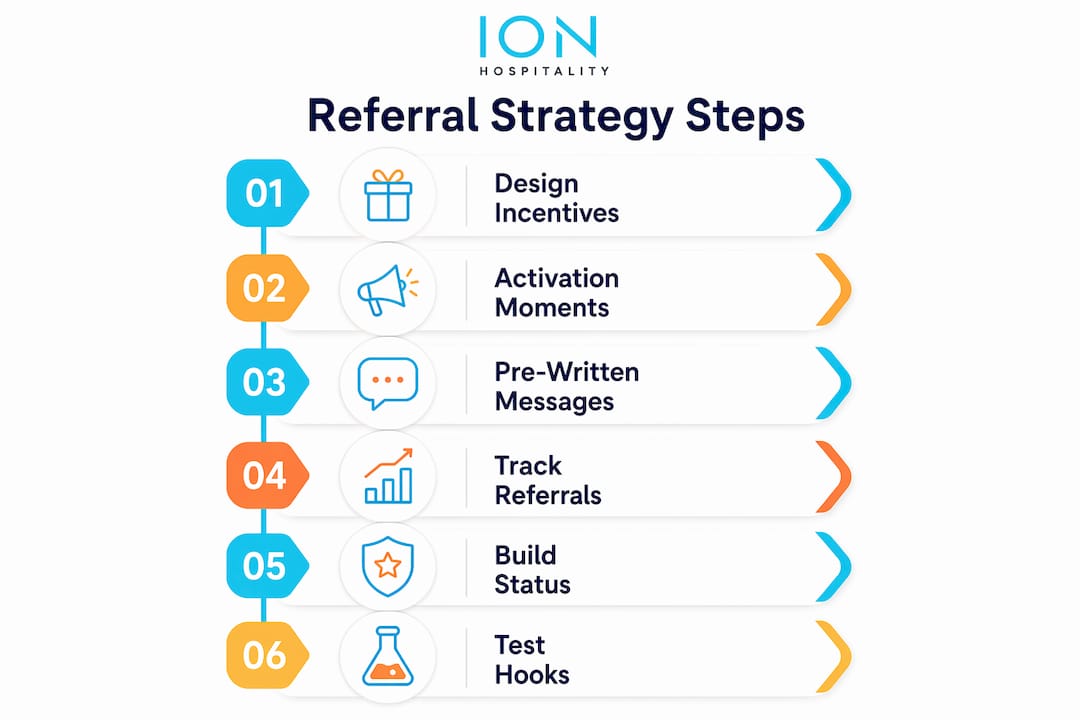
1. Design asymmetric incentives.
Give the referred friend a better deal than the person doing the referring. Asymmetric incentives reduce the social awkwardness of asking someone to try your restaurant. When the friend gets $15 off their first visit and the referrer gets $10 off their next one, the friend has a real reason to act. This structure increases acceptance rates significantly.
2. Identify your activation moments.
The best time to ask for a referral is immediately after a peak experience. A guest just finished a birthday dinner and loved it. That is your moment. Position referral prompts right after these high-value interactions, whether through a follow-up email, a table card, or a post-visit SMS. Waiting 48 hours cuts your conversion rate dramatically.
3. Write the message for them.
Do not ask customers to compose their own referral text. Pre-written, benefit-driven messages reduce friction and increase sharing. Give them a ready-to-post caption for Instagram Stories, a pre-filled text message, or a shareable graphic with their unique code already embedded. The easier you make it, the more they share.
4. Track every referral consistently.
Tracking methods include unique referral links, time-stamped purchase records, and backup tracking through promo code redemption. Social platforms do not always pass clean attribution data, so you need at least two tracking methods running simultaneously. Without accurate data, you cannot improve what is working.
5. Build identity and status into the program.
Leaderboards, tiered rewards, and “VIP Referrer” status create ongoing motivation. Community-led referral engines with identity elements turn one-time advocates into long-term brand ambassadors. Think of your top referrers as an unpaid street team who genuinely love your restaurant.
6. Test your message hooks continuously.
A/B test the subject lines on referral emails, the caption copy on shareable posts, and the incentive amounts. Small changes in wording can produce large changes in share rates. Run tests monthly and document what moves the needle.
Pro Tip: Use Instagram Stories polls and countdown stickers tied to referral offers. The interactive format drives more shares than a static post and keeps your offer visible in followers’ feeds for 24 hours.
Real-world outcomes of social referral marketing in restaurants
The results restaurants see from well-executed referral programs are concrete and measurable. Here is what the data and real scenarios look like in practice.
Booking increases tied to social engagement: Restaurants that actively run social media referral campaigns see 31% more bookings compared to those relying on organic posts alone. That lift comes directly from the amplified reach of customer networks sharing offers with their followers.
The referral multiplier effect: Referred customers make 31%–57% more additional referrals than non-referred customers. This is the multiplier effect, and most restaurants never account for it. Ignoring this downstream value underestimates referral program worth by 20%–36%. You are not just acquiring one guest. You are acquiring a node in a referral network.
A practical scenario: A mid-size Italian restaurant launches a referral program offering $15 off for new guests and $10 back for the referrer. They send a post-visit email with a pre-written Instagram caption and a unique code. Within 60 days, 120 existing customers share the offer. Each share reaches an average of 300 followers. That is 36,000 impressions from customers who already trust the brand, at a fraction of the cost of a paid campaign.
Repeat customer rates climb: Referral participants, both the referrer and the referred friend, visit more frequently than average guests. Pairing your referral program with a repeat customer strategy compounds the retention benefit further.
Referral marketing also pairs naturally with remarketing. Once a referred guest visits once, you can retarget them with ads for private events, seasonal menus, and catering packages. The referral gets them in the door. Remarketing keeps them coming back.
Key takeaways
Social referral marketing is the highest-ROI customer acquisition channel available to restaurants when built with asymmetric incentives, activation-moment timing, and consistent tracking.
| Point | Details |
|---|---|
| Referrals outperform paid ads | Referred customers convert 30% more often and spend 25% more per visit. |
| Cost efficiency is significant | Referral strategies cut customer acquisition costs by an average of 13%. |
| Multiplier effect is real | Referred customers refer 31%–57% more new guests, compounding your program’s value. |
| Timing and friction matter | Ask at peak moments and provide pre-written messages to maximize share rates. |
| Community builds long-term value | Tiered rewards and identity elements turn one-time referrers into ongoing brand advocates. |
Why most restaurants leave referral revenue on the table
I have worked with enough restaurant owners to know the pattern. They run a referral offer once, get modest results, and conclude that referral marketing “doesn’t work for us.” What actually happened is that they treated it like a coupon drop instead of a system.
The multiplier effect from the American Marketing Association’s research is the part that changes everything when you truly internalize it. You are not acquiring one customer. You are acquiring a customer who will refer 31%–57% more people than a non-referred guest, and those people will refer others too. Most operators never measure this downstream chain. They look at the first transaction and stop counting.
The other mistake I see constantly is building a referral program without a great product underneath it. Referral marketing amplifies what already exists. If your food is inconsistent or your service is slow, a referral program accelerates negative word of mouth just as fast as positive. Fix the experience first. Then build the engine.
What I find genuinely exciting about social referral marketing for restaurants is that it is one of the few channels where your existing customers do the heavy lifting. You are not buying attention. You are earning it through people who already trust you. That is a fundamentally different relationship with your marketing spend, and it compounds over time in ways that paid ads never will.
The restaurants winning with referrals in 2026 are the ones treating it as a community program, not a discount program. They give their top referrers status, recognition, and early access to new menu items. They make advocacy feel like belonging. That shift in framing changes everything about how customers engage with the program.
— Doug
Ready to turn your guests into a growth engine?
Ionhospitality builds done-for-you social media marketing and referral campaigns specifically for restaurants. We create the content, run the ads, and set up the systems that turn your happiest guests into your most effective marketing channel, with zero commissions on bookings or orders.
If you want more covers, more private event bookings, and more online orders without managing campaigns yourself, our restaurant social media advertising service is built exactly for that. We handle the strategy, the creative, and the execution. You focus on the food. Book a free discovery call with the Ionhospitality team and see what a referral-powered growth system looks like for your specific restaurant.
FAQ
What is social referral marketing in simple terms?
Social referral marketing is a strategy where your existing customers share referral incentives, like discount codes or exclusive offers, through their social media accounts to bring new guests to your restaurant.
How does a referral program differ from influencer marketing?
A referral program uses real customers who already love your restaurant. Influencer marketing uses paid creators who may not be genuine customers, which is why referrals carry higher trust per share.
What incentives work best for restaurant referral programs?
Asymmetric incentives work best. Give the referred friend a larger reward than the referrer to reduce social friction and increase the likelihood the new guest actually redeems the offer.
How do i track referrals from social media accurately?
Use unique referral links combined with promo code redemption tracking. Running two tracking methods simultaneously protects your data when social platforms do not pass clean attribution.
How quickly should i expect results from a referral program?
Most restaurants see measurable booking increases within 30–60 days of launching a structured referral campaign, especially when referral prompts are tied to high-value customer moments like birthdays or special events.

Add a Comment