

TL;DR:
- Restaurant campaign tracking links marketing efforts directly to customer visits, bookings, and sales to measure true effectiveness. Most restaurants focus on clicks and likes, but the key metrics are actual table visits, orders, and event bookings, tracked using tools like UTM parameters, loyalty scans, and branded links. Effective attribution requires connecting digital data to offline proof points over a 90-day period, enabling better ROI optimization and smarter marketing investments.
Restaurant campaign tracking is the practice of connecting your marketing efforts directly to customer visits, bookings, and sales to measure true campaign effectiveness. Most restaurant owners stop at clicks and likes. That’s a mistake. The real metric is butts in seats, orders placed, and private events booked. Tools like UTM parameters, loyalty program QR scans, OpenTable Boost campaigns, and Toast’s Offers Dashboard now make it possible to trace a customer’s journey from a TikTok ad all the way to a table reservation. This guide shows you exactly how to build that system.
How does restaurant campaign tracking actually work?

Restaurant campaign tracking is the industry term for what marketers call “performance attribution.” It means assigning credit to the right marketing channel for every customer action, from a first ad impression to a coupon redemption at the counter.
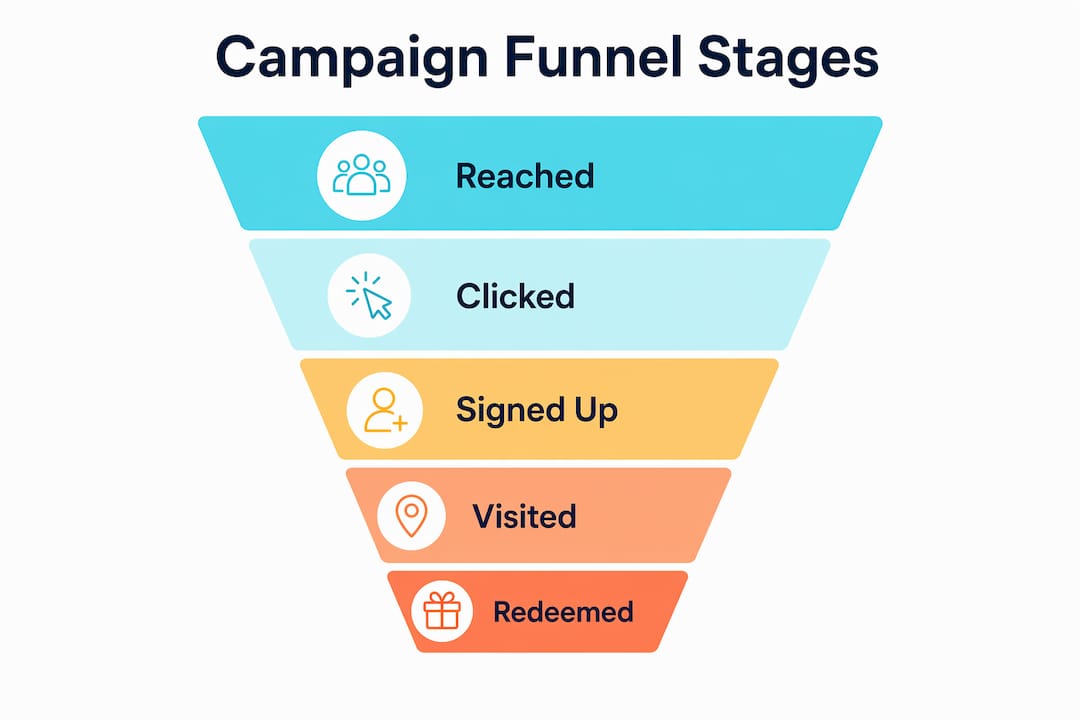
The full campaign funnel covers five measurable stages: Reached, Clicked, Signed Up, Visited, and Redeemed. Each stage requires a different proof point. Reaching someone on Instagram is passive. Getting them to click your link is intent. Getting them through your door is revenue. Most restaurants only track the first two stages, which means they are optimizing for interest, not income.
The core tracking techniques are UTM parameters on every campaign URL, unique booking links per channel, loyalty program scans at the point of visit, and coupon redemption data tied back to specific ads. Platforms like Toast, OpenTable, and Cuttly each play a role in capturing this data at different points in the funnel. When you connect these tools, you get a defensible picture of which campaigns are actually filling tables.
Pro Tip: Set up a simple spreadsheet that maps each campaign to its UTM source, medium, and campaign name before you launch anything. This takes 10 minutes and saves hours of guesswork later.
How does multi-channel attribution work for restaurants?
Multi-channel attribution is the process of assigning credit for a customer visit or booking to one or more marketing channels that influenced that customer along the way. For restaurants, this is harder than it sounds because your customer might see a Facebook ad on Monday, click an Instagram story on Wednesday, and walk in on Saturday.
The challenge is that digital and physical touchpoints do not talk to each other automatically. A click on a Google ad does not know that the same person scanned your QR code at the host stand. Closing that gap requires deliberate setup.
Here is how to do it:
- Unique reservation links per channel. Create a distinct branded URL for your Instagram bio, your TikTok link, your email newsletter, your window QR code, and your SMS campaigns. Branded reservation links with distinct URLs per channel allow precise attribution of bookings by source after about three months of data accumulation.
- QR code scans at the counter. When a guest redeems an offer or checks in via a loyalty app, that scan creates an offline proof point tied to their digital identity.
- Attribution windows. Give your campaigns time. Three months of tracking data is the minimum needed to stabilize performance insights and see which channels consistently drive visits versus which ones just drive clicks.
- Loyalty program tagging. When a customer signs up through a campaign link and then visits, their loyalty profile connects the digital acquisition to the physical visit.
The most common mistake here is treating each channel as a silo. Instagram gets credit for Instagram clicks. Email gets credit for email clicks. But the customer who converted might have touched three channels. Multi-channel attribution gives you a weighted view of what actually moved them.
Pro Tip: Use OpenTable’s Boost campaigns alongside your paid social. OpenTable’s performance tab shows real-time campaign results filtered by status, type, and price, giving you a second data source to cross-reference against your UTM data.
What tools and methods enable effective tracking?
You do not need a massive tech stack. You need the right tools connected in the right order. Here are the five methods that deliver the most reliable dining campaign performance data:
-
UTM tagging on every campaign URL. UTM parameters are free, built into Google Analytics, and work with any platform. Tag every link you share with source (facebook, instagram, email), medium (paid, organic, sms), and campaign name. This is the foundation of any restaurant digital campaign tracking system.
-
Toast’s Offers Dashboard. Toast reports Net Sales Driven, Cost, Redemptions, and ROI for each offer at the offer level. This means you can see exactly which promotion generated revenue versus which one just gave away margin. Offer-based ROI must be calculated as sales driven divided by promotional cost, not just redemption counts. The same number of redemptions can mean very different financial outcomes depending on discount depth.
-
Loyalty program QR scans. Digital loyalty platforms capture customer identity and visit frequency via QR scans at the counter. This closes the loop between a digital ad click and a physical visit. Without this step, you are guessing whether your campaign drove foot traffic.
-
Branded short links with Cuttly or similar tools. Place a different short URL in each marketing location: your Instagram bio, your TikTok profile, your email footer, your window signage, and your SMS blasts. Each URL routes to the same reservation page but carries a unique identifier so you know exactly where each booking originated.
-
OpenTable Boost campaigns. OpenTable’s platform provides campaign performance data directly inside the dashboard, filtered by campaign type and status. This is especially useful for tracking paid reservation campaigns without needing a separate analytics tool.
Here is a quick reference for matching tools to tracking goals:
| Goal | Tool | What it measures |
|---|---|---|
| Track ad clicks to website | UTM parameters + Google Analytics | Source, medium, campaign, conversions |
| Track offer redemptions | Toast Offers Dashboard | Net sales, cost, ROI per offer |
| Track bookings by channel | Cuttly branded short links | Reservations per marketing channel |
| Track in-person visits | Loyalty program QR scans | Visit frequency, campaign-linked visits |
| Track paid reservation ads | OpenTable Boost | Campaign performance by status and type |
Pro Tip: Pilot data from Toast IQ Grow shows restaurants with dedicated marketing managers saw average 8% sales growth and a 4.5x return on ad spend. The difference between those restaurants and the ones that saw nothing? They tracked attribution from ad to visit, not just ad to click.
How to interpret tracked data to optimize restaurant advertising ROI
Collecting data is step one. Knowing what to do with it is where most restaurant owners fall short. Here is how to read your campaign numbers and turn them into better decisions.
Focus on the metrics that map to money:
- Reach tells you how many people saw your campaign. It is a scale metric, not a revenue metric.
- ️ Clicks tell you who was interested enough to act. Compare click-through rates across channels to see which creative and platform resonates.
- ✍️ Signups tell you who entered your funnel. This is where capturing guest contact data becomes critical. If you do not collect an email or phone number at signup, you cannot follow up and you cannot close the loop.
- Visits tell you who actually came in. This is the metric that connects digital spend to real revenue.
- ️ Redemptions tell you who completed the offer cycle. Cross-reference this with Toast’s Offers Dashboard to calculate true ROI per campaign.
Real customer acquisition cost is calculated by dividing total campaign spend by the number of new customers who actually visited and spent money. Not clicks. Not signups. Visits and spend. This number will often surprise you. A campaign that looks expensive on a cost-per-click basis can be extremely efficient on a cost-per-visit basis if the creative targets high-intent diners.
Repeat visits and referrals are compounded ROI factors that most tracking systems ignore. A customer who visits twice and brings a friend has generated three times the value of a single visit. Build a segment in your loyalty program for customers acquired through each campaign and track their 90-day visit frequency. That number tells you the real lifetime value of each marketing channel.
Adjust your budget based on visit data, not click data. If Instagram drives 60% of your tracked visits but only 30% of your ad spend, shift more budget there. If Google Ads drives clicks but no redemptions, cut it or rethink the landing page.
Common pitfalls that break restaurant campaign tracking
Even well-intentioned tracking setups fail. Here are the mistakes that cost restaurants the most clarity and money:
- Stopping at clicks or signups. Campaigns without visit confirmation optimize vanity metrics, not real customers. If your reporting ends at the click, you are flying blind on actual impact.
- Ignoring offline attribution. A customer who saw your ad and walked in without clicking anything still counts. QR code scans and loyalty check-ins are your offline attribution tools. Use them.
- Not capturing guest contact data. If a customer signs up for an offer but you do not collect their email or phone number, you cannot message them again. You have paid to acquire them once and then lost them.
- Reacting to short-term data. One week of campaign data is noise. Three months is a pattern. Do not kill a campaign after seven days because the numbers look flat.
- Pixel tracking failures on booking platforms. Booking platforms may block ad pixels from firing on confirmation pages. This means your Facebook or Google pixel may never register a completed reservation. Use branded short links and UTM parameters as your primary attribution method, not pixels alone.
Pro Tip: Check your booking confirmation page in a private browser window with your pixel helper extension active. If the pixel does not fire on confirmation, you are missing conversion data and your ad platform is optimizing toward the wrong signal.
Key takeaways
Effective restaurant campaign tracking requires linking digital ad data to physical visit proof points across every channel, using tools like UTM parameters, loyalty QR scans, Toast, and OpenTable together.
| Point | Details |
|---|---|
| Track all five funnel stages | Measure Reached, Clicked, Signed Up, Visited, and Redeemed to see true campaign impact. |
| Use unique links per channel | Assign distinct branded URLs to Instagram, TikTok, email, and SMS for precise booking attribution. |
| Calculate ROI from visits, not clicks | Divide total spend by actual customer visits and redemptions to find real acquisition cost. |
| Capture guest contact data | Collect email or phone at signup so you can follow up and track long-term retention. |
| Give campaigns 90 days | Attribution data stabilizes after three months, giving you reliable channel performance insights. |
What I’ve learned after years of tracking restaurant campaigns
Here is the uncomfortable truth: most restaurant marketing fails not because the creative is bad, but because nobody is watching the right numbers. I have seen restaurants spend thousands on Instagram ads, celebrate a spike in profile visits, and then wonder why Tuesday nights are still empty. The creative worked. The tracking did not.
The restaurants that win are the ones that treat their marketing data the way a chef treats a recipe. Every ingredient matters. You cannot swap visits for clicks and expect the same result. When I started connecting UTM data to loyalty program scans and cross-referencing that with Toast’s offer reports, the picture changed completely. Channels that looked expensive on a cost-per-click basis turned out to be the most efficient on a cost-per-visit basis. Channels that looked cheap were driving one-time visitors with no repeat behavior.
The future of this space is AI-powered predictive analytics. Tools like Toast IQ Grow are already showing what happens when machine learning gets applied to customer lifetime value modeling in real time. But the foundation is still the same: you need clean, connected data from digital to physical. No AI can fix a broken attribution setup.
My advice is to start simple. Get your UTM parameters right. Set up one unique link per channel. Connect your loyalty program to your ad campaigns. Then give it 90 days before you draw any conclusions. The restaurants that do this consistently are the ones that know exactly where to spend their next marketing dollar and why.
— Doug
How Ionhospitality helps you track and grow
If you are ready to stop guessing and start measuring, Ionhospitality builds and manages the entire system for you.
Ionhospitality is a social media marketing and advertising agency built specifically for restaurants. We set up your social media advertising campaigns with full attribution tracking from ad impression to table booking, with zero commissions on bookings or private events. Our team handles creative, targeting, and performance reporting so you always know which campaigns are filling seats and which ones need to be cut. Want to see what this looks like for your restaurant? Book a discovery call and we will walk you through a custom tracking setup built around your goals.
FAQ
What is restaurant campaign tracking?
Restaurant campaign tracking is the process of measuring how marketing campaigns drive customer visits, bookings, and sales by linking digital interactions to real-world dining outcomes. It uses tools like UTM parameters, loyalty QR scans, and unique reservation links to attribute revenue to specific campaigns and channels.
How do I track restaurant ads across multiple channels?
Assign a unique branded URL to each marketing channel, including Instagram, TikTok, email, and SMS, and tag every link with UTM parameters. Cross-reference click data with loyalty visit data and offer redemptions in Toast to build a full picture of which channels drive actual visits.
What metrics matter most for restaurant advertising ROI?
The metrics that matter are visits, redemptions, and net sales driven per campaign. Reach and clicks are useful for diagnosing creative performance, but restaurant marketing KPIs tied to revenue, such as cost per visit and redemption rate, are the numbers that determine whether a campaign is worth running again.
Why does my pixel tracking miss restaurant bookings?
Many booking platforms block ad pixels from firing on reservation confirmation pages. This means your Facebook or Google pixel may not register completed bookings as conversions. Use UTM-tagged branded short links as your primary attribution method and treat pixel data as a secondary signal, not the source of truth.
How long should I run a campaign before evaluating results?
Run campaigns for at least 90 days before making major budget decisions. Branded short link attribution and loyalty visit data require three months of accumulation to produce stable, reliable performance insights that reflect true channel behavior rather than short-term noise.

Add a Comment