

TL;DR:
- Tracking offline conversions is crucial because many restaurant bookings occur through calls and walk-ins that website data cannot capture.
- Using tools like GA4, call tracking, and CRM systems, restaurant owners can accurately connect marketing efforts to actual revenue, avoiding costly misinterpretations.
You’re running ads, posting on social media, and maybe even sending email blasts. But when you look at your sales at the end of the month, you’re not sure what actually worked. That gap is where most restaurant owners lose money. Knowing how to track marketing results isn’t just a nice-to-have skill. It’s the difference between spending smart and spending blind. This guide breaks down the exact tools, steps, and metrics you need to connect your marketing efforts to real revenue, from online clicks all the way to confirmed reservations and phone orders.
Table of Contents
- Key takeaways
- How to track marketing results: tools you need first
- Step-by-step setup for tracking campaigns
- Common tracking mistakes that mislead you
- Interpreting your data and growing from it
- My take on tracking for restaurants
- Let Ionhospitality do the tracking for you
- FAQ
Key takeaways
| Point | Details |
|---|---|
| Set up conversion events first | Define trackable actions like confirmed reservations, online orders, and connected calls before running any campaign. |
| Use UTM parameters everywhere | Tag every link in your ads and social posts so you always know which channel drove each visit or sale. |
| Reconcile platform vs. internal data | Ad platforms over-report conversions by up to 30%, so always verify against your own sales records. |
| Track offline conversions too | Call tracking and CRM data close the gap between digital clicks and real-world bookings your analytics would otherwise miss. |
| Review metrics in cycles | Regular analysis of ROI, customer acquisition cost, and conversion rates helps you reallocate budget to what actually drives covers. |
How to track marketing results: tools you need first
Before you touch a single campaign, you need the right infrastructure in place. Think of it like prep work in the kitchen. You don’t start plating before you’ve got your mise en place ready.
Here are the four foundational tools every restaurant needs:
- Google Analytics 4 (GA4): Tracks user behavior on your website, records conversion events like reservation form completions, and connects to your ad platforms.
- UTM parameters: Short tags added to your URLs that tell GA4 which ad, post, or email brought a visitor to your site. No UTMs means no attribution.
- Call tracking software: Tools like CallRail or Marchex log every inbound call, record the source (Google Ads, Facebook, organic), and confirm whether the call actually connected. Call tracking sends conversion data back to your ad platforms automatically.
- CRM or reservation system: OpenTable, Resy, or even a simple spreadsheet where you record confirmed bookings tied to marketing source.
| Tool | What it tracks | Best for |
|---|---|---|
| Google Analytics 4 | Web traffic, on-site behavior, online conversions | Online orders, reservation form submissions |
| UTM parameters | Ad source, medium, campaign | Identifying which post or ad drove traffic |
| Call tracking | Phone lead source, call duration, connection status | Phone reservations, catering inquiries |
| CRM or reservation system | Confirmed bookings, repeat customers | Closing the loop on revenue |
| Meta Ads Manager | Ad reach, clicks, reported conversions | Paid social performance |
Pro Tip: Don’t rely on Meta or Google to tell you what converted. Use their data as a signal, then verify it against your reservation system or order platform.
The piece most restaurant owners skip is offline conversion tracking. Your ads drive phone calls, walk-ins, and private event inquiries that never touch your website. Offline tracking using click identifiers like Google’s GCLID or Meta’s FBCLID bridges that gap by matching ad clicks to confirmed sales.
Step-by-step setup for tracking campaigns
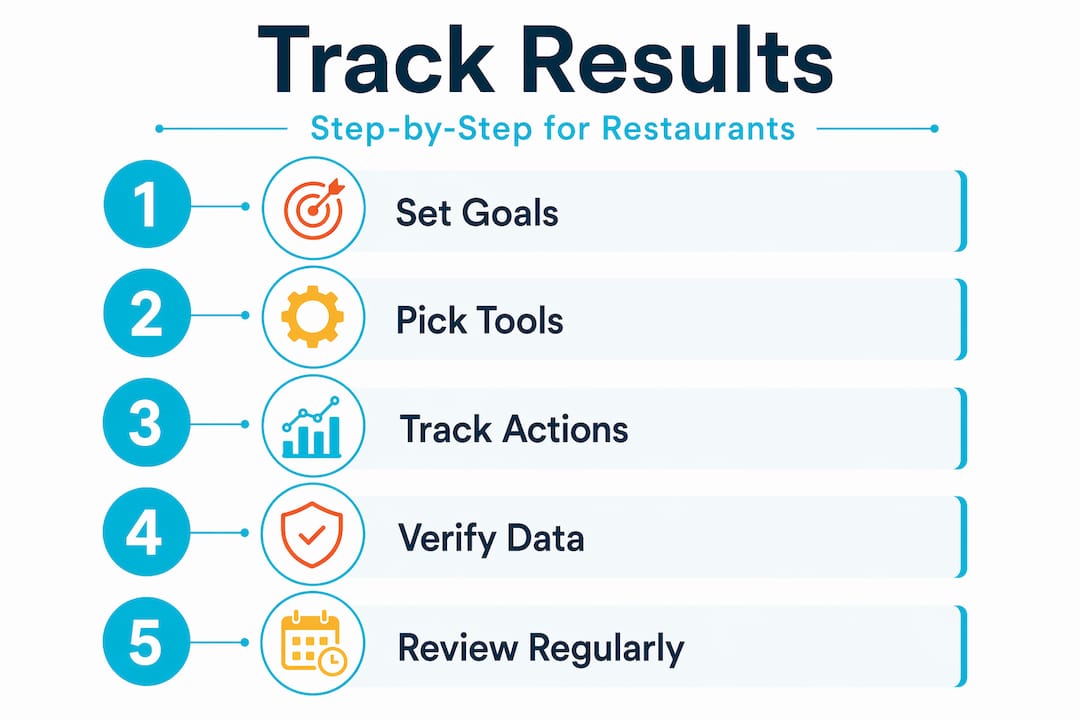
Getting your tracking right takes about two to three hours upfront. Do it once, do it correctly, and your data becomes reliable for every campaign you run after.
-
Define your conversion events. For a restaurant, the most meaningful conversions are: confirmed reservation, completed online order, and connected phone call (minimum 60 seconds). Treat these actions as trackable conversion events from the start. Not “clicked the Reserve button.” Confirmed reservation.
-
Set up GA4 event tracking. Log into GA4 and create custom events for each conversion. Name them clearly: "reservation_complete
,online_order_placed,call_connected`. Then mark each as a key event and assign a value. A reservation might be worth $60 in average spend. Assigning dollar values lets GA4 calculate revenue influence automatically. -
Add UTM parameters to all your links. Every link in a Facebook ad, Instagram bio, email campaign, or Google Ads should have a UTM tag. Use Google’s free Campaign URL Builder. At minimum, include
utm_source,utm_medium, andutm_campaign. Example:utm_source=facebook&utm_medium=paid_social&utm_campaign=valentines_promo. -
Install call tracking. Connect your call tracking software to GA4 and your ad platforms. Set a minimum call duration of 60 seconds before counting it as a conversion. Short or bot calls skew your CPA data significantly if you don’t filter them out.
-
Sync your CRM or reservation data. Export your confirmed bookings weekly and match them against the marketing source recorded in GA4. This reconciliation step is where the real insight lives. You’ll see which channels are sending reservations versus just sending curious browsers.
-
Build a simple dashboard. You don’t need a fancy tool. A Google Looker Studio report connected to GA4 works perfectly. Track: total conversions by channel, cost per acquisition by channel, and conversion rate by landing page.
Pro Tip: Run your restaurant campaigns that drive bookings for at least two weeks before pulling conclusions. Shorter windows give you noise, not signal.
Common tracking mistakes that mislead you
This is where most restaurant owners go wrong. And the mistakes are surprisingly consistent.
- Measuring clicks instead of conversions. Clicks tell you about interest. Confirmed reservations tell you about revenue. Focus on confirmed bookings over button clicks every single time.
- Trusting only ad platform data. Google Ads can over-report conversions by 15 to 30% compared to your actual order system. Always reconcile.
- Ignoring phone call quality. Counting every call as a win inflates your numbers. A 12-second hang-up is not a lead.
- Inconsistent UTM tagging. One team member tags links, another doesn’t. Now your attribution data is full of holes. Make UTM tagging a non-negotiable rule for every outbound link.
- Not separating campaign types. Lumping brand awareness posts and conversion ads into one report makes both look mediocre. Track them separately.
Your tracking is only as good as the events you define upfront. Vague conversion events produce vague insights.
Pro Tip: Do a monthly data reconciliation. Pull your confirmed reservations from OpenTable or Resy, then compare them to what GA4 shows. If the numbers are more than 15% apart, something in your setup needs fixing.
A critical error that gets missed often: closed-loop tracking must map the same conversion types consistently across campaigns. If you track “reservation requested” in January and “reservation confirmed” in February, your year-over-year data is useless. Pick one standard and stick to it.
Interpreting your data and growing from it
You’ve got data. Now what? This is where analyzing marketing performance turns into actual decisions.
Start with three categories of metrics, because business impact, campaign performance, and audience behavior each tell you something different.
Business impact metrics tell you if marketing is paying off:
- Return on ad spend (ROAS)
- Customer acquisition cost (CAC) by channel
- Revenue attributable to marketing campaigns
Campaign performance metrics show what’s working mechanically:
- Conversion rate by channel and ad set
- Cost per reservation or order
- Click-through rate on key ads
Audience behavior metrics reveal how people engage:
- Funnel drop-off points on your reservation page
- Time on page for menu or event pages
- Repeat visitor rate
The goal is to connect these dots. A Facebook ad might show a 4% click-through rate (great campaign performance) but a 0.5% conversion rate on your reservation page (broken landing page). Web analytics measure site behavior while marketing analytics link those behaviors to actual revenue. You need both views simultaneously.
On attribution: last-click attribution works well if you’re running under 500 conversions per month or working with a smaller ad budget. It gives you a clean, simple picture. As your volume grows, consider data-driven attribution, which weighs all touchpoints in a customer’s journey more accurately.
Set a regular measurement review cycle as a non-negotiable calendar item. Weekly for active campaigns, monthly for budget allocation decisions. Check your restaurant marketing KPIs against your goals each cycle and shift spend toward channels with the lowest CAC and highest confirmed conversion rate.
One often-missed insight: ROI evaluation needs the right time horizon. A private events campaign might not pay back in week one. But a guest who books a corporate dinner in week three could be worth $3,000. Give slower-burn campaigns enough time before you cut them.
My take on tracking for restaurants
I’ve worked with restaurant owners at every stage, from single locations nervous about spending $500 a month on ads, to multi-unit groups managing five-figure monthly budgets. The pattern I see most often is that owners either track nothing or track the wrong things.
The biggest misconception I run into is that more data equals more clarity. It doesn’t. I’ve seen dashboards with 40 metrics that tell you nothing useful because none of them are tied to confirmed revenue. What I’ve found actually works is ruthless simplicity: define three to five conversion events that represent real money (confirmed reservation, online order, catering inquiry), build your tracking around those, and ignore everything else until you’ve got that foundation solid.
The online-to-offline gap is the most expensive blind spot in restaurant marketing. You run a great Instagram Reel, someone calls to book a private event, and that revenue never shows up in your ad platform’s dashboard. Call tracking fixes this. I consider it non-negotiable for any restaurant spending money on paid ads.
My advice: start with GA4 and call tracking, get two to three months of clean data, then layer in CRM reconciliation. Don’t try to build the perfect analytics setup on day one. Build the minimum that gives you reliable signal on what’s generating real covers and real revenue.
— Doug
Let Ionhospitality do the tracking for you
At Ionhospitality, we build and manage the full tracking and advertising setup for restaurants. That means social media ads with proper UTM tagging, conversion event configuration, call tracking integration, and regular performance reporting. No guesswork. No spreadsheet headaches.
If you’re ready to stop wondering which posts are filling seats and start seeing the exact numbers, our social media advertising services for restaurants include everything described in this guide, done for you. You can also grab our free retargeting ads playbook to see how we re-engage visitors who didn’t convert the first time. Ready to talk? Book a discovery call and let’s map out your tracking strategy together.
FAQ
What are the most important marketing metrics for restaurants?
Focus on confirmed reservations, cost per acquisition by channel, and revenue per campaign. These three metrics connect directly to business outcomes rather than just website traffic or engagement numbers.
How do you track phone call conversions from ads?
Use a call tracking tool to assign unique phone numbers to each ad source. Count only calls that connect and last at least 60 seconds, since call duration confirms meaningful intent before attributing a conversion.
Why does my Google Ads data differ from my actual sales?
Ad platforms can over-report conversions by 15 to 30% compared to your internal records. Always cross-check your ad platform data against your reservation system or order platform to get accurate ROI numbers.
What is the best free tool for tracking restaurant marketing results?
Google Analytics 4 is the most powerful free option. Pair it with UTM parameters on all your links and you have a solid foundation for measuring marketing effectiveness across every digital channel you use.
How often should I review my marketing analytics?
Check active campaign performance weekly and make budget allocation decisions monthly. Using a regular measurement review cycle keeps your spending aligned with what’s actually driving reservations and orders.

Add a Comment