
TL;DR:
- Private event promotion relies on targeted segmentation, exclusivity tactics, and dark social outreach to fill private dining rooms. Starting early with a structured timeline and measuring outcomes ensures ongoing success and efficiency. Most restaurants neglect consistent promotion, missing opportunities to reliably book private events.
Private event promotion strategies are the planned set of actions restaurants and event coordinators use to attract, engage, and convert guests for exclusive, invite-only dining experiences. The most effective approach combines audience segmentation, personalized outreach, and a timed multi-channel campaign. Generic event marketing falls short here. Private events demand a different playbook, one built around exclusivity, precise timing, and channels your guests actually trust. This guide breaks down exactly how to promote private restaurant events in the U.S., from identifying the right guests to measuring what works.
What are the best private event promotion strategies for restaurants?
Private event promotion in the restaurant context is also called exclusive event marketing. The term covers everything from crafting the initial guest list to sending the final reminder before doors open. The core components are audience targeting, compelling event branding, channel selection, and measurable goals.
You cannot promote a private dinner the same way you promote a public happy hour. The audience is smaller, the expectations are higher, and the messaging must feel personal. Effective event advertising for private events prioritizes quality of reach over volume of reach.
Ionhospitality works with restaurants across the U.S. to build these campaigns from the ground up. The results speak for themselves: private dining rooms that once sat empty on Tuesday nights become booked weeks in advance.
How do you identify and segment your audience for private events?
The first step in any private event promotions guide is knowing exactly who you are inviting. Audience segmentation means dividing your potential guests into groups based on behavior, spending history, and relationship to your restaurant.
Start by building buyer personas for your event. A corporate event coordinator booking a client dinner has different priorities than a couple celebrating an anniversary. Your messaging, pricing, and channel choices should reflect that difference.
Here is how to segment effectively:
- High-value regulars: Guests who visit frequently and spend above your average check. These are your first-tier invites.
- Corporate accounts: Companies that have booked group dining or catering before. Reach them through direct email and LinkedIn outreach.
- Lapsed guests: People who visited once and never returned. A private event invitation can re-engage them.
- Referral prospects: Guests referred by your best customers. They arrive with built-in trust.
Segmented messaging for VIP guests differs from messaging for first-time invitees, and that difference drives higher RSVP rates. Generic invitation blasts consistently underperform tailored outreach.
Pro Tip: Pull your top 20% of spenders from your POS system and treat them as a separate list. Write their invitations as if you are personally calling them. That tone converts.
Data from your reservation system, email open history, and past event attendance all feed into smarter segmentation. The more specific your list, the less you spend on promotion and the more seats you fill.
What marketing channels work best for promoting private events?
The right channel depends on the exclusivity level of your event. Omnichannel event promotion that prioritizes quality over quantity drives more engagement than spreading thin across every platform. Pick the channels where your guests already spend time and go deep there.
For private restaurant events, these channels consistently outperform the rest:
- Personalized email: A direct, one-to-one email with the guest’s name, a specific reason they were chosen, and a clear call to action. No mass-blast templates.
- Dark social channels: WhatsApp, private Facebook groups, and direct messaging. WhatsApp open rates exceed 90%, with click-through rates between 45–60%. That performance gap compared to public channels is significant.
- Private RSVP landing pages: A dedicated page with early-bird pricing, event details, and a single booking button. No distractions.
- SMS: Short, direct, and personal. Works best for final reminders and last-chance availability alerts.
- Social media (targeted): Use paid ads on Instagram and Facebook to reach lookalike audiences based on your existing guest list. Keep the creative exclusive-feeling, not promotional.
Approximately 80% of social sharing for events happens on dark social platforms. Most event planners ignore this entirely. That is a missed opportunity you can capitalize on right now.
Peer recommendations convert at 31.9% conversion rates. Turn your confirmed guests into advocates by giving them a simple, forwardable asset: a single image with event details, or a short voice-note style explainer they can share in their own WhatsApp groups.
For restaurants managing group dining logistics alongside promotion, the group dining workflow guide from Kokcha offers a useful operational framework to pair with your marketing efforts.
How do you structure the promotion timeline for maximum bookings?
Timing is the most underrated element of private event promotion tips. Start too late and you scramble. Start too early without a plan and you lose momentum.
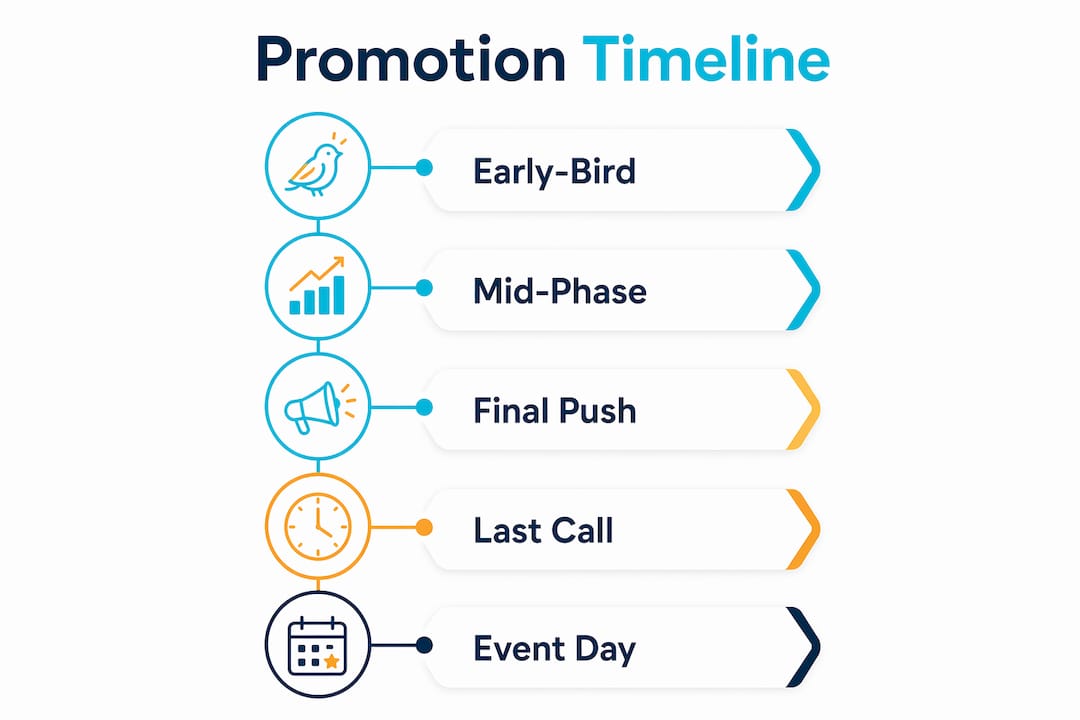
Here is the proven timeline structure:
- 6 months out: Launch your event landing page and open a “super early-bird” pricing window. This creates urgency and captures your most motivated guests first.
- 8–12 weeks out: Begin your full email and social campaign. This is your awareness phase. Promotion for large events should start 8–12 weeks before the date, with smaller gatherings needing 4–6 weeks.
- Weeks 3–6: This is your peak registration window. Focus your budget and energy here. Send follow-up emails, activate your dark social outreach, and push your advocates to share.
- Final 4 weeks: Shift to urgency messaging. “Only 6 seats remaining” is more powerful than any discount. Use SMS and direct messages for last-chance alerts.
- Final week: Confirmation emails, event reminders, and logistical details. Keep guests excited and reduce no-shows.
| Phase | Timing | Primary Goal |
|---|---|---|
| Early-bird launch | 6 months out | Capture motivated guests, build list |
| Awareness campaign | 8–12 weeks out | Broad reach, email and social activation |
| Peak registration | Weeks 3–6 | Convert interest into confirmed bookings |
| Urgency push | Final 4 weeks | Fill remaining seats, reduce hesitation |
| Confirmation phase | Final week | Reduce no-shows, build anticipation |
Sales and marketing teams must stay aligned throughout this timeline. Collaboration between sales and marketing is a direct driver of filling the room with the right guests.
What role does exclusivity play in private restaurant event success?
Exclusivity is not a tactic. It is the entire positioning of a private event. When guests feel chosen rather than invited, their commitment to attending increases dramatically.
Invite-only tactics, tiered rollouts, and waitlists increase perceived scarcity and desirability for VIP events. The mechanics are straightforward, but most planners skip them because they feel complicated.
Here is how to build exclusivity into your promotion:
- Tiered invitation rollouts: Send invitations to your top-tier guests first. Give them a 48-hour window before opening to the next tier. This signals their importance.
- Private RSVP microsites: A dedicated URL with a password or unique link. The friction of accessing it makes the event feel more valuable.
- Waitlist mechanics: Even if you have open seats, a waitlist creates social proof. “Join the waitlist” converts better than “Register now” for exclusive events.
- Invite-only private communities: Create a WhatsApp group or private Facebook group for confirmed guests. Share behind-the-scenes content, menu previews, and chef introductions. This builds buzz before the event even happens.
- Language that signals significance: Replace “You’re invited” with “You’ve been selected” or “We’re reserving a seat for you.” The word choice matters.
Pro Tip: For a tiered invite-only pre-sale, build a curated list of your top 50 guests and contact them personally before any public or semi-public promotion goes out. That first wave of confirmed bookings creates social proof for every wave that follows.
Personalized language tailored to guest interests drives better engagement than generic messaging. A corporate coordinator booking a client dinner responds to different language than a food-obsessed regular. Write for the person, not the list.
How do you measure and improve your event promotion results?
Measurement turns a one-time event into a repeatable system. The goal is to know exactly which channel, message, and timing drove each booking.
QR codes on print materials connect physical promotion to digital booking funnels and create measurable outcomes. A printed invitation with a QR code tells you how many people scanned it, when, and whether they booked. That data shapes your next campaign.
| Metric | What it tells you |
|---|---|
| Email open rate | Whether your subject line and sender name are working |
| Click-through rate | Whether your offer and copy are compelling |
| QR code scans | How effective your print and physical materials are |
| RSVP conversion rate | Whether your landing page and pricing are aligned |
| No-show rate | Whether your confirmation and reminder sequence needs work |
Track open and click rates on every dark social message you send. WhatsApp Business lets you see delivery and read receipts. Use that data to identify which message formats and timing windows perform best. Then repeat what works and cut what does not.
Key Takeaways
The most effective private event promotion combines audience segmentation, exclusivity mechanics, dark social outreach, and a structured timeline to consistently fill private dining rooms.
| Point | Details |
|---|---|
| Segment your guest list | Divide guests by value and relationship before writing a single word of copy. |
| Use dark social channels | WhatsApp and private messaging outperform public channels with open rates above 90%. |
| Start your timeline early | Launch your landing page 6 months out and run your main campaign 8–12 weeks before the event. |
| Build exclusivity into every touchpoint | Tiered invitations, waitlists, and private RSVP pages increase perceived value and bookings. |
| Measure every channel | Use QR codes, email metrics, and RSVP data to improve each campaign over the last. |
What I’ve learned about private event promotion that most guides miss
Most articles on event outreach strategies focus on public events. They tell you to post on Instagram, send a newsletter, and hope for the best. Private restaurant events are a completely different animal.
The biggest shift I have seen in the last few years is the move away from public channels toward private, high-trust messaging. Planners who figured out WhatsApp and personalized email early are filling rooms that others cannot. The data backs this up, but the real insight is behavioral. Guests at private events want to feel chosen. The moment your promotion feels like a broadcast, you have already lost the plot.
The second thing most guides miss is the power of the pre-sale window. Launching a landing page six months out feels premature. But that early-bird window captures your most motivated guests and creates a confirmed base that makes every subsequent wave of outreach easier. You are not selling to a cold room. You are adding to a list that already has momentum.
The third lesson is harder to hear: most restaurants do not promote their private events at all. They rely on word of mouth and the occasional Instagram post. That is not a strategy. It is a hope. The restaurants that consistently book their private dining rooms treat promotion like a campaign, with phases, metrics, and a clear audience. That discipline is what separates full rooms from empty ones.
If you are a corporate event coordinator or a planner working with restaurants, the restaurant event marketing strategies that work are not complicated. They are just consistent.
— Doug
How Ionhospitality helps restaurants book more private events
Filling your private dining room takes more than a great menu. It takes a marketing system built specifically for restaurants.
Ionhospitality specializes in social media advertising for restaurants, including targeted campaigns designed to drive private event bookings. The team builds landing pages, runs retargeting ads, and manages the full promotion cycle so you do not have to. Every campaign runs on a 0% commission model, meaning your revenue stays yours. If you want to see what a purpose-built private event marketing campaign looks like for your restaurant, book a discovery call and get a plan built around your space, your guests, and your goals.
FAQ
What are private event promotion strategies?
Private event promotion strategies are the targeted marketing actions used to fill exclusive, invite-only restaurant events. They include audience segmentation, personalized outreach, dark social channels, and timed promotion phases.
How far in advance should you promote a private restaurant event?
Large events need 8–12 weeks of promotion, while smaller gatherings need 4–6 weeks. Launching a landing page and early-bird pricing 6 months out captures the most motivated guests first.
What is dark social and why does it matter for private events?
Dark social refers to private messaging platforms like WhatsApp and direct email. About 80% of event sharing happens on these platforms, making them the highest-performing channel for private event outreach.
How do you make a private event feel exclusive in your marketing?
Use tiered invitation rollouts, waitlist mechanics, password-protected RSVP pages, and language that signals the guest was personally selected rather than mass-invited.
How do you track the success of a private event promotion campaign?
Track email open rates, click-through rates, QR code scans on print materials, RSVP conversion rates, and no-show rates. Each metric points to a specific part of your campaign that can be improved for the next event.

Add a Comment