

TL;DR:
- Digital advertising transforms restaurant marketing into measurable, targeted campaigns that increase bookings and brand visibility. It allows precise audience targeting, real-time optimization, and timing flexibility, outperforming traditional channels in efficiency and cost control. Consistent digital presence across platforms fosters customer loyalty and clarifies that strategy, not budget, determines success.
Digital advertising is defined as paid online promotion that targets specific audiences by location, behavior, and intent, then tracks every click and conversion in real time. For restaurant owners, this matters more than any other marketing channel because it turns your ad budget from a guess into a measurable investment. Platforms like Facebook Ads and Google Ads let you reach a hungry diner searching “best tacos near me” at 6:45 PM on a Friday. That is not luck. That is precision. Understanding why digital ads matter is the first step toward filling more seats, booking more private events, and building a brand that locals recognize and trust.
Why digital ads matter more than traditional advertising for restaurants
Digital ads give restaurants the ability to target specific audiences by location, demographics, interests, and real-time intent. A radio spot or a newspaper insert reaches everyone in a zip code, including people who never eat out. A Facebook Ads campaign can reach only adults aged 25 to 45 within three miles of your restaurant who have shown interest in dining out on weekends. That gap in precision is the difference between wasted spend and a packed dining room.
The importance of digital advertising becomes obvious when you compare budget efficiency. Traditional channels like print, radio, and direct mail charge flat rates regardless of results. Digital platforms charge only when someone clicks, views, or takes action. You can set daily caps and bid limits so your $500 weekly budget never disappears overnight. This level of control simply does not exist with a billboard.
Timing is another area where digital wins. You can run a lunch special ad from 10 AM to 1 PM on weekdays and shut it off automatically at 1:01 PM. You can promote a Friday night event starting Monday and pause it the moment you hit capacity. That kind of flexibility lets you respond to your actual business needs, not a print deadline from three weeks ago.
- Audience targeting: Reach diners by ZIP code, age, dining habits, and time of day
- Budget control: Set daily caps and only pay for results, not impressions you cannot measure
- ⏱️ Timing precision: Schedule ads around your actual service hours and promotions
- Local intent: Capture diners actively searching for restaurants near them right now
Pro Tip: Run separate ad sets for your lunch crowd and your dinner crowd. Different audiences, different messages, different times. You will spend less and convert more.
How to measure what your restaurant ads actually do
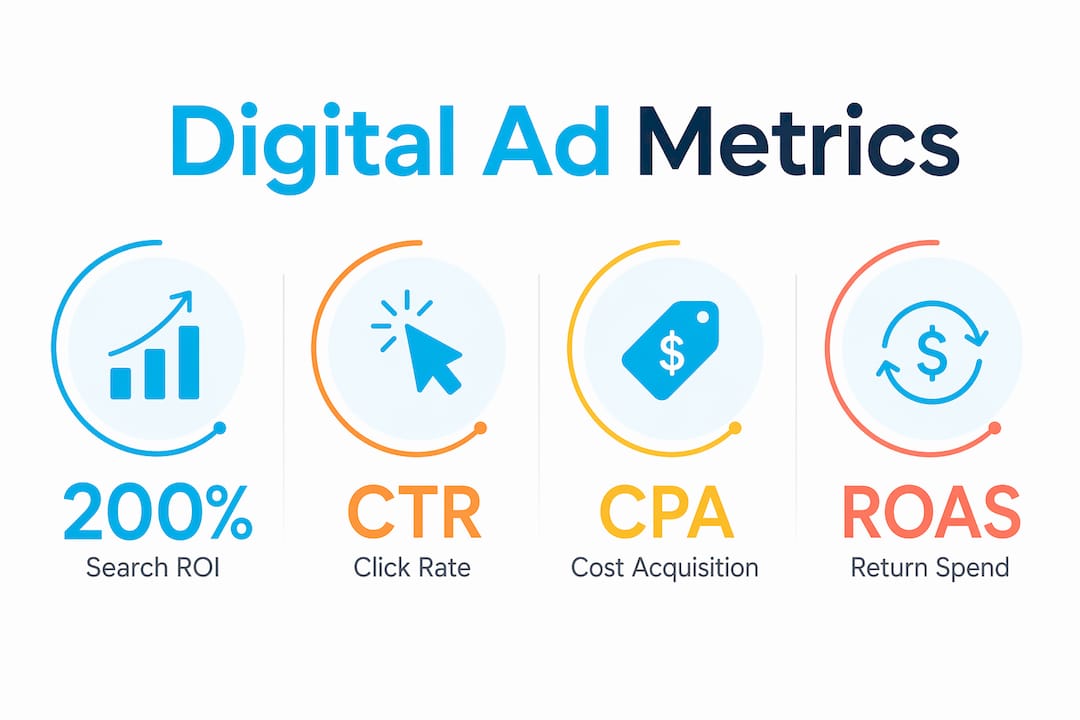
Real-time analysis of impressions, click-through rates (CTR), conversion rates, and cost per acquisition (CPA) allows you to adjust campaigns while they are still running. This is the single biggest operational advantage digital advertising holds over every traditional format. You do not wait until the campaign ends to find out it did not work.
Here is how a practical optimization cycle looks for a restaurant running Google Ads:
- Launch the campaign with two or three ad variations targeting different audience segments or messages.
- Check performance after 72 hours. Which ad has the higher CTR? Which one drives reservations or online orders?
- Pause the underperformer. Shift that budget to the ad that is converting.
- Test a new variable. Change the headline, the image, or the call to action on the paused ad and relaunch it.
- Repeat weekly. Each cycle makes your spend more efficient than the last.
“Digital advertising converts advertising from a speculative expense into a measurable investment by tracking the full customer path from impression to conversion.” This shift in mindset, from expense to investment, is what separates restaurants that grow from restaurants that plateau.
The metrics that matter most for restaurants are not vanity numbers. Impressions tell you reach. CTR tells you relevance. CPA tells you what it actually costs to acquire one new customer. Return on ad spend (ROAS) tells you whether the campaign is profitable. When you know your CPA is $4.50 and your average check is $38, the math makes the decision for you.
Campaign optimization speed and agility also protect you from bad creative. If an ad is not resonating, you know within days, not months. That speed is why the benefits of online ads compound over time. Every test you run makes the next campaign smarter.
How digital ads build restaurant brand visibility and loyalty
Presence on digital platforms is no longer optional. Customers discover restaurants on Google Search, Instagram, Facebook, Yelp, and Google Maps before they ever walk through your door. If you are not showing up in those spaces with paid visibility, a competitor who is spending $20 a day on ads is taking your seat.
Repeated exposure across multiple touchpoints builds recognition. A diner might see your Instagram ad on Monday, Google your name on Wednesday, and book a table on Saturday. That three-touch journey is normal. The role of advertising in the digital age is to stay present across each of those moments so your restaurant is the one they remember when hunger strikes.
The table below shows how digital ad placements map to different stages of the customer decision journey:
| Platform | Customer stage | What it drives |
|---|---|---|
| Instagram / Facebook Ads | Discovery and awareness | New followers, brand recognition, event interest |
| Google Search Ads | Active intent | Reservations, online orders, directions |
| Google Display / YouTube | Consideration and retargeting | Repeat visits, loyalty, upsell opportunities |
| Email retargeting ads | Post-visit loyalty | Return bookings, catering inquiries |
Consistent digital ad presence also supports your organic social media efforts. When someone sees your scroll-stopping reel of a sizzling steak and then gets served a retargeted ad two days later, the combination of organic content and paid promotion creates a recognition loop. That loop is how you boost restaurant brand awareness without relying on word of mouth alone.
The digital marketing impact on loyalty is real. Customers who see your brand consistently across platforms are more likely to choose you over a new competitor, recommend you to friends, and book private events with you rather than searching for alternatives.
Common misconceptions restaurants have about digital advertising
The biggest misconception is that digital ads are just about clicks. Clicks are a signal, not a result. The result is a reservation, an online order, or a private event inquiry. Focusing on revenue-driving metrics rather than vanity clicks is what separates a profitable campaign from one that looks busy but generates nothing.
A second misconception is that any ad on any platform will work. It will not. A restaurant running the same ad on LinkedIn and Instagram will get very different results because the audiences and behaviors on those platforms are completely different. Aligning your channel mix with where your customers actually make dining decisions is what drives real revenue. For most restaurants, that means Facebook, Instagram, and Google. Not LinkedIn. Not Twitter.
Here are the most common mistakes restaurant owners make with digital ads:
- ❌ Running one ad with no testing or variation
- ❌ Targeting too broad an audience to save setup time
- ❌ Measuring success by likes instead of reservations or orders
- ❌ Stopping campaigns after one week because results were not instant
- ❌ Ignoring mobile optimization when most diners search on their phones
Pro Tip: Give any new campaign at least three weeks before drawing conclusions. The algorithm needs time to learn your audience, and you need enough data to make decisions that are statistically meaningful.
Search ads deliver an average 200% ROI when executed with a clear strategy and proper targeting. That number drops sharply when campaigns run without direction or without a strong landing page to capture the click. The ad is only half the equation. Where you send the diner matters just as much.
Why businesses need digital ads is not a philosophical question. It is a practical one. Your competitors are already running them. The question is whether your campaigns are smarter than theirs.
Key takeaways
Digital ads matter for restaurants because they replace guesswork with measurable, targeted campaigns that drive real bookings and brand recognition across every stage of the customer journey.
| Point | Details |
|---|---|
| Precision targeting wins | Reach local diners by location, intent, and behavior instead of broadcasting to everyone. |
| Measure revenue, not clicks | Track CPA, ROAS, and conversions to know exactly what your ad spend is generating. |
| Optimize continuously | Run weekly testing cycles on creative and targeting to improve efficiency over time. |
| Visibility builds loyalty | Consistent presence across Instagram, Facebook, and Google keeps your restaurant top of mind. |
| Strategy beats spend | Aligning your ads with the customer decision journey matters more than increasing your budget. |
What I’ve learned running restaurant ad campaigns that actually fill seats
I have seen restaurant owners spend $2,000 a month on digital ads and get almost nothing back. I have also seen owners spend $400 a month and book out their private dining room every weekend. The difference is never the budget. It is always the strategy.
The mistake I see most often is treating digital advertising like a set-it-and-forget-it tool. You launch a campaign, check it once a week, and wonder why the numbers are flat. Real results come from weekly optimization. You test two headlines. One wins. You test two audiences. One converts. You keep the winner and test something new against it. That cycle, repeated consistently, is what compounds into real growth.
I also think most restaurant owners underestimate how much the landing page matters. You can run a perfect ad and send someone to a slow, confusing website and lose the booking entirely. The ad gets the click. The website closes the deal. Both have to work.
The other thing I push back on is the idea that you need a massive budget to compete. Local restaurant advertising on Facebook and Instagram can be highly effective at $15 to $30 a day if your targeting is tight and your creative is specific. A photo of your actual dish, a clear offer, and a button that says “Reserve Your Table” will outperform a polished generic ad every single time. Specificity wins. Always.
— Doug
Ready to turn your ad spend into real bookings?
Ionhospitality builds and manages social media ad campaigns specifically for restaurants. No generic templates. No shared attention. Every campaign is built around your menu, your location, and your goals, whether that is filling weeknight covers, selling out private events, or growing your catering pipeline.
Ionhospitality handles the targeting, creative, testing, and optimization so you can focus on running your restaurant. There are no commissions on bookings and no long-term contracts that trap you. If you want to see what a properly built restaurant ad campaign looks like, schedule a discovery call and we will show you exactly what is possible for your location and budget.
FAQ
Why do digital ads matter more than print ads for restaurants?
Digital ads let you target local diners by location, intent, and behavior in real time, while print reaches a broad audience with no way to measure results. The ability to track every click and conversion makes digital advertising a measurable investment rather than a fixed expense.
How much should a restaurant spend on digital advertising?
Most local restaurants see strong results starting at $15 to $30 per day on Facebook and Instagram Ads, with Google Ads adding incremental reach for search-intent customers. Budget matters less than targeting precision and creative quality.
What metrics should restaurants track in digital ad campaigns?
The most important metrics are cost per acquisition (CPA), return on ad spend (ROAS), and conversion rate, which measures reservations or online orders generated. Click-through rate is a useful signal for ad relevance but should never be the primary success measure.
How long does it take for restaurant digital ads to show results?
Most campaigns need at least three weeks to generate enough data for meaningful optimization decisions. The algorithm on platforms like Facebook Ads requires time to learn your audience before delivery becomes efficient.
Can digital ads help restaurants fill private events and catering bookings?
Yes. Targeted campaigns on Facebook and Instagram can reach local businesses, event planners, and social groups actively looking for private dining options. Pairing those ads with a strong event marketing strategy significantly increases private booking inquiries.

Add a Comment