

TL;DR:
- Step-by-step holiday marketing involves detailed planning, multi-channel campaigns, and early execution to maximize revenue during peak seasons.
- Restaurants that start planning at least 8 to 12 weeks in advance, segment audiences, and focus on key offers outperform last-minute efforts.
Step by step holiday marketing is the practice of methodically planning, launching, and optimizing seasonal campaigns across defined phases to capture customer interest, fill seats, and maximize revenue during peak festive periods. For restaurants, this structured approach separates the owners who pack their dining rooms every December from those who scramble for last-minute bookings. Holiday campaigns work best with a coordinated multi-channel approach spanning email, social media, paid search, and retargeting, sequenced across campaign phases. The difference between a $10,000 holiday revenue week and a $40,000 one often comes down to how early and how deliberately you planned. This guide gives you the exact framework to do it right.
What do you need before starting your holiday marketing campaign?
Before you write a single email or post a single reel, you need three things: data from last year, clear goals for this year, and a segmented picture of your audience. Skipping this step is why most restaurant holiday campaigns feel scattered and underperform.
Start with a campaign audit. Pull your numbers from last holiday season. What was your average table spend? Which promotions drove the most private event inquiries? Which email subject lines got opened? If you don’t have this data, platforms like Mailchimp, Klaviyo, and Meta Ads Manager all store historical performance you can access today.
Define your commercial objectives. Clear commercial objectives before channel decisions prevent diluted messages and wasted budget. Be specific. “Increase revenue” is not a goal. “Book 20 private dining events in November and December at an average of $2,500 each” is a goal. Set targets for new customers acquired, repeat visit rate, and average order value.
Segment your audience into three groups:
- Existing customers — people who’ve dined with you before. They need loyalty offers and early access.
- Active searchers — people currently looking for holiday dining options. They need visibility through paid search and Google Business Profile.
- Out-of-market prospects — people not yet thinking about holiday dining. They need awareness through social media and retargeting.
Segmenting holiday audiences by these three groups helps tailor messaging and offers effectively, since each segment requires different channels and communication strategies.
| Resource | Purpose |
|---|---|
| Email platform (Mailchimp, Klaviyo) | Segmented sequences and automation |
| Meta Ads Manager / Google Ads | Paid social and search campaigns |
| Google Analytics 4 | Traffic, conversion, and behavior data |
| Canva or Adobe Express | Fast holiday creative production |
| Your POS system | Revenue tracking and customer data |
Pro Tip: Set your team roles before October. Assign one person to own email, one to own social, and one to own paid ads. Campaigns fail when everyone assumes someone else is handling it.
How to build your step by step holiday marketing timeline
The most common mistake restaurant owners make is starting too late. Launching holiday campaigns in October improves conversion rates and reduces ad costs as competition rises toward December. By November, ad costs on Meta and Google spike. By December, you’re paying premium rates to reach customers who’ve already made their plans.
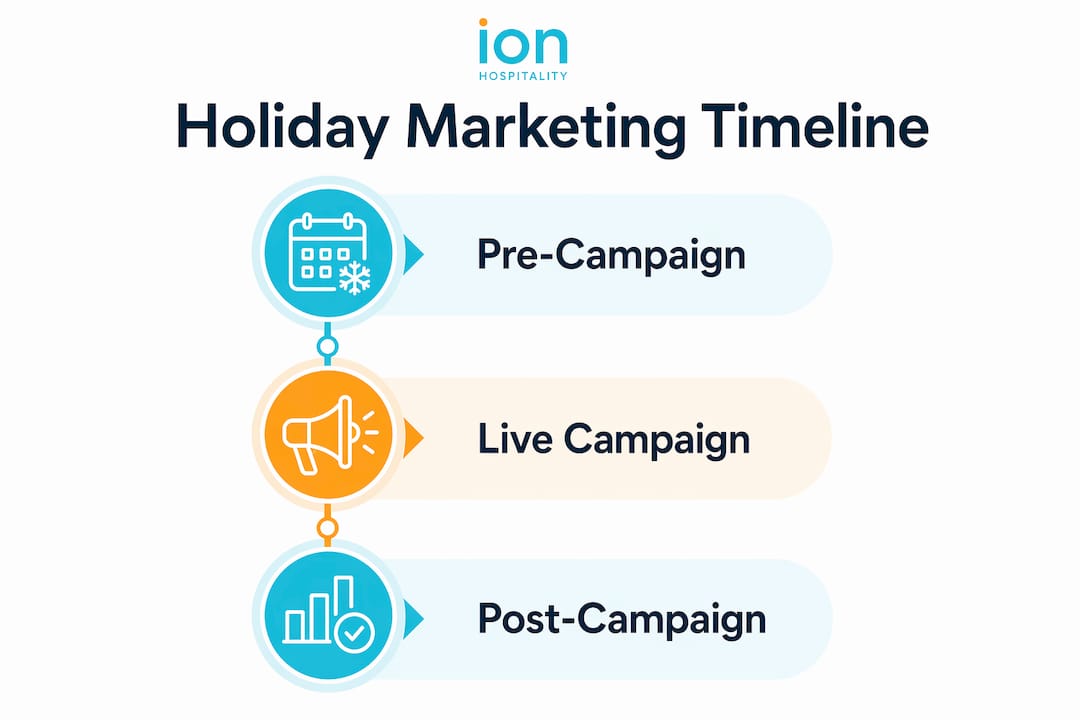
Structure your campaign in three phases:
Phase 1: Pre-Campaign (8 to 12 weeks out)
This is your foundation phase. Build your email list, finalize your holiday menu or private dining packages, create your content calendar, and set up your landing pages. Effective holiday campaigns require 8 to 12 weeks of lead time, with flagship events needing up to 24 weeks. Use this window to test creative, warm up your audience with organic content, and lock in your paid ad targeting.

Phase 2: Live Campaign (4 to 6 weeks)
This is execution mode. Launch your email sequences, activate paid ads, post daily or near-daily on Instagram and Facebook, and monitor performance weekly. Keep your messaging focused on urgency and specific offers, not general holiday cheer.
Phase 3: Post-Campaign (2 to 4 weeks after the holiday)
Most restaurants skip this phase entirely. That’s a mistake. Post-holiday January is an undervalued period to onboard holiday customer cohorts, improving long-term retention and lifetime value. Send a thank-you sequence to everyone who dined with you, offer a January loyalty incentive, and document every campaign result while it’s fresh.
Here’s how the three phases compare in focus and output:
| Phase | Timeline | Primary Focus |
|---|---|---|
| Pre-Campaign | 8 to 12 weeks before | List building, content creation, landing pages |
| Live Campaign | 4 to 6 weeks of execution | Email sequences, paid ads, social posting |
| Post-Campaign | 2 to 4 weeks after | Retention, analysis, documentation |
Pro Tip: Build evergreen holiday landing pages that you update annually instead of creating new seasonal pages. Evergreen landing pages accumulate SEO authority and improve rankings season after season. Redirect old seasonal URLs to the evergreen page to consolidate link equity.
What are the most effective holiday marketing strategies for restaurants?
Now you have your timeline. Here’s what to actually run inside it. The most effective seasonal marketing tactics for restaurants combine personalized email, social media content, retargeting ads, and a focused product strategy.
Email sequences that convert. Don’t send one holiday email blast. Build a sequence: an early access offer for existing customers four to six weeks out, a gift guide or holiday menu reveal three weeks out, a flash sale or limited booking window two weeks out, and a last-chance reminder one week out. Segment your list so loyal customers get VIP pricing and new subscribers get a first-visit incentive.
Social media content that stops the scroll. Your Instagram and Facebook content during the holiday season should feature your actual food and atmosphere. Film a 15-second reel of your holiday cocktail being made. Show a packed private dining room with festive decor. Post a behind-the-scenes clip of your chef plating the holiday special. This content builds desire and urgency without a single discount.
Retargeting ads that recover lost interest. Someone visited your private dining page and didn’t book. Someone opened your holiday email but didn’t click. Retargeting ads on Meta bring those people back. Combining holiday deadlines with time-sensitive trigger offers creates a double layer of urgency, boosting customer action significantly. A 25-minute personal offer layered on top of a 3-day holiday event deadline outperforms either tactic alone.
The restaurants that win the holiday season don’t promote everything. They pick their best 2 or 3 offers and go deep on those. Broad catalog promotions underperform compared to focused hero showcases. Focusing on 5 to 15 hero products using data-driven selection creates a frictionless experience and improves conversions.
Pro Tip: Coordinate your email send times with your social posts and ad launches. If your email goes out Tuesday morning, your retargeting ad should activate Tuesday afternoon. Synchronized timing builds momentum and makes your brand feel everywhere at once.
How should you measure and optimize your holiday campaign results?
Tracking performance during a live campaign is not optional. It’s how you protect your budget and improve results in real time. Here’s the process:
-
Set your KPIs before launch. Define your targets for conversion rate on private event inquiries, average booking value, new customer acquisition cost, email open rate, and overall campaign ROI. Write these down before the campaign starts so you have a benchmark to measure against.
-
Monitor weekly, not monthly. Check your Meta Ads Manager and Google Analytics every Monday during the live campaign phase. Look for ads with declining click-through rates and swap in fresh creative. Look for email subject lines with low open rates and A/B test a new version.
-
Run a post-campaign review session. Block two to three hours within one week of the campaign ending. Document what worked, what didn’t, and what you’d change. This session is the single highest-ROI activity you can do for next year’s campaign.
-
Apply learnings to compound growth. Restaurants that document and apply campaign learnings year over year build a compounding advantage. Your 2027 holiday campaign will outperform your 2026 campaign because you’ll know exactly which offers, channels, and timing drove results.
| KPI | What it tells you |
|---|---|
| Private event inquiry conversion rate | Whether your landing page and offer are compelling |
| Email open rate | Whether your subject lines and send times are working |
| Retargeting ad click-through rate | Whether your creative and urgency messaging land |
| Average booking value | Whether your upsell and package strategy is effective |
| New customer acquisition cost | Whether your paid spend is efficient |
Pro Tip: Don’t wait until January to analyze December results. Set a calendar reminder for December 28th. Your memory of what happened and why is sharpest within the first week after the campaign ends.
What challenges do restaurant marketers face in holiday campaigns?
Even well-planned campaigns hit obstacles. Knowing what’s coming lets you sidestep the most common ones.
-
Discount fatigue. Running too many promotions trains your customers to wait for deals. Limiting major discount campaigns to 6 to 8 annually prevents discount fatigue and preserves your margins. Create quiet periods between campaigns so your holiday events feel genuinely special.
-
Mobile-heavy traffic on a slow website. Most of your holiday traffic arrives on mobile. A landing page that loads in more than three seconds loses a significant portion of visitors before they even see your offer. Test your restaurant website speed on mobile before every campaign launch.
-
Overlapping campaigns creating mixed messages. Thanksgiving, Christmas, New Year’s Eve, and Valentine’s Day all cluster within a few months. Plan each campaign with its own distinct visual identity and offer so customers don’t experience message blur.
-
⏰ Starting too late. A campaign launched in late November for a December holiday is already behind. You’re paying higher ad costs, competing with saturated inboxes, and missing the early-decision customers who book weeks in advance.
-
No clear positioning. The restaurants that get lost in holiday noise are the ones without a clear answer to: “Why should someone choose us over every other option this holiday season?” Define your positioning before you define your channels.
Key takeaways
Restaurants that execute step by step holiday marketing with defined phases, early timelines, and segmented audiences consistently outperform those that treat the holidays as a single promotional moment.
| Point | Details |
|---|---|
| Start in October | Early campaign launch captures larger wallet share at lower ad cost before competition peaks. |
| Use three campaign phases | Pre-Campaign, Live Campaign, and Post-Campaign each serve a distinct purpose and drive compound growth. |
| Segment your audience | Existing customers, active searchers, and out-of-market prospects need different messages and channels. |
| Focus on hero offers | Promote 2 to 3 signature packages or menu items deeply rather than your entire catalog. |
| Document and apply learnings | A post-campaign review session within one week of closing drives measurable improvement year over year. |
Why most restaurant holiday campaigns leave money on the table
I’ve worked with restaurant owners across every type of holiday campaign, from intimate New Year’s Eve dinners to large-scale corporate holiday buyouts. The pattern I see most often is not a lack of effort. It’s a lack of sequence. Owners post on Instagram the week of Thanksgiving and wonder why the private dining room isn’t full. The customers who book holiday events make those decisions in October, sometimes September. By the time you’re posting last-minute, those customers are already committed somewhere else.
The other thing I’ve noticed is that the restaurants winning the holiday season are not necessarily the ones with the biggest budgets. They’re the ones with the clearest offer and the most consistent presence over a 10 to 12 week window. A focused multi-channel holiday approach that starts early, targets the right segments, and tracks results weekly will outperform a last-minute spend every time. The data backs this up, and so does every post-campaign review I’ve ever sat in on.
Start earlier than feels necessary. Be more specific than feels comfortable. And treat January as the beginning of next year’s holiday campaign, not the end of this one.
— Doug
How Ionhospitality helps restaurants win the holiday season
Running a full holiday marketing campaign while managing a restaurant is genuinely hard. Ionhospitality specializes in social media advertising and retargeting campaigns built specifically for restaurants, handling everything from content creation to paid ad management with zero commissions on bookings.
We build tailored holiday campaigns that drive private event bookings, fill seats during peak periods, and create the kind of word-of-mouth that carries into the new year. If you want a personalized strategy built around your restaurant’s specific goals and calendar, book a discovery call with our team. We’ll map out your holiday marketing plan together and show you exactly where the biggest opportunities are for your location and concept.
FAQ
When should restaurants start holiday marketing?
Restaurants should launch holiday campaigns in October to capture early-decision customers at lower ad costs. Waiting until November means competing in a saturated market at significantly higher paid media rates.
What is a three-phase holiday campaign framework?
The three-phase framework divides campaigns into Pre-Campaign (planning and list building), Live Campaign (execution and monitoring), and Post-Campaign (retention and analysis). Each phase serves a distinct purpose and the full sequence drives stronger results than focusing only on the live execution window.
How many holiday promotions should a restaurant run per year?
Limiting major discount campaigns to roughly 6 to 8 per year prevents customer discount fatigue and protects margins. Quiet periods between promotions make each holiday event feel more exclusive and urgent.
What KPIs matter most for restaurant holiday campaigns?
The most important KPIs are private event inquiry conversion rate, email open rate, retargeting ad click-through rate, average booking value, and new customer acquisition cost. Tracking these weekly during a live campaign lets you adjust creative and offers before budget is wasted.
How do you market a restaurant for a specific holiday event?
Focus on one to three signature offers, build a segmented email sequence, activate retargeting ads for website visitors who didn’t convert, and coordinate your social content with your email send schedule. Step by step event marketing works best when every channel reinforces the same message and deadline.

Add a Comment