

Budget 3–6% of gross revenue if you’re an established restaurant, but don’t stop there. The sharper method: figure out how many net new covers you need this month, cap what you’ll pay to acquire each one, then build your budget from that number up. The percentage is a checkpoint, not a plan.
Do these three things this week:
- Pick your covers target. Decide how many net new covers or online orders you need this month, not “more business.”
- Set a CAC ceiling. Take your gross margin per cover and use it to cap what you’ll pay to acquire a customer through any channel.
- Reserve a marketing tax. Set aside 15–25% of your total budget for subscriptions, loyalty redemptions, and small vendor fees that eat spend without anyone noticing.
The SBA’s guidance on small-business marketing budgets backs this up: prioritize measurement over volume. Toast’s benchmark of 3–6% gives you a sanity check. RestaurantVelocity’s covers-to-CAC method gives you the actual math.
Key Takeaways
The most reliable restaurant marketing budget starts with a covers target and CAC ceiling, then checks itself against the 3–6% revenue guideline.
| Point | Details |
|---|---|
| Build from covers, not percentages | Set your net new covers target and CAC ceiling first, then let the percentage follow. |
| Reserve a marketing tax | Set aside 15–25% of total spend for subscriptions, loyalty redemptions, and small vendor fees. |
| Test before scaling | Give paid channels 30–60 days or 50 conversions before deciding to scale or cut them. |
| Front-load new openings | Concentrate 8–15%+ of revenue in the 90 days before and 180 days after opening. |
| Get expert help when time-strapped | Ionhospitality manages paid social, content, retargeting, and tracking for owners without 5+ hours a week to run campaigns themselves. |
Table of Contents
- How much should a restaurant marketing budget be?
- What KPIs should your restaurant marketing budget track?
- What does a sample restaurant marketing budget look like?
- Where should each dollar of your restaurant marketing budget go?
- How often should you review and reallocate your marketing budget?
- What are the best low-cost marketing tactics for restaurants?
- When does it make sense to hire a restaurant marketing agency?
- Ready to put your marketing budget to work?
- Where can you find more restaurant marketing budget resources?
- Frequently asked questions
- Sources
How much should a restaurant marketing budget be?
The 3–6% guideline applies to restaurants that are already established, profitable, and not trying to reinvent themselves. If that’s you, start there and adjust based on what your covers/CAC math tells you.
Growth mode changes the math. If you’re expanding hours, adding a second location’s worth of demand, or pushing hard into catering, plan for 6–8% of revenue. You’re paying to build awareness faster than organic word of mouth can carry it.
New restaurant openings run hotter still, especially in saturated markets where other spots are fighting for the same lunch crowd. Front-load that spend. The 90 days before opening and the 180 days after are when you’re building the habit loops that determine whether year two is profitable or a slog.
Seasonality should shift your allocation too. If a portion of the year drives most of your covers, don’t spread your budget evenly across the entire year. Concentrate it where the demand already is, and pull back hard during your slow stretch.
Pro Tip: Budget a “marketing tax” line worth a significant share of your total marketing spend. This covers loyalty program redemptions, review management subscriptions, and the small vendor fees that never show up in a campaign report but quietly drain the account every month.
What KPIs should your restaurant marketing budget track?
A budget without KPIs is just a hope. Track these:
- Net new covers — the actual number of first-time or lapsed guests who came back.
- CAC — what it cost to acquire each new cover across a channel.
- LTV — average check times visit frequency times how long a guest sticks around.
- Online orders attributed to specific campaigns, not just total order volume.
- Private booking leads generated per dollar spent.
- Email/SMS revenue per dollar, which is often your highest-margin line.
Simple formulas make this workable. CAC ceiling equals your gross margin per cover multiplied by how many visits you’re willing to wait for payback. LTV equals average check times visit frequency times customer lifespan in months. You don’t need a data scientist. You need a spreadsheet and the discipline to fill it in.
Set your tracking floor at covers, attributed online orders, email/SMS revenue, and a rough return on ad spend (ROAS) per channel. Use coupon codes, tracked landing pages, and UTM-tagged links to know which dollar did what. Review spend against conversions weekly, and reconcile the full budget against revenue monthly. Anything less and you’re flying by feel, which is exactly the headwind senior marketers keep running into even with better tools at their disposal.
What does a sample restaurant marketing budget look like?
Numbers land better than percentages. Here’s how three different revenue tiers translate into an actual annual plan, based on RestaurantVelocity’s revenue-tier framework:
Smaller operations run a higher percentage because fixed costs (a basic website, a photographer for a day, an email platform subscription) don’t shrink just because revenue is lower. That tracks with Sprout Sage’s cost data showing single-location independents typically spending $1,500 to $3,000 a month regardless of exact revenue.
Break each tier into line items:
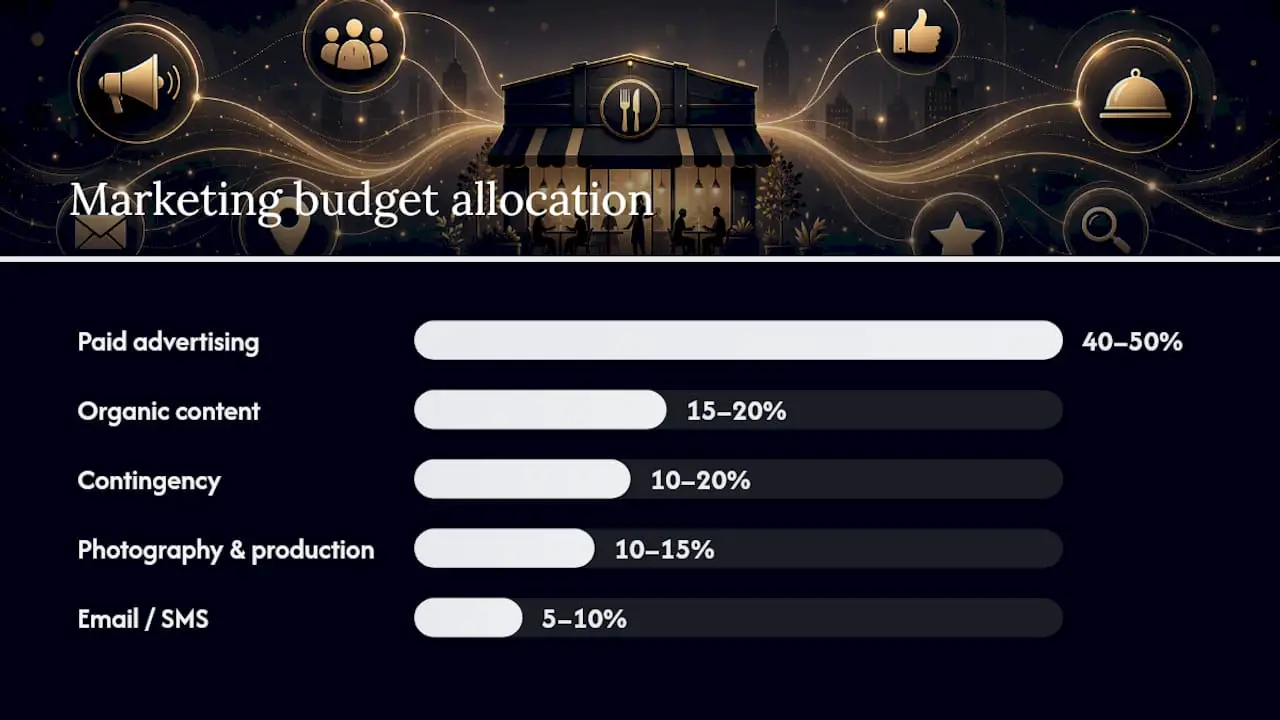
- Paid advertising: 40–50% of the total, split across Meta, Google, and TikTok based on where your covers actually come from.
- Organic content and community management: 15–20%, covering the photos, reels, and replies that keep your feed alive between paid pushes.
- Email/SMS: 5–10%, disproportionate to its share because the ROI per dollar is usually the highest line in the budget.
- Photography and content production: 10–15%, since paid ads without fresh creative burn out fast.
- Loyalty and discount liability: 5–10%, the redemption cost of whatever program you’re running.
- Tools and subscriptions: 5%.
- Contingency: 10–20% of monthly spend, held back so you can double down mid-campaign when something’s clearly working. If you’re managing this across multiple locations, the math shifts again since shared creative and centralized ad accounts change your per-unit cost.
To convert covers/CAC into these line items, split acquisition versus retention roughly 60/40 for a growth-stage restaurant, closer to 40/60 for an established one where repeat guests already carry most of your revenue.
Where should each dollar of your restaurant marketing budget go?
Not every channel deserves the same allocation, and treating them all equally is one of the fastest ways to waste money.
- Google Ads: Best for capturing people already searching “restaurants near me” or your cuisine type. Cost-per-click varies by market, but this channel earns its budget on intent, not reach.
- Meta (Facebook and Instagram) Ads: Strong for local awareness and retargeting people who’ve visited your site or app but haven’t booked. Split budget 70/30 toward retargeting once you have traffic flowing; cold audiences burn money fast without a retargeting pool behind them.
- TikTok Ads: Built for discovery, especially with a younger demographic and food content that performs well as short video. Test with small daily budgets before committing real spend.
- Email/SMS platforms like Mailchimp or Constant Contact: Consistently deliver some of the highest ROI per dollar in the entire budget because you already own the list.
- Video and connected TV (CTV): Best for long-term brand building, not immediate conversion. Budget here only after your acquisition and retention lines are covered.
- Direct mail and print: Still works for hyper-local geographic targeting, but expect a smaller, slower-moving audience than digital.
Adwave’s phased framework recommends tight budgets stay concentrated on owned and local search channels, growth budgets add paid social, and established operations run always-on campaigns across search, social, and streaming.
Pro Tip: Every dollar you send through a third-party delivery app comes with a commission that functions as a hidden acquisition cost. Building your own online ordering system doesn’t just save commission fees. It gives you first-party customer data you can actually market to later.
How often should you review and reallocate your marketing budget?
Give a paid channel 30 to 60 days, or roughly 50 conversions, before you decide whether it’s working. Anything shorter and you’re reacting to noise. Below $1,000 a month, most paid channels won’t generate enough data to optimize, so treat that as your practical floor for testing.
Run a light weekly check on spend versus conversions, and a formal monthly reallocation meeting where you actually move money. Your monthly checklist should cover channel ROAS, CAC against your ceiling, retention metrics, email list growth, creative performance, and whether spend is pacing correctly against seasonal demand.
The decision rules are simple: scale a channel that’s hitting your ROAS and CAC targets over the full test window. Pause anything trending below 2x ROAS for 60 days straight unless you have a specific, correctable reason. Use UTMs, tracked phone numbers, and POS integration for campaign tracking so attribution isn’t a guessing game, and lean on frameworks like LTV, CAC, and payback period analysis to know whether a channel is actually profitable once you account for how long a guest sticks around.
What are the best low-cost marketing tactics for restaurants?
Cash-strapped doesn’t mean powerless. These moves cost time more than money, and they compound because you own the channel:
- Optimize your Google Business Profile with fresh photos and prompt review responses.
- Run targeted email/SMS re-engagement campaigns to lapsed guests.
- Promote loyalty offers to your existing list instead of chasing new faces.
- Host a low-cost community event (a wine tasting, a chef’s table night) that generates its own content.
- Partner with a neighborhood business for cross-promotion to their list.
- Turn guest photos and videos into your next week of social content.
A lapsed guest who gets a “we miss you” email with a small offer, then sees a retargeted ad from your Instagram the same week, often returns within 30 days. That’s two owned channels working together for close to zero incremental spend.
What templates and tools should you use to build your budget?
Toast offers a restaurant marketing budget template built for POS integration. A basic Google Sheet works fine for smaller operations. Use Google Ads and Meta Ads Manager for paid campaigns, and Mailchimp or Constant Contact for email. Add paid tools like review management or loyalty platforms only once organic traction slows.
When does it make sense to hire a restaurant marketing agency?
If you don’t have 5 or more hours a week to run and optimize campaigns, or you need creative and retargeting that actually brings guests back, that’s when an agency earns its fee. Most owners I talk to underestimate how much ongoing optimization paid campaigns require. Setting up a Meta ad once and letting it run for three months isn’t a strategy. It’s a slow leak.
Ionhospitality handles social media advertising and management, geo-targeted and retargeted campaigns, content production, and website development with ordering and reservation integrations built in, plus the campaign tracking to know what’s actually working. Engagements typically start with a discovery call, then move into either a project scope or an ongoing retainer, depending on whether you need a one-time push or always-on management.
Ready to put your marketing budget to work?
Ionhospitality is the alternative to guessing your way through ad spend. We build the campaigns, create the content, and manage the retargeting so your budget goes toward covers booked and orders placed instead of trial and error.
Most restaurant owners we talk to have already tried running ads themselves and hit the same wall: no time to check performance daily, no clear read on what’s actually converting. That’s exactly the gap our social media advertising service closes, with geo-targeted and retargeted campaigns built specifically for full-service restaurants trying to grow covers, online orders, and private event bookings.
Book a discovery call and you’ll walk away with a quick audit of your current marketing and a recommended set of priorities for the next 90 days. No obligation, just a clear next step.
Where can you find more restaurant marketing budget resources?
- Toast’s restaurant marketing budget guide includes a downloadable template and the standard 3–6% benchmark.
- National Restaurant Association’s 2026 industry outlook covers the cost and demand trends shaping this year’s budgets.
- Sprout Sage’s restaurant marketing cost breakdown compares DIY tool costs against typical agency retainer pricing.
- Adwave’s phased marketing guide breaks down recommended monthly spend by channel and growth stage.
Frequently asked questions
What percentage of revenue should a restaurant spend on marketing?
How much should a new restaurant spend on marketing before opening?
What’s the minimum ad budget to see real results?
Most channels need at least $1,000 a month to generate enough data for meaningful optimization. Below that, you’re mostly guessing.
How often should I review my restaurant marketing budget?
Check spend against conversions weekly, and hold a formal reallocation review monthly. Give any new paid channel 30 to 60 days before deciding to scale or cut it.
What’s the highest-ROI marketing channel for restaurants?
Email and SMS marketing consistently deliver strong returns because you already own the list, making the cost per incremental cover low compared to paid social or search.
Sources
- Creating a Restaurant Marketing Budget — Toast
- Restaurant Advertising: A Complete Marketing Guide (2026) — Adwave

Add a Comment