

The best facebook.com alternatives right now are Mastodon (decentralized, ad-free, chronological feeds), Discord (active topic-based communities with voice and events), Telegram (broadcast channels and secure group chat), Nextdoor (hyperlocal neighborhood reach), and Mighty Networks or Circle (owned, paid community hubs). Global social media usage has passed 5 billion users — more than 68% of the world population., which means that the ecosystem is far bigger than Facebook alone. The right pick depends on whether you need reach, privacy, community control, or monetization.
Quick picks by use case:
- 🏘️ Mastodon — chronological feed, no ads, federated servers; best for privacy-first communities
- 💬 Discord — real-time chat, voice, roles, and events; best for active, engaged groups
- 📣 Telegram — large public channels and bot automation; best for announcements and broadcasts
- 📍 Nextdoor — geography-based neighborhood structure; best for local business discovery
- 💰 Mighty Networks / Circle — paid memberships, courses, events; best for owned community revenue
- 📸 Instagram — visual content and commerce; best for restaurant marketing and food photography
Table of Contents
- How do the top Facebook alternatives compare side by side?
- How do you pick the right platform for your goals?
- What does each platform actually do, and who is it best for?
- How do you move a Facebook group or page without losing your members?
- What actually changes when you leave Facebook’s privacy and ad model?
- Which platform should you use for each specific goal?
- Key Takeaways
- The platform strategy most restaurants get wrong
- Ionhospitality helps restaurants replace Facebook reach with campaigns that actually convert
- Useful sources and further reading
How do the top Facebook alternatives compare side by side?
How we evaluated these platforms: Each platform was assessed across nine dimensions: best-fit use case, primary content types, audience reach, privacy and tracking model, moderation tools, discoverability vs. closed-group balance, business and monetization tools, cost, and decentralized/federated support. Data sources include StatCounter’s global social media stats, UNLV’s platform guidance, and official platform documentation.
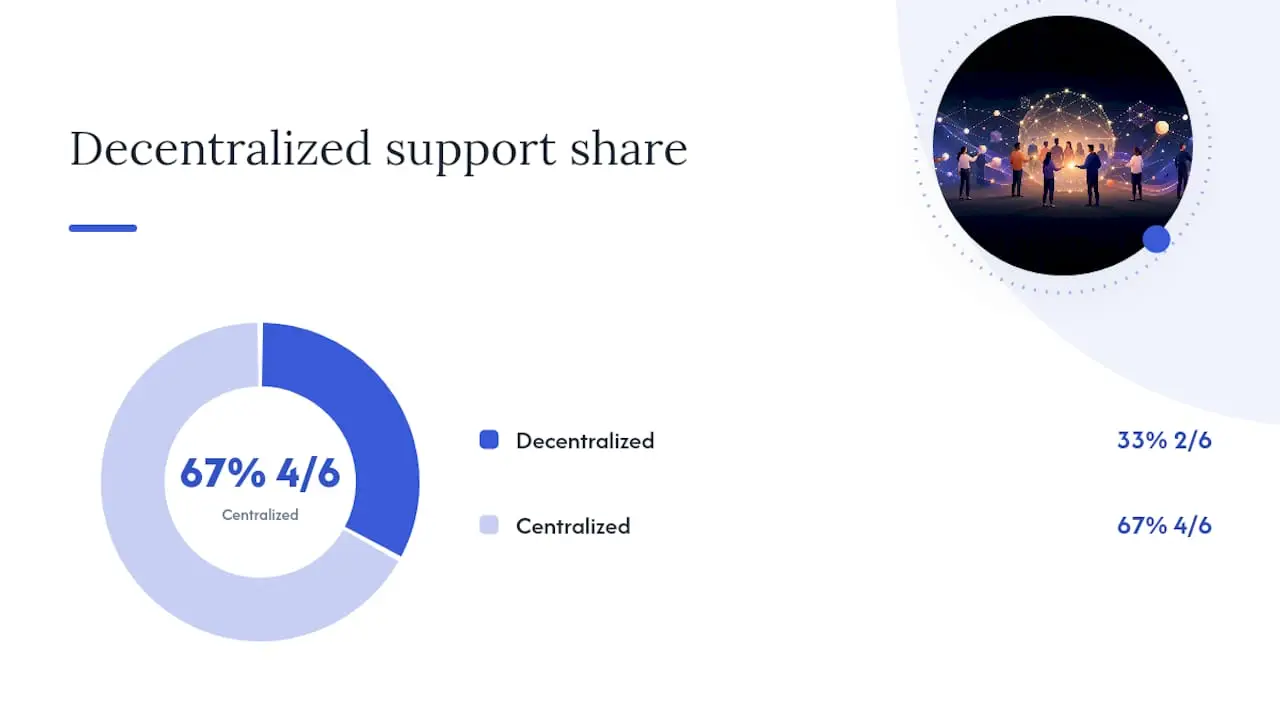
Column legend: Privacy/Tracking: Ad-based = sells ad targeting data; Subscription = no ads, paid access; E2E = end-to-end encrypted messaging; Federated = decentralized, no central data owner. Cost: Free = no paywall; Freemium = free tier + paid upgrades; Paid = subscription required.
| Platform | Best For | Content Types | Audience/Reach | Privacy & Tracking | Moderation Tools | Discoverability | Business/Monetization | Cost | Decentralized |
|---|---|---|---|---|---|---|---|---|---|
| Mastodon | Privacy-first communities | Text, images | Niche/growing | Federated, no ads | Server-level rules | Low (closed servers) | None | Free | ✅ Yes |
| Bluesky | Protocol-driven conversation | Text, images | Growing, tech-leaning | Open protocol, no ads | User-curated | Medium | None | Free | ✅ Yes |
| Topic-based Q&A, discovery | Text, links, images | Massive, niche depth | Ad-based | Subreddit mods | High | Limited ads | Freemium | ❌ No | |
| Discord | Active community chat | Text, voice, video | Large, younger | Ad-light, no data selling | Roles, bots, rules | Low (invite-based) | Stage events, subscriptions | Freemium | ❌ No |
| Telegram | Broadcasts, secure chat | Text, media, bots | Very large | Partial E2E (secret chats) | Admin controls | Medium (public channels) | Bots, paid channels | Free | ❌ No |
| Signal | Private messaging | Text, voice, video | Small, privacy-focused | Full E2E, no metadata | Minimal | None | None | Free | ❌ No |
| Visual brand marketing | Photos, Reels, Stories | Massive, broad | Ad-based | Creator tools | High | Shops, ads, collabs | Free | ❌ No | |
| TikTok | Short-form viral video | Short video | Massive, Gen Z-heavy | Ad-based | Creator tools | Very high (algo) | Creator fund, ads | Free | ❌ No |
| B2B, professional networking | Text, articles, video | Professional, global | Ad-based | Page/group tools | Medium | Ads, premium | Freemium | ❌ No | |
| Visual planning, purchase intent | Images, boards | Broad, planning-oriented | Ad-based | Board moderation | High (search-driven) | Shopping ads | Free | ❌ No | |
| X (Twitter) | Real-time news, conversation | Text, images, video | Large, news-focused | Ad-based | Limited | High | Subscriptions, ads | Freemium | ❌ No |
| Vero | Ad-free chronological feed | Photos, music, links | Small, niche | No ads | Basic | Low | None | Free (early adopters) | ❌ No |
| Diaspora | Privacy-minded self-hosting | Text, images | Very small | Federated, no ads | Pod-level | Very low | None | Free | ✅ Yes |
| MeWe | Ad-free groups | Text, images, groups | Small-medium | No ads | Group admin tools | Low | Paid features | Freemium | ❌ No |
| Minds | Free speech, crypto rewards | Text, video | Small, niche | Open-source, token-based | Community | Low | Token rewards | Freemium | Partial |
| Nextdoor | Local community, neighborhood | Text, images | Hyperlocal | Ad-based (local) | Neighborhood rules | Local only | Local business ads | Free | ❌ No |
| YouTube | Long-form video, evergreen | Video | Massive, global | Ad-based | Creator Studio | Very high (search) | Ads, memberships, Super Thanks | Free/Freemium | ❌ No |
| Trust Cafe (WT.Social) | Civility-focused news discussion | Text, links | Very small | No engagement-driven ranking | Editorial moderation | Low | None | Free | ❌ No |
| Mighty Networks | Paid community hubs | Text, video, courses | Medium, creator-focused | Subscription, no ads | Full admin suite | Low (owned) | Memberships, courses, events | Paid | ❌ No |
| Circle | Subscription communities | Text, video, events | Medium, creator-focused | Subscription, no ads | Full admin suite | Low (owned) | Memberships, subscriptions | Paid | ❌ No |
| Snapchat | Ephemeral visual content | Photos, video, Stories | Large, Gen Z | Ad-based | Creator tools | Medium | Ads, creator monetization | Free | ❌ No |
| GroupApp | Membership-first communities | Text, video | Small-medium | Subscription | Member management | Low | Payments, memberships | Paid | ❌ No |
| Kajabi | Courses + paid community | Video, text, courses | Creator-focused | Subscription | Course/community tools | Low | Full commerce suite | Paid | ❌ No |
| Podia | Simple paid content + community | Text, video, courses | Small, creator | Subscription | Basic | Low | Digital products, memberships | Paid | ❌ No |
| Slack | Professional team/community chat | Text, files, integrations | Professional | Subscription, no ads | Channel permissions | Low (invite-only) | Paid plans, integrations | Freemium | ❌ No |
| Forums (Discourse/phpBB) | Searchable, archival discussion | Text, threads | Niche, self-selected | Self-hosted, configurable | Full admin control | Medium (SEO-indexed) | Self-hosted, ads optional | Free/Paid | Optional |
How do you pick the right platform for your goals?
Not every Facebook substitute fits every situation. Ask yourself three questions before committing: Who is my audience and where do they already spend time? What type of content do I actually produce? Do I need discoverability or community control?
Match your goal to a platform category:
- 🎯 Growing reach and new discovery → Instagram, TikTok, YouTube, Reddit, Pinterest
- 🔒 Privacy-first or moderation-heavy community → Mastodon, Signal, Diaspora, MeWe
- 📣 Broadcast updates to a large audience → Telegram, YouTube, X (Twitter)
- 💼 Professional networking or B2B outreach → LinkedIn, Slack
- 🏡 Local neighborhood or community announcements → Nextdoor
- 💰 Monetize your community with memberships or courses → Mighty Networks, Circle, Kajabi, Podia, GroupApp
- 💬 Real-time chat and live events → Discord, Slack
- 📰 Searchable, long-lived topic archives → Reddit, Forums (Discourse/phpBB)
Red flags to watch before you commit:
- Low discoverability on closed platforms. Discord and Mighty Networks are invite-based. If you need strangers to find you, pair them with a public-facing channel (Instagram, YouTube, or a blog).
- Moderation overhead on federated servers. Running your own Mastodon instance means you set and enforce the rules. That is power, but it takes time.
- Algorithmic feed limits. Research on algorithmic sovereignty shows that platforms with ad-driven feeds will always prioritize paid content over organic reach. If you want your posts seen without paying, choose chronological or federated platforms.
- Platform lock-in. Proprietary paid platforms (Kajabi, Podia) give you control but make migration harder later. Export your member list and content regularly.
Pro Tip: For restaurants, the winning combo is usually a high-reach public platform (Instagram or TikTok) paired with an owned community hub (Mighty Networks, Circle, or even a mailing list). One drives discovery; the other drives loyalty and repeat bookings.
What does each platform actually do, and who is it best for?
Privacy-first and decentralized platforms
Mastodon runs on the ActivityPub protocol, meaning no single company owns your data or your feed. You join a server (instance) that fits your community’s values, and your posts appear in chronological order with zero ad targeting. It replaces Facebook Groups and Pages for communities that want full moderation control. The trade-off: discoverability is low, and onboarding is more complex than mainstream apps.
Bluesky takes a similar protocol-first approach but with a cleaner interface closer to X (Twitter). It lets users build custom feeds and moderation lists, giving you real control over what you see. Best for text-heavy conversation communities that want an alternative to algorithmic timelines. Still growing its user base, so reach is limited compared to mainstream social networks.
Diaspora is open-source and runs on independently operated “pods.” You own your data and can move between pods. It replaces Facebook’s social feed for privacy-minded users, but the community is small and the interface feels dated. Best for technically comfortable users who want maximum data sovereignty.
MeWe markets itself as the ad-free Facebook. It offers groups, pages, and a familiar feed without selling your data to advertisers. Reach is modest, but for communities that have already built a following elsewhere and want a private group space, it works cleanly.
Vero strips the feed back to chronological order with no ads and no algorithm. It supports photos, music, film, and book recommendations. The user base is small, but for creators who want an intimate, curated audience, it is a genuine alternative to Facebook Pages.
Minds adds a cryptocurrency layer: you earn tokens for engagement and can spend them to boost posts. It is open-source and leans toward free-speech communities. Niche, but worth knowing if alternative monetization models matter to you.
Messaging and broadcast platforms
Telegram supports channels with unlimited subscribers, broadcast-style updates, and bot automation for scheduling, polls, and payments. Secret Chats use end-to-end encryption; regular chats do not. For restaurants, Telegram channels work well for weekly specials announcements and event reminders. It replaces Facebook Groups for broadcast-heavy use cases.
Signal is the gold standard for private messaging. Full end-to-end encryption, minimal metadata collection, and no ads. It replaces Facebook Messenger for small-group coordination where privacy matters. It is not a public community tool; discoverability is zero.
Trust Cafe (WT.Social) is a news-and-discussion network built to reduce engagement-driven ranking. Posts surface by topic, not by what generates the most outrage. The community is small but civil. Best for readers and discussion groups that want a quieter alternative to Facebook’s news feed.
High-reach public platforms
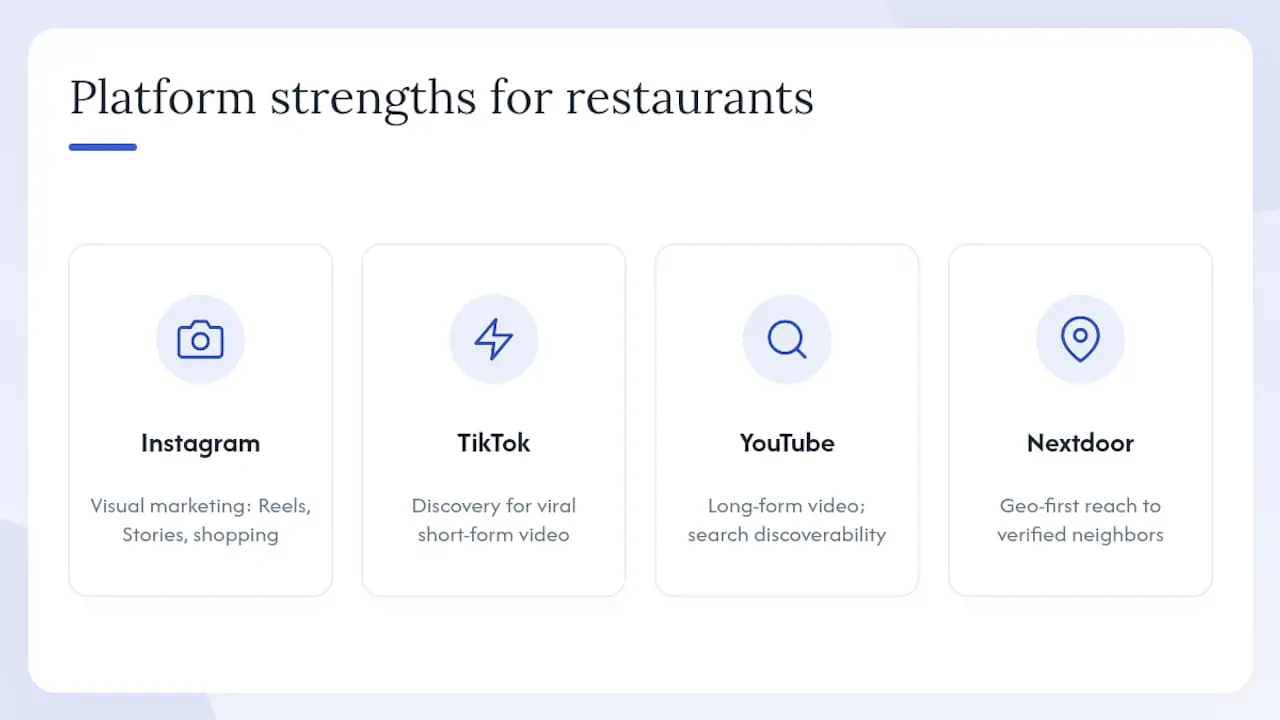
Instagram remains the top visual platform for restaurants. Reels, Stories, and shopping integrations make it the strongest replacement for Facebook Pages when your goal is food photography, event promotion, and influencer partnerships. UNLV’s platform guidance classifies Instagram as the primary channel for visual content marketing. Pair it with restaurant Instagram marketing ideas to get the most from the platform.
TikTok is the discovery engine for younger diners. Its algorithm surfaces content to users who have never heard of you, which makes it powerful for new restaurant launches and viral menu moments. Short-form video is the only content type that matters here.
YouTube is the long-form counterpart. Recipe videos, behind-the-scenes kitchen tours, and event recaps build evergreen search traffic that Facebook video never could. Search Engine Journal’s platform comparison notes YouTube’s search discoverability as a key differentiator from social feeds.
Pinterest drives high purchase intent through visual planning. For restaurants, seasonal menu boards, private event inspiration, and catering package visuals perform well. Users on Pinterest are actively planning, not passively scrolling.
X (Twitter) is best for real-time updates: a last-minute reservation opening, a weather-related closure, or a trending food moment. Reach has shifted since the platform’s rebranding, but it still delivers fast conversational amplification.
Snapchat reaches Gen Z with ephemeral Stories and Spotlight videos. For restaurants targeting a younger crowd, limited-time offers and behind-the-scenes content work well. It replaces Facebook Stories for youth-oriented campaigns.
Reddit is the best platform for topic-based discovery. Subreddits like r/FoodNYC or r/Entrepreneur give you access to highly engaged niche audiences. Reddit’s community threads show users actively comparing Facebook alternatives, which signals real intent. It replaces Facebook Groups for interest-driven discussion.
LinkedIn is the right channel for B2B outreach, recruiting, and thought leadership. For restaurant owners, it is less about filling seats and more about catering partnerships, corporate event bookings, and supplier relationships.
Nextdoor is geography-first. Your posts reach verified neighbors and local residents, making it the strongest replacement for Facebook’s local community groups. Restaurant owners can post specials, events, and hiring notices to people within walking or driving distance.
Community and membership platforms
Discord organizes communities into servers with channels, roles, and voice rooms. It replaces Facebook Groups for active, chat-oriented communities. The invite-based model limits discoverability, but for engaged regulars (a restaurant’s loyalty community, for example), it creates a tight, manageable space.
Mighty Networks and Circle are the strongest owned-community alternatives to Facebook Groups. Both support paid memberships, courses, and events inside a branded space you control. Mighty Networks leans toward courses and cohort-based learning; Circle is cleaner for discussion-first communities. Neither relies on an algorithm, and neither sells your member data.
GroupApp focuses on membership payments and member management. It is simpler than Mighty Networks but purpose-built for creators who want to charge for community access from day one.
Kajabi and Podia go further: they combine community with full course and digital product commerce. Kajabi is the more powerful (and more expensive) option; Podia is the faster, simpler entry point for small creators launching their first paid community.
Slack works best for professional communities and customer support channels. Its integration ecosystem (Zapier, Google Workspace, CRM tools) makes it the right choice when your community overlaps with a workflow. Not ideal for casual social engagement.
Forums (Discourse, phpBB, or self-hosted) are the oldest and most archivable format. Threaded discussions are indexed by search engines, which means your community’s knowledge compounds over time. Discourse is the modern, mobile-friendly option; phpBB suits technically comfortable admins who want full control.
How do you move a Facebook group or page without losing your members?
Migration is not a one-day event. Plan for 6–8 weeks and treat it like a campaign, not a technical task.
- Use reservation links and event RSVPs as migration hooks. For restaurants, linking a Mighty Networks or Discord event to an actual reservation page gives members a concrete reason to join the new space. Pair this with your private event promotion strategy for maximum impact.
Week-by-week timeline:
What actually changes when you leave Facebook’s privacy and ad model?
Facebook’s business model is built on behavioral ad targeting. Every like, comment, and group join feeds its ad auction. When you move to an alternative, the privacy picture changes significantly depending on which model the new platform uses.
The four privacy models you will encounter:
- End-to-end encrypted messaging (Signal, Telegram Secret Chats): — Messages are unreadable to the platform itself. Signal collects almost no metadata. Telegram’s standard chats are not E2E encrypted; only Secret Chats are.
The 2026 research on algorithmic sovereignty identifies this shift as the primary driver pushing community managers toward alternatives. People want to control what they see, not have it chosen by an ad auction.
Privacy and E2E status at a glance:
| Platform | Ad Tracking | Data Selling | E2E Messaging | Federated |
|---|---|---|---|---|
| Signal | None | None | ✅ Full | ❌ |
| Mastodon | None | None | ❌ (DMs visible to admins) | ✅ |
| Telegram | Minimal | None claimed | Partial (Secret Chats only) | ❌ |
| MeWe | None | None | Partial | ❌ |
| MOiN | None | None | ✅ | ❌ |
| Full | Yes | Partial | ❌ | |
| Discord | Limited | Limited | ❌ | ❌ |
Moderation differences: On centralized platforms (Discord, Reddit, Mighty Networks), one team sets the rules and enforces them globally. On federated platforms (Mastodon, Diaspora), each server operator moderates independently. That means a Mastodon instance focused on food culture can have tighter rules about spam than the broader fediverse. The trade-off is consistency: federated moderation varies widely between servers.
Best practices regardless of platform: publish clear community rules on day one, assign at least two moderators, create an escalation path (warn, mute, ban), and review rules quarterly as the community grows.
Which platform should you use for each specific goal?
| Goal | Top Pick | Runner-Up | One-Line Reason |
|---|---|---|---|
| Local community announcements | Nextdoor | Facebook (legacy) | Geography-verified reach within your neighborhood |
| Paid/owned community hub | Mighty Networks | Circle | Full membership, course, and event tools with no algorithm |
| Customer support chat | Discord | Slack | Real-time channels with role-based permissions |
| High-reach visual marketing | TikTok | Massive reach + commerce integrations for restaurants | |
| Private secure messaging | Signal | Telegram (Secret Chats) | Full E2E encryption with minimal metadata |
| Event promotion | Discord + Eventbrite | Mighty Networks | Event RSVPs, reminders, and community discussion in one place |
| Viral short-form video | TikTok | Instagram Reels | Algorithmic discovery with no follower requirement |
| Evergreen content and search | YouTube | Forums (Discourse) | Search-indexed content that compounds over time |
| B2B and corporate events | Slack | Professional audience actively seeking vendors and partners | |
| Privacy-first community | Mastodon | MeWe | No ads, chronological feed, server-level control |
For restaurant owners specifically: Instagram and TikTok handle public discovery and new customer acquisition. Pair them with Mighty Networks or Circle for a loyalty community where regulars get early access to events, exclusive menus, and private dining offers. That combination replaces Facebook’s Groups + Pages model without surrendering your audience to an algorithm. For social media campaigns that tie these platforms together, the strategy is the same: own the contact, rent the reach.
Key Takeaways
The strongest Facebook alternatives in 2026 pair a high-reach public platform such as Instagram, TikTok, or YouTube with an owned community hub like Mighty Networks, Circle, or email so you control both discovery and the customer relationship.
| Point | Details |
|---|---|
| Match platform to goal | Use Instagram/TikTok for reach, Discord/Mighty Networks for community, Signal/Telegram for private chat. |
| Capture contacts before migrating | Collect email addresses or phone numbers before leaving Facebook — you lose access to that audience otherwise. |
| Privacy model matters | Ad-based platforms (Instagram, TikTok) trade reach for data; subscription and federated platforms trade reach for control. |
| Plan 6–8 weeks for migration | Run both platforms simultaneously during weeks 3–5 to retain members through the transition. |
| Ionhospitality for restaurants | Ionhospitality helps full-service restaurants build platform strategies that replace Facebook reach with owned campaigns and zero commissions. |
The platform strategy most restaurants get wrong
The conventional advice is to “just pick a new platform and post consistently.” That misses the real problem. When you leave Facebook, you do not just lose a posting channel. You lose the audience data Facebook has been holding for you. Every follower, every group member, every event attendee — Facebook owns that relationship, not you.
The restaurants that navigate this well treat the migration as a customer-data project first and a content project second. They capture emails and phone numbers before they reduce Facebook activity. They build a reservation-linked event on Mighty Networks or Discord and use that event as the migration hook. They keep Instagram and TikTok running for discovery while the owned community grows behind the scenes.
The platforms that look most appealing — Mastodon, Diaspora, MeWe — are often the worst fit for restaurants because their discoverability is near zero. A privacy-first platform is a great choice for a community that already exists and wants to move somewhere safer. It is a poor choice for a restaurant trying to attract new diners.
The smarter play: use high-reach platforms for acquisition, use owned platforms for retention, and never let a third-party algorithm be the only thing standing between your restaurant and your regulars.
Ionhospitality helps restaurants replace Facebook reach with campaigns that actually convert
Switching platforms is only half the job. The other half is making sure your new presence actually fills seats, drives online orders, and books private events. That is exactly what Ionhospitality does for full-service restaurants across the United States.
Ionhospitality builds the complete picture: geo-targeted and retargeted ad campaigns on the platforms where your diners actually spend time, scroll-stopping content (photography, video, copywriting), and a social media advertising strategy built around your restaurant’s specific KPIs — not vanity metrics. No commissions on orders or bookings. No guessing which platform to prioritize. If you are ready to stop relying on Facebook’s algorithm and start owning your customer relationships, book a discovery call and let’s map out the right platform mix for your restaurant.
Useful sources and further reading
- Harvard Kennedy School research (global social media usage)
- Tandfonline: 2026 tech trends analysis on algorithmic sovereignty
- UNLV integrated marketing & branding — social media platforms (platform guidance)
- Mastodon — decentralized social media
- MOiN — built for people, not algorithms
- Telegram — official site
- StatCounter — Desktop & mobile social media stats worldwide
- Search Engine Journal — Top social media platforms compared

Add a Comment