

TL;DR:
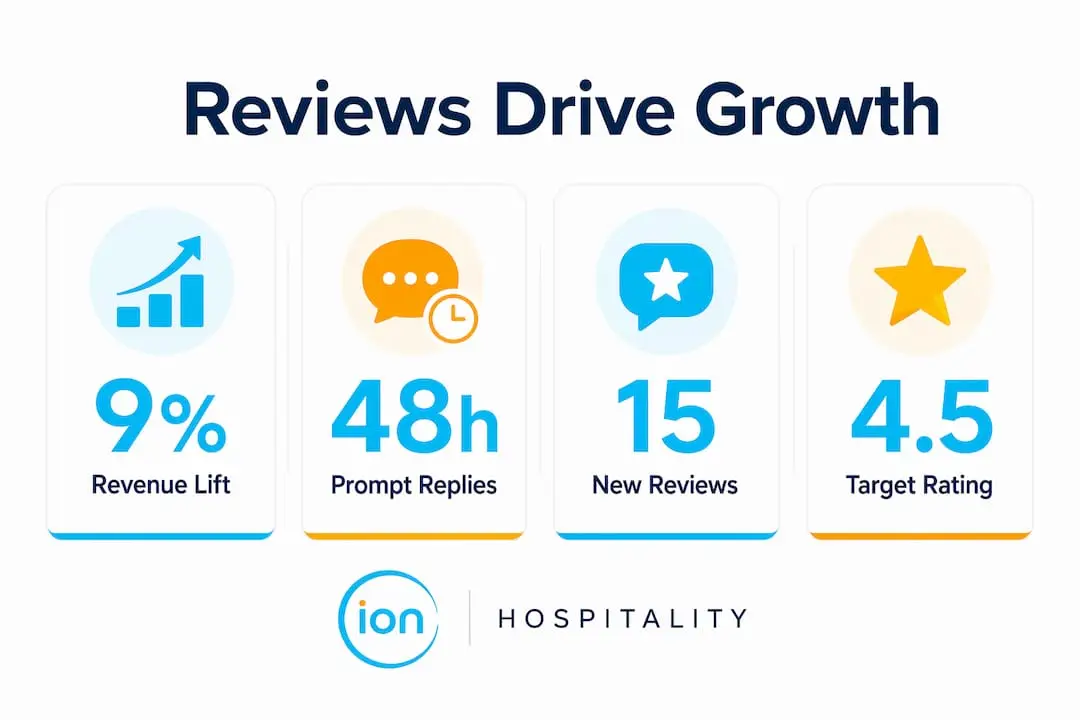
- Online reviews directly influence independent restaurants’ discovery, trust, and revenue, with a one-star Yelp increase causing up to a 9% revenue rise. Building a steady review generation, responding promptly, and fixing operational issues based on feedback turn reviews into a powerful growth engine. Focusing on review recency, volume, and sentiment, while avoiding policy violations, helps maximize their impact on profitability and customer retention.
Online reviews are one of the most direct growth levers available to independent restaurant owners. They shape trust before a guest ever walks through your door, feed the local search algorithms that determine whether new customers find you at all, and convert browsers into reservations. The research is clear: a one-star increase on Yelp is causally linked to a 5–9% revenue increase for independent restaurants. That is not a correlation. Harvard Business School researchers used a regression discontinuity design to isolate the causal effect, and the finding holds specifically for independents — chain restaurants show no significant revenue sensitivity to ratings.
Here is what that means operationally:
- Reviews drive discovery. Google Business Profile and Yelp both weight review volume and recency in local search rankings. More reviews, more visibility.
- Reviews drive conversion. A guest who finds you on Google and sees 200 recent reviews at 4.4 stars is far more likely to book than one who sees 12 reviews at 4.1 stars.
- Reviews drive revenue. The HBS finding is the strongest causal evidence in the literature. Independent restaurants are the most sensitive.
- Reviews drive retention. Closing the feedback loop — collecting, analyzing, fixing, and communicating changes — turns one-time guests into regulars.
Your priority: build a steady, automated review-generation habit, respond to every review within 48 hours, and use the feedback to fix real operational problems. That is the entire playbook, and the rest of this guide shows you exactly how to run it.
Table of Contents
- How do reviews actually shape customer decisions and your reputation?
- What does the research actually say about reviews and revenue?
- Which platforms should you prioritize for discovery and bookings?
- How do you generate more reviews without violating platform rules?
- How should you respond to reviews — and turn them into real improvements?
- What KPIs should you track to connect reviews to revenue?
- What mistakes and compliance issues do you need to avoid?
- How do you close the feedback loop and use reviews as an operational KPI?
- Your 30/60/90-day plan to turn reviews into measurable growth
- Key Takeaways
- The part most operators get wrong about reviews
- How Ionhospitality turns your review profile into a full booking engine
- Useful sources and further reading
How do reviews actually shape customer decisions and your reputation?
Every prospective guest who searches for a place to eat is making a risk calculation. They do not know your food. They do not know your service. What they have is your review profile, and they use it as a proxy for the experience they are about to pay for. This is social proof at work: the behavior of past diners signals to new ones that your restaurant is worth the risk.
The mechanism runs deeper than a star average, though. Guests weigh several signals simultaneously:
- Recency: A 4.8-star average built on reviews from three years ago carries less weight than a 4.3 built on 40 reviews in the last 90 days. Recency signals that the experience is consistent now.
- Volume: More reviews reduce perceived uncertainty. A restaurant with 500 reviews feels like a safer bet than one with 15, even at the same rating.
- Sentiment in comments: Qualitative language in review text — mentions of specific dishes, service moments, or atmosphere — gives prospective guests a richer picture than a star count alone.
- Management responsiveness: When owners reply to reviews, especially negative ones, it signals accountability. Guests notice when no one responds.
Google Business Profile amplifies all of this. Google’s local search algorithm factors in review count, recency, and rating when ranking restaurants in the local pack. A restaurant with a strong, active review profile gets more impressions, which means more clicks, which means more covers. The discovery and conversion effects are connected.
Pro Tip: Ask your front-of-house staff to mention your Google or Yelp page by name when guests compliment the experience. A warm, in-person mention converts far better than a generic “please leave us a review” on a receipt.
What does the research actually say about reviews and revenue?
The evidence base here is stronger than most owners realize. Let’s look at what the studies actually show.
The Harvard Business School causal finding
The most-cited study in this space used Yelp’s star-rounding system as a natural experiment. Because Yelp rounds ratings to the nearest half-star for display, restaurants just above a rounding threshold (say, 3.75 → 4.0) get a meaningfully different display rating than those just below it (3.74 → 3.5), even though their underlying scores are nearly identical. This regression discontinuity design allowed researchers to isolate the causal effect of the displayed rating on revenue. The result: a one-star increase drives a meaningful revenue lift for independent restaurants. Chain restaurants showed no significant effect, likely because their brand equity already anchors consumer expectations.

Regional and firm-level evidence
A Texas firm-level study found that review platforms accelerate consumer learning about restaurant quality. High-quality independent restaurants gained revenue as review activity increased; poor-quality ones lost it. Reviews do not manufacture a reputation — they surface the one you already have, faster.
Belgian firm-level research published in Cornell Hospitality Quarterly analyzed 63,904 Dutch and 42,980 English TripAdvisor reviews for restaurants in Flanders. The finding is striking: qualitative sentiment in review comments had a larger impact on profitability than star ratings alone. Comments in the local language (Dutch) outperformed those in a global language (English) in terms of bottom-line effect. The implication for U.S. owners: the text of your reviews matters as much as the number of stars.
Segment differences matter
Casual dining is more directly driven by average ratings than fine dining, which relies more on reputation, word-of-mouth networks, and personal experience. If you run a neighborhood bistro or a mid-price full-service restaurant, your rating band has a direct, measurable effect on foot traffic. Fine dining operators should weight qualitative sentiment and press mentions more heavily.
| Research Source | Key Finding | Applicable Segment |
|---|---|---|
| Harvard Business School (Yelp) | 1-star increase → 5–9% revenue lift | Independent restaurants |
| Texas firm-level study | Review volume accelerates quality signal | Independent restaurants |
| Belgian / Cornell Hospitality Quarterly | Sentiment in comments > star ratings for profitability | All full-service restaurants |
| MDPI dining segments study | Ratings drive casual dining visits more directly | Casual and mid-price dining |
Practical target: For most independent full-service restaurants, aim for a 4.0–4.5 rating band with at least 10–15 new reviews per month. Below 4.0, a significant share of searchers will disqualify you before clicking. Above 4.5 with high volume, you are in the top tier of local trust signals.
Which platforms should you prioritize for discovery and bookings?
Not all review platforms are equal, and spreading your energy thin across all of them is a mistake. Here is how the major platforms break down by discovery intent and conversion behavior.
Platform-by-platform breakdown
-
Google Reviews (Google Business Profile): The highest-priority platform for most U.S. restaurants. Google reviews feed directly into local pack rankings and Google Maps. Guests searching “restaurants near me” or “[cuisine] in [city]” see your rating before they see your website. Volume and recency here have the most direct effect on discovery.
-
Yelp: Still the dominant review platform for restaurant discovery in many U.S. markets, particularly on the coasts and in major metros. Yelp’s algorithm is opaque and its moderation aggressive, but a strong Yelp profile drives meaningful walk-in and reservation traffic. Note: Yelp explicitly prohibits asking customers for reviews, so your strategy here is about making it easy, not asking directly.
-
Tripadvisor: Higher intent for travel-adjacent dining (tourists, visitors, business travelers). If your restaurant is in a destination city or near a hotel district, Tripadvisor reviews carry outsized weight. Less relevant for purely neighborhood-focused independents.
-
OpenTable: Reviews here are tied directly to reservation behavior. A guest who books through OpenTable and leaves a review is a verified diner — which gives OpenTable reviews a credibility signal other platforms lack. Strong OpenTable ratings can increase your visibility within the platform’s own recommendation engine.
-
Facebook / Meta Reviews: Useful for community-based trust, especially in suburban and smaller markets where Facebook Groups drive local dining decisions. Less critical than Google for pure discovery, but important for social proof when guests check your Facebook page before visiting.
-
Delivery apps (DoorDash, Uber Eats, Grubhub): If you offer delivery or pickup, your in-app rating directly affects your placement in search results within those platforms. A lower rating pushes you down the list, reducing order volume. Treat these ratings with the same urgency as Google.
| Platform | Primary Use Case | Review Ask Allowed? | Priority for Independents |
|---|---|---|---|
| Google Business Profile | Local search discovery | Yes | Highest |
| Yelp | Local discovery, walk-in traffic | No (direct asks prohibited) | High |
| Tripadvisor | Travel/tourist dining | Yes | Medium (location-dependent) |
| OpenTable | Reservation conversion | Yes (verified diners only) | Medium |
| Facebook / Meta | Community trust, social proof | Yes | Medium |
| Delivery apps | In-app order ranking | Yes | High (if you offer delivery) |
How do you generate more reviews without violating platform rules?
The single biggest mistake restaurants make with reviews is treating them as a one-off campaign. You send a blast, get a spike, then nothing for six months. That pattern actually hurts you — platforms weight recency, and a stale review profile signals an inactive business.
The fix is automation. Build review asks into the systems you already use.
Step-by-step review generation system
-
Connect your POS or reservation system to a review request flow. Most modern POS systems (Toast, Square for Restaurants, Lightspeed) and reservation platforms (OpenTable, Resy) support post-visit email or SMS automation. Set a trigger: 2–4 hours after a completed visit, send a neutral follow-up.
-
Use a neutral, consistent ask. Do not route guests based on their perceived satisfaction. Asking only happy customers to leave reviews is called “review gating,” and it violates both FTC guidelines and most platform policies. Ask everyone the same way, every time.
-
Include direct links to multiple platforms. Make it one tap. A link that opens directly to your Google review form converts far better than one that sends guests to your homepage.
-
Add QR codes to receipts and table cards. Physical touchpoints catch guests who do not open emails. A simple card that says “Enjoyed your visit? Tell us on Google” with a QR code is low-cost and effective.
-
Train staff on a consistent verbal ask. When a guest compliments the food or service, your team should know exactly what to say: “We’re so glad you enjoyed it. If you have a moment, a Google review would mean a lot to us.” That’s it. No pressure, no incentive offer.
-
Integrate with your loyalty program. If you run a loyalty program, trigger a review ask after a guest’s second or third visit. Repeat guests are your most credible reviewers.
Sample follow-up SMS template:
Pro Tip: Send review requests within 24–72 hours of the visit. After 72 hours, recall fades and conversion drops sharply. Set your automation trigger at 2–4 hours post-visit for best results.
- Keep the ask short (under 50 words in SMS).
- Never offer a discount, free item, or any incentive in exchange for a review.
- Always include a direct link, not a general URL.
- Test your QR codes monthly to confirm they still resolve correctly.
How should you respond to reviews — and turn them into real improvements?
Responding to reviews is not a PR exercise. It is an operational signal. When you reply consistently and thoughtfully, you change who writes reviews next: guests who see active management are more likely to leave feedback, and guests who see ignored negatives are more likely to assume the worst.
Response timing and tone
- Negative reviews: Respond within 24–48 hours. Waiting longer signals indifference, and the guest has already moved on emotionally.
- Positive reviews: Respond within a week. A brief, specific reply (“So glad the short rib hit the mark for you — Chef Marco will love hearing that”) is far better than a generic “Thanks for visiting!”
- Neutral or mixed reviews: These are your most valuable feedback. Respond with genuine acknowledgment and a specific fix or invitation to return.
Response templates
Positive review:
Negative review (service issue):
Mixed review (food great, wait too long):
The escalation flow
- Frontline reply within 24–48 hours (owner or manager responds publicly).
- Internal ticket created for any operational issue mentioned (wait times, specific dish complaints, cleanliness).
- Operational fix assigned to the relevant team member with a deadline.
- Close-the-loop follow-up if the guest shared contact info — a brief message confirming what changed.
This four-step flow converts a negative review from a reputation liability into a retention opportunity. Guests who see their feedback acted on are among the most loyal customers you will ever have.
What KPIs should you track to connect reviews to revenue?
Tracking your review profile without connecting it to business outcomes is a vanity exercise. Here is how to build a measurement system that actually tells you something.
| KPI | Definition | How to Measure |
|---|---|---|
| Average rating | Mean star score across all platforms | Weekly check via Google Business Profile dashboard and Yelp owner portal |
| Review velocity | New reviews per 30-day period | Count manually or use a reputation tool (Birdeye, Podium, or similar) |
| Sentiment themes | Recurring positive and negative topics in review text | Manual tagging weekly; AI-assisted analysis for higher volume |
| Conversion rate | Discovery clicks → reservations or orders | Google Business Profile “Actions” data; OpenTable conversion reports |
| Revenue per cover | Average check size over time | POS reporting, tracked monthly |
Attribution techniques
You do not need a data science team to connect reviews to revenue. Start simple:
- Period-over-period correlation: Track your average rating and review velocity monthly alongside covers and revenue. When you see a rating improvement, does revenue follow in the next 30–60 days? For most independents, it does.
- Uplift calculation using the HBS benchmark: If your monthly revenue is $80,000 and you improve your rating by one star, the HBS finding suggests a 5–9% revenue lift — roughly $4,000 to $7,200 more per month. Use this as a planning target, not a guarantee.
- Sentiment-to-fix tracking: When you fix an operational issue surfaced in reviews (slow service, a specific dish complaint), track whether that theme disappears from new reviews over the next 60 days.
Reporting cadence: Weekly sentiment check, monthly rating and velocity trends, quarterly revenue-link assessment. Keep it simple enough that you actually do it.
What mistakes and compliance issues do you need to avoid?
The review ecosystem has hard rules, and breaking them can get your listing penalized or removed entirely.
Platform and legal red lines
- Never buy reviews. Fake reviews violate every major platform’s terms of service and the FTC’s guidelines on endorsements. Google and Yelp actively detect and remove them, and the reputational damage from a public takedown is severe.
- Never incentivize positive sentiment. Offering a free appetizer or discount in exchange for a 5-star review is a violation of FTC rules and platform policies. You can ask for honest feedback; you cannot pay for a specific outcome.
- Never gate reviews. Routing guests to a review platform only if they indicate they had a positive experience is review gating. The FTC has taken enforcement action against this practice. Ask everyone, always.
- Never respond aggressively to negative reviews. A defensive or hostile public reply does more damage than the original negative review. Stay professional, stay brief, and take the conversation offline.
Practical pitfalls
- Templated replies: Copy-paste responses (“Thank you for your feedback! We hope to see you again!”) are worse than no reply. Guests and algorithms both notice.
- Ignoring negatives: A string of unanswered 1-star reviews signals to prospective guests that no one is minding the store.
- Chasing removals as a primary strategy: Most negative reviews do not violate platform policies and will not be removed. Spending hours on removal requests is a poor use of time. Focus on generating new positive reviews to dilute the impact.
- Over-relying on one platform: If your entire review presence is on Yelp and Yelp’s algorithm suppresses your reviews, you have no fallback. Build across Google, Yelp, and at least one other platform.
The FTC’s guidelines on endorsements and testimonials apply to review solicitation. Any material connection between a reviewer and a restaurant (including incentives) must be disclosed. When in doubt, ask everyone the same way and offer nothing in return.
This article is general information, not legal advice. Confirm current FTC and platform policies with a qualified professional for your specific situation.
How do you close the feedback loop and use reviews as an operational KPI?
Most restaurants collect reviews. Far fewer actually use them. The ones that do have a structural advantage: they find and fix problems before those problems compound into a pattern of negative reviews.

The feedback loop has four steps: collect → analyze → apply → close. The first two are table stakes. The last two are where the growth actually happens.
Operationalizing sentiment analysis
You do not need expensive software to start. Manual tagging works fine at lower volume. Read every new review weekly and tag it by theme: food quality, service speed, atmosphere, value, specific dishes. After four weeks, you will have a clear picture of your top two or three recurring pain points. Fix those first.
At higher volume (50+ reviews per month), AI-assisted sentiment tools like those integrated into Birdeye, Podium, or even basic NLP features in some POS systems can surface themes automatically. The goal is the same: turn unstructured text into a prioritized fix list.
Closing the loop
Fixing the problem is step three. Step four — telling customers what changed — is what most operators skip. When a guest mentions slow service and you fix the staffing issue, a brief public reply on their review (“We’ve since added a second server on Friday nights — hope you’ll come back and see the difference”) does two things: it shows that guest you listened, and it shows every future reader that you act on feedback.
This is the customer feedback loop applied to hospitality: a structured cycle that turns reviews from a vanity metric into a retention and churn-reduction engine. The role of reviews in restaurant growth is not just about attracting new guests. It is about keeping the ones you already have.
Short action plan:
- Weekly: Read and tag all new reviews by theme.
- Monthly: Identify top two recurring pain points and assign fixes.
- Quarterly: Review whether tagged themes have decreased; assess revenue and booking trends.
Your 30/60/90-day plan to turn reviews into measurable growth
Here is a realistic timeline you can start this week.
30 days: Instrument and train
- Connect your POS or reservation system to an automated review request flow (email or SMS, triggered 2–4 hours post-visit).
- Set up your Google Business Profile dashboard and claim your Yelp and Tripadvisor listings if you have not already.
- Create a simple weekly reporting template: average rating, new review count, top three sentiment themes.
- Train front-of-house staff on the verbal ask script and receipt QR code placement.
- Write and save three response templates (positive, negative, mixed) so replies take under two minutes.
60 days: Analyze and fix
- Run your first monthly sentiment review. Identify your top two operational pain points from review text.
- Assign fixes to specific team members with a 30-day deadline.
- Begin a steady multi-platform ask cadence: Google as primary, OpenTable or Facebook as secondary.
- Start responding to every new review within 48 hours using your saved templates as a starting point, not a copy-paste.
90 days: Measure and iterate
- Compare your average rating and review velocity to your 30-day baseline. Are both trending up?
- Check whether the operational issues you fixed in month two are appearing less frequently in new reviews.
- Run a simple revenue correlation: compare covers and average check against the same period last year.
- Formalize review-driven ops as a standing agenda item in your weekly manager meeting.
| Phase | Owner Task | Staff Task | Measurement Check |
|---|---|---|---|
| 30 days | Set up automation, claim listings | Learn verbal ask, place QR codes | Baseline rating and velocity |
| 60 days | Assign operational fixes | Respond to reviews daily | Sentiment theme frequency |
| 90 days | Revenue correlation review | Maintain ask cadence | Rating trend, booking lift |
Pro Tip: The 90-day mark is when most operators give up or declare victory too early. Neither is right. Review-driven growth compounds over 6–12 months. Commit to the cadence before you judge the results.
The impact of reviews on restaurants compounds over time. A restaurant that generates 15 new reviews per month for 12 months has a fundamentally different trust profile than one that generated 180 reviews in a single campaign and then went quiet.
Key Takeaways
Online reviews are both a demand signal and a trust signal, and independent restaurants are the most revenue-sensitive to rating changes of any restaurant category.
| Point | Details |
|---|---|
| Revenue sensitivity is real | A one-star Yelp increase drives a 5–9% revenue lift for independent restaurants, per Harvard Business School research. |
| Sentiment beats star counts | Qualitative review text has a larger impact on profitability than star ratings alone, per Belgian firm-level research. |
| Recency and volume matter most | A steady flow of recent reviews outperforms a high average built on old scores; automate asks to maintain cadence. |
| Close the feedback loop | Collect, analyze, fix, and communicate changes; this turns reviews into a retention tool, not just a reputation score. |
| Ionhospitality accelerates the system | Ionhospitality builds the automation, response workflows, and ad funnels that connect your review profile to bookings and private-event sales. |
The part most operators get wrong about reviews
Here is a perspective that most guides will not give you: the operators who win with reviews are not the ones obsessing over their star average. They are the ones who treat the review feed as a real-time operations report.
A 3-star review that says “the pasta was cold and our server disappeared for 20 minutes” is not a reputation problem. It is a line-check problem and a floor-management problem. Fix those, and the reviews fix themselves. Chase the star rating without fixing the underlying issue, and you are playing a losing game.
The other thing most guides understate: the selection effect of responding. When guests see that a restaurant owner replies to every review, including the tough ones, they are more likely to leave a review themselves. They know someone is reading. That changes the composition of your review pool over time, and it changes it in your favor.
The HBS finding is powerful, but it is also a ceiling. A one-star increase gets you 5–9% more revenue. Closing the feedback loop, fixing the real problems, and building a reputation for responsiveness? That compounds in ways no regression model fully captures. Reviews are the signal. Operations are the answer.
How Ionhospitality turns your review profile into a full booking engine
Your review profile is the front door of your digital presence. But most restaurants stop there, collecting stars without connecting them to reservations, private events, or online orders. Ionhospitality builds the full system: automated review generation flows tied to your POS, response workflows that keep your profile active and credible, and social media advertising campaigns that retarget guests who found you through reviews but did not book yet.
We also build conversion-focused websites with reservation integrations, online ordering, and SEO that captures the traffic your review profile generates. Every piece connects: a guest finds you on Google, reads your reviews, lands on a fast-loading menu page, and books a table or a private event without friction. No commissions, no long-term lock-in, just a done-for-you system that fills seats.
Ready to put your review profile to work? Book a discovery call with our team and we’ll show you exactly where your current review presence is leaving revenue on the table.
Useful sources and further reading
For owners who want to go deeper on the research and tools referenced in this guide:
Academic and peer-reviewed research:
- Harvard Business School — Reviews, Reputation, and Revenue (Yelp causal study): The primary causal evidence linking Yelp ratings to independent restaurant revenue.
- SSRN working paper — regression discontinuity methodology: Full methodology for the HBS finding; useful if you want to understand the causal design.
- Texas firm-level study — review-driven consumer learning (Management Science): Evidence that review volume accelerates quality signaling for independent restaurants.
- Belgian / Cornell Hospitality Quarterly — sentiment in review comments and profitability: Firm-level evidence that qualitative review text outperforms star ratings as a profitability predictor.
- MDPI — review attributes and dining segments: Segment-specific evidence on how ratings affect casual vs. fine dining differently.
Practitioner and industry guides:
- Katalyst — restaurant online reputation and reviews: Practical guidance on response strategy and review generation compliance.
- Zendesk — customer feedback analysis: Step-by-step framework for turning unstructured review text into operational intelligence.
- Malou — Google Reviews for restaurants: Consumer trust patterns and Google-specific ranking factors explained for operators.
- Koji — customer feedback loop guide: The collect → analyze → apply → close framework applied to service businesses.
- Wild Foodz — the role of customer reviews in hospitality: Cross-industry practitioner perspective on review dynamics in hospitality.
Ionhospitality resources:
- Digital reputation for restaurants: Boost bookings now: How reputation work ties directly to bookings and private-event sales.
- How to increase repeat customers at your restaurant: Retention strategies that align with the feedback loop approach in this guide.

Add a Comment