

Why audience segmentation is the foundation of restaurant marketing
Most restaurants send one message to their entire customer list and wonder why nobody responds. The answer is simple: a guest who visits every week has completely different needs than someone who came once six months ago. Sending them the same message guarantees it resonates with neither.
Audience segmentation is the practice of dividing your customer base into meaningful groups based on actual behavior, then sending each group a message that fits where they are in their relationship with you. It is the single most impactful shift you can make in your restaurant marketing strategy.
Here is why it matters so much right now:
- Higher open rates: Segmented campaigns achieve significantly higher open and redemption rates than batch-and-blast messages
- Better ROI: Personalized campaigns convert at significantly higher rates than general broadcast messages.
- Retention over acquisition: Acquiring a new customer costs significantly more than retaining an existing one
- Smarter spend: Segmentation lets you allocate marketing budget toward the customers most likely to respond
- Lifecycle visibility: You can see where each guest is in their relationship with your restaurant and act on it
The common segmentation frameworks restaurants use are demographic, geographic, behavioral, and psychographic. Behavioral data, specifically visit frequency, recency, and spend, consistently outperforms the others in predicting what a guest will do next. Build your segments around what customers do, not just who they are.
1. Demographic segmentation: who your guests are
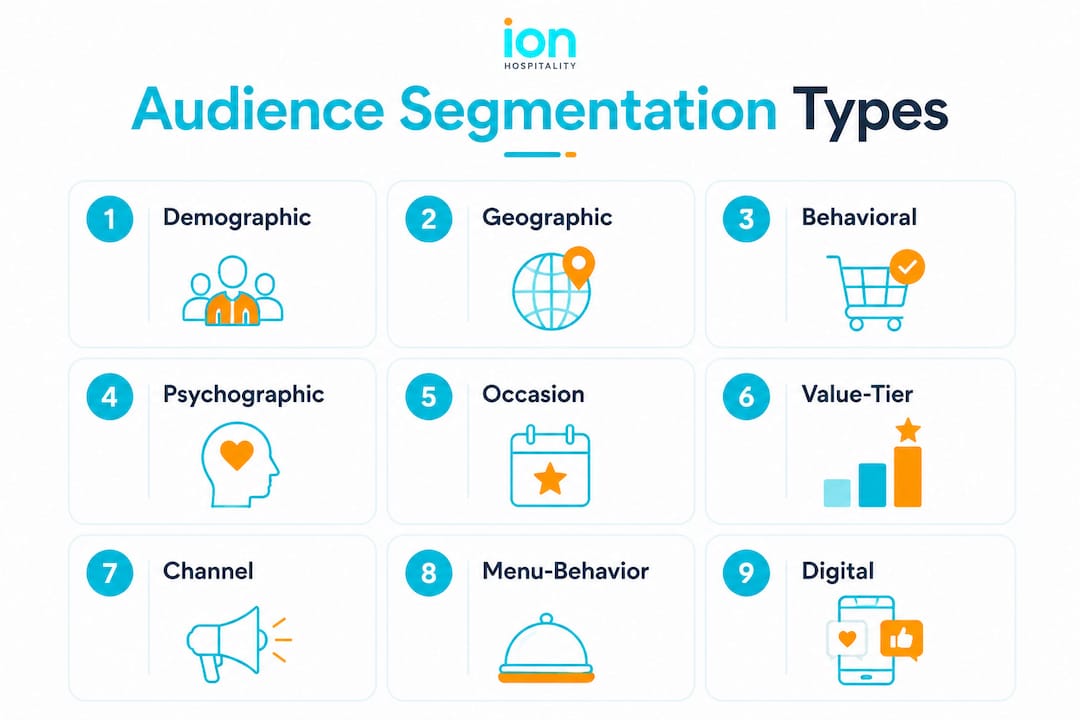
Demographic segmentation groups customers by age, gender, income, household size, and occupation. A family-friendly casual concept in the suburbs targets differently than a downtown cocktail bar. Knowing that your lunch crowd skews toward working professionals aged 30–45 tells you to push weekday specials and quick-service messaging to that group.

Demographics give you a useful starting point, especially when you are opening a new location or refining your concept. They are less reliable for predicting individual behavior once you have real transaction data, but they remain a practical lens for broad audience analysis in dining contexts.
2. Geographic segmentation: where your guests come from
Location shapes dining decisions more than most operators realize. A guest who lives two blocks away behaves differently from one who drives 20 minutes for a special occasion. Geographic segmentation lets you target local diners with neighborhood-specific promotions, happy hour pushes timed to their commute, or delivery offers scoped to a precise radius.

For multi-location operators, geographic data also reveals which locations draw from overlapping trade areas, so you avoid cannibalizing your own marketing spend. Geo-targeting on platforms like Meta and Google lets you layer this segmentation directly into paid campaigns.
3. Behavioral segmentation: what your guests actually do
Behavioral segmentation is where the real precision lives. Visit frequency, recency, average check size, day-of-week patterns, and order history all tell you far more about a guest’s next move than their age or zip code ever will.
The most effective behavioral framework for restaurants is the RFM model: Recency (when did they last visit?), Frequency (how often do they come?), and Monetary value (how much do they spend?). RFM data powers lifecycle segmentation, which divides your customer base into groups like:
- Champions: High frequency, recent visit. Your top guests who need recognition, not discounts.
- Loyals: Moderate frequency, recent visit. On their way up or sliding down. Progression nudges work here.
- At-risk: Good history, quiet for 30–60 days. The highest-ROI segment to target.
- New and occasional: 1–3 visits. Need a “welcome to the family” moment to convert into regulars.
- Lapsed: No visit in 60+ days. Harder to win back, but worth a structured sequence.
Lifecycle segmentation alone can significantly increase your campaign effectiveness because each stage requires a fundamentally different message and offer.
4. Psychographic segmentation: why your guests choose you
Psychographics go beyond what guests do and into why they do it. Values, lifestyle, dining motivations, and social identity all influence where someone chooses to eat. A guest who visits for date nights responds to romance-forward messaging. A guest who comes for business lunches cares about speed, privacy, and a professional atmosphere.
Psychographic data is harder to collect directly, but you can infer a lot from order history and occasion patterns. Guests who consistently order wine pairings and tasting menus signal a different motivation than guests who always order the family combo on Sunday afternoons. Use those behavioral signals as a proxy for psychographic insight, and your messaging gets sharper without needing a survey.
5. Occasion-based segmentation: when guests show up
Some of your best customers are occasion-driven. They come every Friday for date night, every Sunday for family brunch, or every Tuesday for business lunch. Occasion-based segmentation identifies these patterns and sends messages that arrive the morning of their typical visit day.
This approach works especially well for private event promotion and seasonal campaigns. A guest who always books a table for Valentine’s Day should receive your February promotion before anyone else. Timing the message to the occasion, not just the calendar, is what makes it feel personal.
6. Value-tier segmentation: not all guests deserve equal effort
Your top 20% by spend deserve personalized, high-touch communication. Your middle 60% should receive targeted but scalable messages. Your bottom 20%, typically one-time visitors, get automated nurture sequences. Allocating marketing effort proportional to customer value is one of the most practical shifts you can make in restaurant customer targeting.
A value-tier overlay works best when layered on top of lifecycle segmentation. A high-value at-risk guest gets a personal outreach from the GM. A standard new customer gets an automated welcome sequence. Same segment, different tier, completely different treatment.
7. Channel-based segmentation: how guests prefer to engage
Some guests open every email. Others only respond to SMS. A growing share of your audience engages primarily through push notifications from a loyalty app. Segmenting by preferred channel prevents you from burning your email list on guests who only check texts, and vice versa.
Segmented email campaigns consistently outperform generic blasts because the message matches both the person and the medium. When you know a guest prefers SMS and you send them a time-sensitive win-back offer via text, the response rate climbs sharply compared to the same offer sent by email to someone who never opens it.
8. Menu-behavior segmentation: what guests order tells you everything
A guest who orders from the bar menu but has never reserved a dining table is a conversion opportunity. A lunch regular who has never visited for dinner is another. Menu-behavior segmentation identifies these gaps and sends targeted invitations to try the experience they are missing.
When you tailor offers to past orders, vegetarians get plant-based specials, wine lovers hear about new bottle additions, and families with kids learn about kid-friendly events. This approach also informs menu design decisions. If your behavioral data shows that a specific dish drives repeat visits among your Champions segment, that dish earns a permanent spot, not a seasonal rotation.
9. Digital segmentation: using first-party data for precise targeting
Modern digital restaurant marketing has shifted away from broad demographic assumptions toward intent-based targeting. First-party data from loyalty programs, online ordering platforms, and reservation systems gives you engagement signals that are far more reliable than third-party audience data.
DoorDash’s Brand Interest Targeting, for example, uses real engagement signals to reach customers who are actively exploring brands on the platform, connecting your ads to high-intent diners already in a decision-making moment. On your own channels, first-party data from POS and loyalty integrations lets you build custom audiences for Meta and Google ads that mirror your best existing guests. This is what separates data-driven restaurant marketing from guesswork.
How to implement audience segmentation in your restaurant
Getting segmentation right comes down to execution, not theory. Here is a practical sequence that works for most US restaurant operators:
-
Audit your data sources. Pull from your POS, reservation system, loyalty program, and any email or SMS tools. Most restaurants have more usable data than they think.
-
Build five core lifecycle segments. New (1 visit, last 30 days), Developing (2–3 visits, last 60 days), Regular (4+ visits, last 90 days), At-Risk (was regular, no visit in 30+ days), and Lapsed (no visit in 60+ days). This model captures the majority of segmentation value with minimal complexity.
-
Add a value-tier overlay. High (top 25% by average check), Medium (middle 50%), Standard (bottom 25%). This two-dimensional matrix tells you exactly how much effort each guest deserves.
-
Create segment-specific messaging. New: “We loved having you. Come back this week and try [dish].” At-Risk: “Your usual table is waiting. Here’s 15% off your next visit.” Each segment gets a different message, offer, and channel.
-
Set up automation triggers. A customer enters At-Risk when they have not visited in 30 days, triggering an automated message that same day. A customer moves to Regular after their fourth visit, triggering a VIP invitation. No spreadsheet, no manual export.
-
Measure segment-level KPIs. Track open rate, redemption rate, and repeat visit rate by segment. Compare segmented campaign performance to your historical batch results. The gap justifies the effort.
Pro Tip: Start with just two segments: Champions and At-risk. Champions need recognition, not discounts. At-risk guests need a specific reason to return. Get both automations running and converting before you add any more complexity. A simple model that runs consistently beats a sophisticated one that sits in a spreadsheet.
How segmentation drives marketing success and business growth
Precise segmentation changes the economics of restaurant marketing in ways that compound over time.
- Open rates jump: Untargeted push notifications typically run at lower open rates, while segmented campaigns see substantially higher openness, resulting in much better performance with the same effort.
- Repeat visits increase: Many US restaurants lose a significant portion of first-time guests every year. Lifecycle segmentation with RFM-based push notifications directly addresses that churn.
- Customer lifetime value grows: Guests who feel recognized come back more often and spend more per visit. Segmentation is what makes recognition possible at scale.
- Budget goes further: When you stop sending the same message to everyone, you stop wasting spend on guests who will not respond. High-value segments get high-touch outreach; lower-value segments get automated sequences.
- Private events fill faster: Occasion-based and value-tier segmentation identifies the guests most likely to book a private event, so your outreach lands on the right people at the right time.
The shift that changes everything: The restaurants winning in 2026 are not the ones with the biggest marketing budgets. They are the ones who stopped guessing which customers to reach and started letting behavioral data make that decision for them. Intent-based segmentation, built on first-party engagement signals, is what separates a campaign that fills tables from one that fills inboxes with unsubscribes.
The math is direct. For a casual dining concept with a $32 average ticket and 1,500 monthly customers, lifting repeat visits by 7 percentage points through RFM-tier offers adds approximately $67,200 in annual revenue at a single location. Segmentation is the mechanism that makes that lift possible.
Advanced tactics: targeting at-risk guests and intent-based marketing
The at-risk segment, loyal guests who have gone quiet for 30–60 days, returns the highest marketing ROI of any group you can target. These guests already know you, already like you, and stopped coming for a reason that is usually fixable. Reactivating them costs far less than acquiring new guests and leverages existing brand loyalty.
Automated segmentation identifies the moment a previously regular customer crosses the 30-day inactivity threshold and fires a win-back campaign the same day. A three-message sequence works well: a soft check-in first, then a specific incentive, then a last-chance offer with urgency. If they do not respond to all three, stop messaging and reallocate the budget.
Intent-based tools take this further by using first-party engagement signals rather than broad demographic assumptions. When a guest opens your app, clicks a menu link, or engages with a social post, that signal tells you they are in a consideration moment. Reaching them with a targeted offer at that exact point converts at a rate that no demographic-based campaign can match. Afterwork promotions, for example, can be timed to guests who have shown engagement signals during late-afternoon hours, a tactic explored in depth in afterwork restaurant promotions.
The loyalty program integration is what makes all of this mechanically possible. Every scan at the point of sale tells you who the customer is, when they came, how much they spent, and how long it has been since their last visit. Without that data connection, you are segmenting in the dark.
Challenges and common pitfalls in implementing audience segmentation
Segmentation fails more often from execution problems than from bad strategy. Here are the mistakes that trip up most restaurant operators, and how to avoid them.
Starting with too many segments. Creating eight segments before you have a single automation running guarantees nothing gets done. Complexity kills execution. Start with two, get them converting, then expand.
Segmenting by demographics instead of behavior. Age, gender, and zip code are poor predictors of restaurant behavior. Visit frequency, recency, and spend patterns tell you what someone will actually do next. Many operators default to demographic data because it is easier to collect, but it produces weaker results.
Sending the same message to every segment. Segmentation without differentiated messaging is wasted effort. If every segment gets the same email with a different name in the subject line, you have done the analysis without the execution.
Ignoring the at-risk segment. Many restaurants focus on lapsed customers when the real opportunity is preventing the lapse in the first place. The at-risk window, 30–60 days of inactivity for a previously regular guest, is where you can still save the relationship.
Relying on manual processes. Exporting POS data to a spreadsheet and classifying customers manually produces a snapshot that is already outdated by the time you act on it. By the time you build your at-risk list, some of those guests have already been gone for 60 days instead of 30. Automated Customer Data Platforms eliminate that lag.
Neglecting privacy and data compliance. Collecting guest data for segmentation requires clear consent practices, especially for email and SMS marketing. The CAN-SPAM Act governs commercial email in the United States, and the Telephone Consumer Protection Act (TCPA) governs text message marketing. Always provide an easy opt-out, honor unsubscribe requests immediately, and store customer data securely. Guests who feel their data is handled responsibly are more likely to engage with your loyalty program, which feeds better segmentation data back into your system.
Skipping the measurement step. If you are not tracking open rate, redemption rate, and repeat visit rate by segment, you cannot improve. Set benchmarks before you launch, and review segment-level performance monthly.
A digital menu strategy can also support segmentation by capturing behavioral data from online interactions, giving you another signal layer to work with alongside POS and loyalty data.
Let Ionhospitality put your segmentation to work
You now know what audience segmentation can do. The gap between knowing and executing is where most restaurants lose. Ionhospitality builds targeted social media campaigns that put your best offers in front of the right guests at exactly the right moment, with zero commissions and done-for-you execution. We handle the targeting, the creative, and the data so you can focus on running your restaurant.
Ready to stop broadcasting and start converting? Book a discovery call and we will show you exactly how segmentation-driven marketing fills seats and books private events for restaurants like yours.
Key Takeaways
Audience segmentation is the single most effective way to improve restaurant marketing ROI because it replaces generic broadcasts with messages that match each guest’s exact relationship with your restaurant.
| Point | Details |
|---|---|
| Segmented campaigns outperform batch sends | Open rates for segmented campaigns run substantially higher compared to untargeted pushes. |
| Behavioral data beats demographics | Visit frequency, recency, and spend predict guest behavior far better than age or zip code. |
| At-risk guests offer the highest ROI | Loyal guests inactive for 30–60 days are the most cost-effective segment to reactivate. |
| Start simple, then scale | Launch with Champions and At-risk automations first; add complexity only after both convert. |
| Automation closes the execution gap | Automated triggers fire win-back campaigns the day a guest crosses an inactivity threshold, not weeks later. |

Add a Comment