

TL;DR:
- Targeted restaurant advertising focuses on reaching local, high-intent diners within strategic radius, increasing conversion rates and maximizing return on ad spend. Using platforms like Google, Meta, and CTV, restaurants can tailor messaging to specific audiences and track results for continuous optimization. Expanding beyond immediate neighbors toward a wider ring of potential customers offers the greatest growth opportunity, guided by expert management and data-driven strategies.
You’re running ads, spending real money, and still watching empty tables on a Friday night. Sound familiar? Understanding why restaurant ads need targeting is the difference between throwing your budget into a black hole and actually filling seats, driving online orders, and booking private events. Most restaurant ads fail not because the creative is bad, but because they reach the wrong people at the wrong time. Targeted ads fix that. This guide breaks down exactly how targeting works, which platforms to use, and how to measure results that actually move your bottom line.
Table of Contents
- The fundamentals of targeted advertising for restaurants
- Key targeting strategies to maximize restaurant ad effectiveness
- Comparing platforms: How targeting works across Google, Meta, and streaming TV
- Measuring success and optimizing targeted ads for continuous growth
- Why many restaurants misunderstand targeting and how to get it right
- How ION Hospitality helps restaurants master targeted advertising
- Frequently asked questions
Key Takeaways
| Point | Details |
|---|---|
| Target high-intent local keywords | Ads focusing on nearby, ready-to-order customers yield higher returns and lower cost per click. |
| Use precise location targeting | Narrow radii for dine-in and targeted zip codes for delivery prevent wasted ad spend on uninterested audiences. |
| Retarget website visitors | Retargeting recovers abandoned orders and boosts conversion by reminding interested diners to complete actions. |
| Measure orders, not just clicks | Tracking actual online orders or reservations provides a true picture of ad effectiveness and helps optimize spend. |
| Optimize and adjust regularly | Continuous monitoring and tweaking of keywords, timing, and audiences are crucial for sustained campaign success. |
The fundamentals of targeted advertising for restaurants
Targeted advertising means showing your ads only to people most likely to become paying customers. Not everyone in the country. Not random scrollers. We’re talking about hungry people within driving distance of your restaurant, searching for exactly what you serve, right now.
For restaurants, targeting typically works across three dimensions:
- 📍 Location: Show ads only to people within a set radius of your restaurant or delivery zone.
- 🎯 Intent: Capture people actively searching for food with keywords like “best tacos near me” or “Italian restaurant open now.”
- 👥 Demographics: Reach specific age groups, income brackets, or interest categories (date night, family dining, craft beer lovers).
Here’s a quick contrast. A generic ad for a local pizza place might run to everyone in the state with the headline “Order Pizza Online.” A targeted ad runs only to people within 5 miles who searched “pizza delivery near me” between 5 and 9 PM on a Thursday. One of these ads converts. The other burns cash.
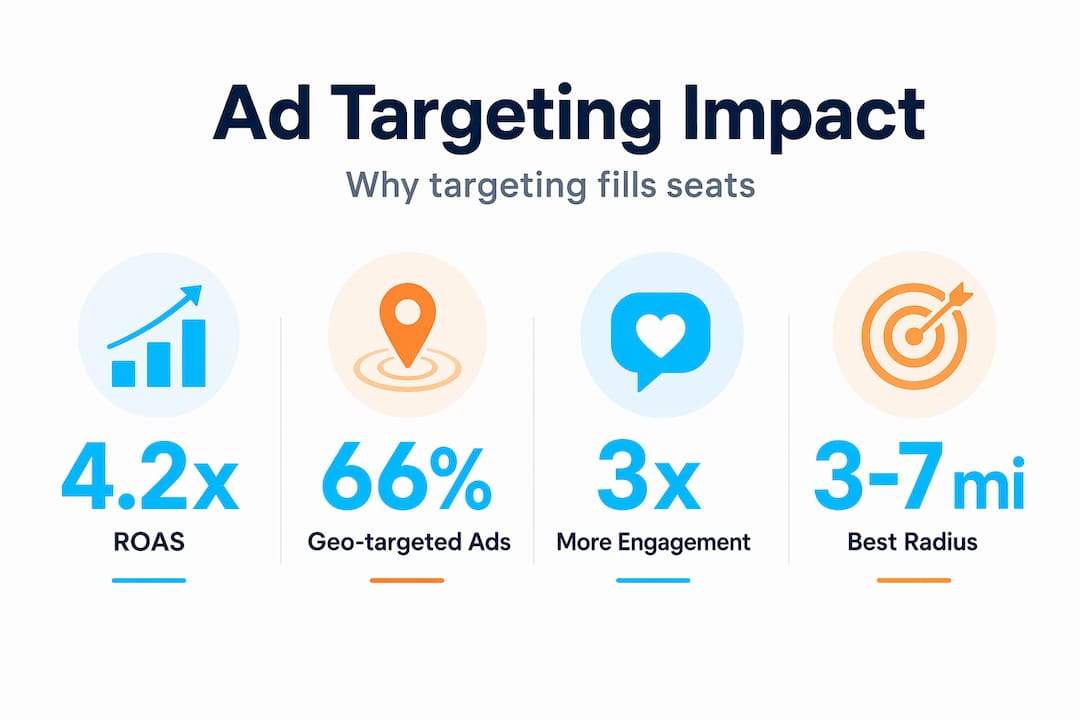
The numbers back this up. Google PPC ads for restaurants yield a 4.2x return on ad spend, with “near me” keywords driving 58% of clicks during peak dinner hours. That’s not a coincidence. High-intent searches pull in customers who are already in buying mode.
The importance of targeted restaurant ads goes beyond just saving money. When you identify your target audience before launching a campaign, every dollar works harder. You pay per click, so if 90% of clicks come from people who actually want to eat at your restaurant, your cost per new customer drops fast. That’s the core promise of targeting, and it’s why the benefits of restaurant advertising multiply significantly once you stop advertising to everyone and start advertising to someone.
Key targeting strategies to maximize restaurant ad effectiveness
Ready to get tactical? Here’s a starter plan to implement targeting step by step and start seeing results fast.
1. Set your location radius precisely.
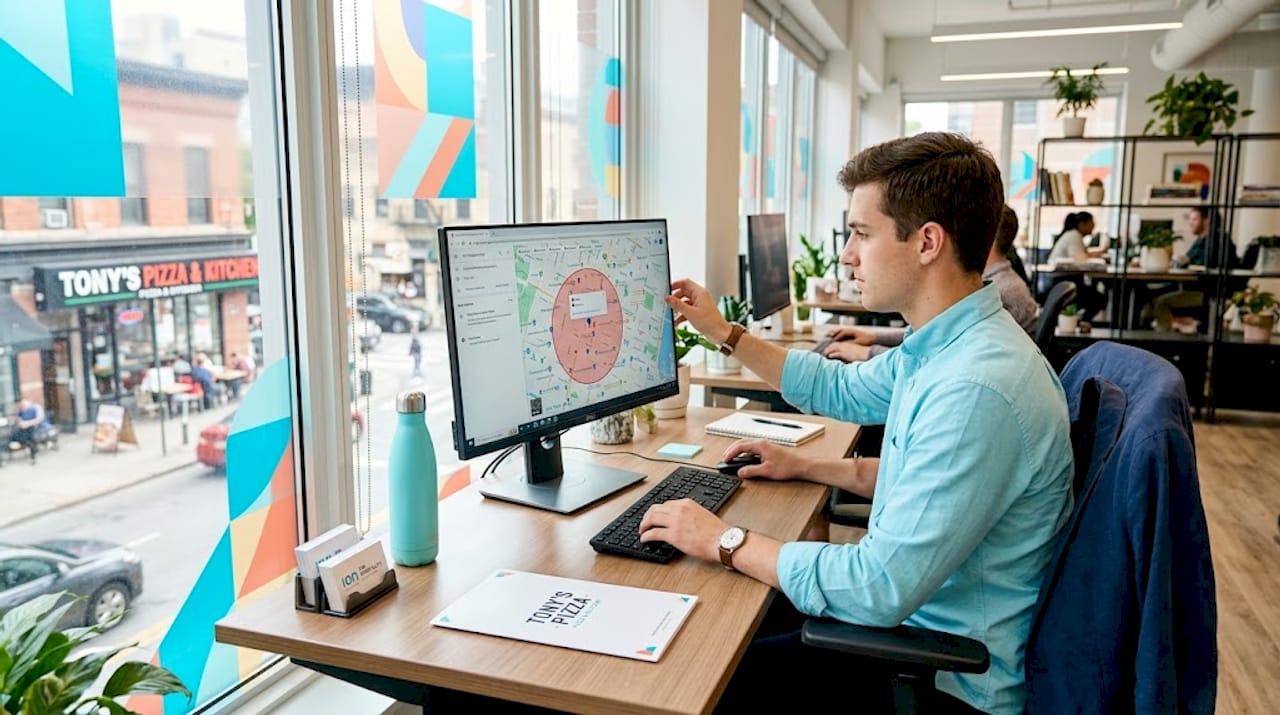
For dine-in, target 3 to 7 miles depending on your market. For delivery, match your actual delivery zone. Never target the entire United States unless you’re running a national chain with a gift card campaign.
2. Build a focused keyword list.
Lead with high-intent phrases like “brunch near me,” “best sushi downtown [your city],” or “restaurants open late.” Cut low-intent terms immediately. Add negative keywords for “jobs,” “recipes,” “free,” and “homemade.” These searches will never put a diner in your seat.
3. Set up restaurant retargeting.
Anyone who visited your website and didn’t book or order is a warm lead. Why restaurants use retargeting comes down to one simple truth: someone already showed interest. A retargeting ad that says “Still thinking about dinner? Your table is waiting” converts at 3 to 5 times the rate of a cold ad. Recovering abandoned carts through retargeting is one of the highest-ROI moves in digital advertising.
4. Schedule ads for peak hours.
Run your ads hardest from 11 AM to 1 PM (lunch decision window) and 4 PM to 8 PM (dinner planning window). Reduce spend during low-conversion overnight hours. Most platforms let you automate this with ad scheduling.
5. Track orders and reservations, not just clicks.
Clicks mean nothing if they don’t convert. Connect your ads to your reservation system or online ordering platform using conversion tracking. You want to know your cost per order, not just your cost per click.
Restaurants spending 3 to 6% of revenue on targeted advertising see results in as little as 1 to 2 weeks for Google Ads, with benchmarks of 5x or better ROAS. That’s a proven model. The Google Ads ROI framework for restaurants reinforces this, showing that tighter targeting directly correlates with stronger returns.
Learning how to launch restaurant campaigns with these fundamentals in place gives you a serious edge over competitors who are still broadcasting ads into the void.
Pro Tip: Avoid the “donut effect” by not targeting uniform circles around your restaurant. Your closest neighbors already know you exist. Expand your radius to 4 to 10 miles to capture people who haven’t visited yet but would if they saw the right ad.
Comparing platforms: How targeting works across Google, Meta, and streaming TV
Knowing how to target is vital, but the platform shapes how well your message connects with the right diners. Different channels serve different moments in the customer journey.
| Platform | Avg. cost | Targeting options | Best for | Typical ROAS |
|---|---|---|---|---|
| Google Ads | $1.84 CPC | Keywords, location, device, time | High-intent searches, delivery orders | 4x to 5x |
| Meta (Facebook/Instagram) | $0.50 to $1.20 CPM | Age, interest, radius, lookalike | Reservations, event promotions, new audiences | 3x to 4x |
| Connected TV (CTV) | $20 to $35 CPM | Geo-fencing, household income, viewing behavior | Brand awareness, grand openings, seasonal campaigns | Hard to track directly |
Platform-specific best practices:
- Google Ads: Use location extensions so your address and phone number appear directly in the ad. Pair with call-only campaigns for mobile users who want to book by phone.
- Meta Ads: Build lookalike audiences from your existing customer email list. If your best customers are 30 to 45-year-old professionals who love craft cocktails, Meta can find more people just like them within your city.
- Connected TV: Run 15 to 30-second video ads geo-fenced to your zip codes. Great for announcing a new menu, a seasonal event, or a catering package. Pair with a retargeting campaign on Meta or Google to capture viewers who search for you after seeing the TV ad.
The data on location targeting is compelling. 66% of online foodservice ads are location-targeted, and they generate 3x higher click-through rates than generic banner ads. The role of niche targeting in restaurant ads becomes very clear when you see that level of performance difference.
Understanding what is niche restaurant advertising also means knowing when to layer platforms. A diner might see your CTV ad on Tuesday, your Instagram reel on Wednesday, and then search “Italian restaurant near me” on Thursday. If your Google ad captures that final search, you close the loop. That multi-touch approach is where restaurant social media ads and search ads work together to drive real reservations.
Measuring success and optimizing targeted ads for continuous growth
Targeting and platform choices only pay off when you measure results carefully and tune your ads accordingly. Here’s what to watch.
Key metrics every restaurant owner should track:
- ROAS (return on ad spend): Your north star. At 5x, you’re in good shape. At 7x or better, scale up your budget immediately.
- Cost per click (CPC): For local restaurant keywords, a healthy CPC is around $1.84. If you’re paying $4 or more, your targeting is too broad or your keywords need pruning.
- Order volume and reservation count: The real test. Connect your ads to your booking platform and online ordering system so you can see exactly how many seats your ads filled.
- Call-through rate: If you run call extensions, track how many people actually called after clicking. This is huge for catering and private event bookings.
Restaurants targeting high-intent local keywords average a $1.84 CPC with a 4.2x ROAS. If you’re beating those numbers, keep going. If you’re not hitting them, the fix is almost always in the targeting settings, not the creative.
Weekly optimization tasks:
- ✅ Review search term reports and add new negative keywords
- ✅ Check which zip codes or radius zones are converting and shift budget there
- ✅ Pause ads running below a 3x ROAS after enough data (at least 30 clicks)
- ✅ Test one new ad variation per week against your current winner
- ✅ Review scheduling data to see if peak-hour assumptions are holding true
The digital advertising bookings guide at ION Hospitality breaks this process down further with restaurant-specific benchmarks.
Pro Tip: Add UTM parameters to every ad URL so your Google Analytics shows you exactly which campaign, keyword, and platform drove each reservation or online order. This takes 10 minutes to set up and saves hours of guessing later.
Why many restaurants misunderstand targeting and how to get it right
Here’s a perspective most restaurant marketing guides won’t give you: targeting your immediate neighborhood is often the biggest waste of your budget.
Think about it. The people within a one-mile radius of your restaurant already know you exist. They’ve walked past your sign. They’ve smelled your kitchen. If they haven’t come in yet, a Google ad isn’t going to change their mind. You’re spending money to remind people who’ve already decided.
“The real opportunity in local advertising is not the neighbor who passes your door daily. It’s the diner 6 miles away who has no idea you exist yet, but would become a weekly regular if they ever tried you.”
This is what location strategists call the “donut effect”. The most valuable new customers live in a ring around your restaurant, not at its center. Targeting the 4 to 14-mile zone around your location is where real behavior change happens. These are people whose dining habits you can actually influence.
Beyond radius, most restaurants also run the same generic ad to every audience. A 24-year-old celebrating a birthday needs a different message than a 45-year-old booking a corporate dinner. The targeting strategy for restaurant promotions should include audience-specific messaging. Segment by occasion, age group, and past behavior. Your retargeting ad for someone who visited your private events page should look completely different from a cold ad targeting a new diner.
Another underused tactic: combining local SEO with paid retargeting for full-funnel coverage. Someone finds you organically, reads your menu, doesn’t book. Now you retarget them with a time-sensitive offer. That combination turns casual browsers into paying customers without needing a bigger ad budget, just a smarter one.
Customer retention strategies work best when paired with targeting that speaks to where someone is in their relationship with your restaurant. First visit, repeat diner, or lapsed customer each deserve a different ad, a different offer, and a different message.
How ION Hospitality helps restaurants master targeted advertising
The right strategy and the right execution partner make all the difference between ads that drain your budget and ads that pack your dining room.
At ION Hospitality, we build and manage data-driven targeted ad campaigns exclusively for restaurants. We handle Google Ads, social media ad creation, retargeting, and local audience building, all with zero commissions on your orders or reservations. Every campaign is built around your actual menu, your market, and your goals. Whether you want more walk-ins, more online orders, or a full calendar of private events, we dial in the targeting to make it happen.
What you get when you work with us:
- 📍 Location and demographic targeting tailored to your restaurant’s market
- 🔄 Restaurant retargeting campaigns that recover lost website visitors
- 📊 Weekly performance reporting with real reservation and order data
- 🎬 Scroll-stopping ad creative built for your brand and audience
- 🗓️ Private event and catering campaign strategy to fill your event calendar
See how advertising drives growth for restaurants like yours, and then schedule a discovery call to get a free audit of your current advertising and a personalized targeting plan.
Frequently asked questions
Why is targeting important in restaurant advertising?
Targeting ensures your ads reach customers who are ready to order nearby rather than random users with no intent to dine, which means every dollar works harder. With “near me” keywords driving 58% of clicks during dinner hours and a 4.2x ROAS, targeted ads consistently outperform generic campaigns.
What are common targeting mistakes restaurants make?
The most common mistake is targeting only the immediate neighborhood where customers already know the restaurant exists, which wastes budget on people unlikely to change their behavior. Uniform radius targeting ignores the higher-value ring of potential new customers 4 to 14 miles away.
How quickly can restaurants see results from targeted ads?
Most restaurants see measurable results like increased reservations and online orders within 1 to 2 weeks of launching a properly configured campaign. Restaurants spending 3 to 6% of revenue on targeted Google Ads consistently hit this timeline.
Which digital platforms work best for targeted restaurant ads?
Google Ads captures high-intent local searches and drives direct orders, Meta supports detailed interest and lookalike targeting for reservations and events, and Connected TV builds local brand trust through geo-fenced video. 66% of foodservice ads are already location-targeted, generating 3x higher click-through rates than untargeted formats.
How can restaurants measure the success of their targeted ads?
Track ROAS, cost per click, and actual orders or reservations attributed directly to your ads using conversion tracking and UTM parameters. Restaurants targeting local, high-intent keywords average a $1.84 CPC with a 4.2x return on ad spend, giving you a clear benchmark to measure against.

Add a Comment