
TL;DR:
- Most restaurants still view marketing as a one-time effort, but successful ones are building systems driven by data and automation in 2026. These retention-first strategies focus on turning first-time guests into loyal customers and scheduling private events through personalized, behavior-triggered outreach. Proper operations, capacity planning, and digital presence are crucial to sustain growth and maximize marketing ROI.
Most restaurant owners still treat marketing like a one-time event. Run a promotion, get a spike in traffic, then go quiet until the next slow season. That cycle used to work. It doesn’t anymore. In 2026, the restaurants pulling ahead are the ones who have built systems, not just campaigns. They’re using data, automation, and personalized outreach to keep guests coming back and their private event calendars packed. This guide breaks down exactly what those strategies look like and how you can put them to work starting now.
Table of Contents
- How restaurant marketing is changing in 2026
- Building a retention engine: The foundation for growth
- Tailoring outreach: Personalization and frequency in practice
- Maximizing discovery: Digital presence, reviews, and frictionless journeys
- Budgeting for impact in 2026: Where smart money goes
- Our perspective: What most restaurants overlook in 2026 marketing
- Take your restaurant marketing further
- Frequently asked questions
Key Takeaways
| Point | Details |
|---|---|
| Retention-first wins | Building a segmented, automated CRM puts guest loyalty and events on autopilot for 2026. |
| Personalize outreach | Frequent, targeted communications by guest and location outperform generic mass emails. |
| Invest in digital presence | Accurate listings and strong reviews directly impact discovery and bookings. |
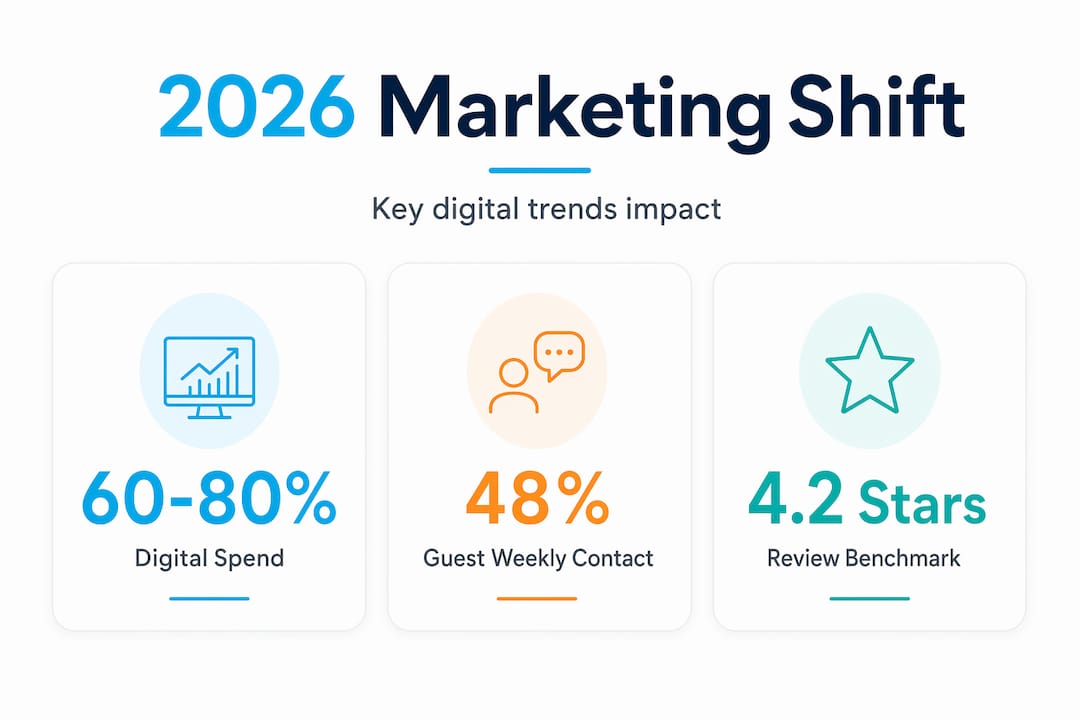
| Budget for growth | Allocating 60-80% of your marketing spend to digital ensures maximum returns in 2026. |
| Operations must keep pace | Your system only works if operations can handle increased event and customer demand. |
How restaurant marketing is changing in 2026
The rules have changed. And if you’re still running the same playbook from three years ago, you’re already behind.
Restaurant marketing strategy for 2026 is shifting from one-off campaigns toward retention-first, CRM/automation-led systems. That means your goal isn’t just getting someone in the door once. It’s turning that visit into a relationship that generates repeat visits, referrals, and private event bookings over time.
Here’s what’s driving this shift:
- 🔁 Repeat customers spend more. Loyal guests spend 67% more on average than new ones, and they bring friends.
- 📍 Hyperlocal marketing is winning. Guests want to feel like a restaurant knows them and their neighborhood.
- 🤖 Automation is no longer optional. Operators who don’t use CRM tools are losing ground to those who do.
- 📣 Frequency matters. 2026 operators are increasing marketing frequency and tailoring communications by location and individual guest behavior.
“The brands winning in 2026 aren’t the ones with the biggest ad budgets. They’re the ones with the best systems for staying connected to their guests.”
This shift shows up across every channel, from email and SMS to social media and event marketing. Check out these 2026 hospitality marketing trends and the top marketing trends shaping how smart operators approach growth this year.
The bottom line: one-off promotions are table stakes. The real game is building a retention engine that runs whether you’re in the kitchen or not.
Building a retention engine: The foundation for growth
Now that you understand what’s driving the shift, let’s talk about how to build the actual system. Your retention engine is the backbone of everything else. Without it, every marketing dollar you spend on acquisition works harder than it needs to.
Here’s how to build it step by step:
- Collect guest data from day one. Use your POS system, reservation platform, or loyalty program to capture names, emails, visit frequency, and spend levels.
- Segment your guest list. Not all customers are equal. Group them by behavior: first-time visitors, regulars, lapsed guests, and high-value event bookers.
- Set up behavior-based triggers. When a regular hasn’t visited in 30 days, send a “we miss you” message. When a guest hits their fifth visit, offer a loyalty reward. These automated actions run 24/7 without your team lifting a finger.
- Create relevant messaging for each segment. A first-time guest needs education and a reason to return. A regular needs to feel valued and in the know. An event prospect needs clear package info and fast follow-up.
- Measure and adjust monthly. Track open rates, redemption rates, and visit frequency to see what’s working.
This approach outperforms batch-and-blast marketing every time. Retention strategies built on segmented CRM triggers produce higher engagement and lower cost per guest than constantly chasing new faces.
Here’s a quick comparison to see the difference clearly:
| Feature | Campaign-based marketing | Retention-driven marketing |
|---|---|---|
| Trigger | Calendar date or promotion | Guest behavior |
| Personalization | Low (same message to all) | High (based on visit history) |
| Cost per engagement | High | Low over time |
| Long-term ROI | Unpredictable | Compounding |
| Event booking impact | Minimal | Significant |
| Team effort required | High (manual each time) | Low (automated) |
The difference is night and day. And when you pair this retention engine with your event marketing, you’re not just attracting new customers. You’re activating the guests who already love you to fill your private dining room, too.
Pro Tip: Don’t try to automate everything at once. Start with two triggers: a welcome sequence for new guests and a re-engagement message for lapsed ones. Get those running smoothly before you build out more complex flows.
Tailoring outreach: Personalization and frequency in practice
With your retention system in place, the next question is: how often should you be reaching out, and what should you actually say?
Here’s what the data tells us. 48% of guests expect to hear from their favorite restaurants at least once a week. That might feel like a lot, but when the message is relevant, it doesn’t feel like spam. It feels like a relationship.
Effective personalization in 2026 looks like this:
- 🎂 Birthday and anniversary messages with a special offer attached
- 🍽️ Menu update alerts sent to guests who ordered that category before
- 🎉 Early event access for your top 20% of spenders
- 📍 Neighborhood-specific promotions tied to local events or holidays
- 🔔 Last-minute table alerts for regulars on slow nights
Here’s a sample outreach calendar to help you map this out:
| Guest type | Weekly touch | Monthly touch | Quarterly touch |
|---|---|---|---|
| New guest (0-1 visit) | Welcome email + social follow | “How was your visit?” check-in | Special offer to return |
| Regular (2-6 visits) | Menu feature or special | Loyalty update or reward | VIP event invite |
| High-value / event booker | Personalized note or SMS | Private event availability alert | Exclusive preview or tasting |
| Lapsed (60+ days) | Re-engagement offer | “We miss you” story | Last chance discount |
“Personalization isn’t about using someone’s first name in an email. It’s about sending the right message to the right person at the right moment.”
The critical warning here: don’t let your outreach calendar run faster than your team can handle the response. This is a real operational trap. If you’re sending event inquiry campaigns but your team takes 48 hours to respond to leads, you’re burning money. Check out event marketing strategies that account for this balance and deliver results without overwhelming your front-of-house.
For private event success specifically, fast lead follow-up and crystal-clear package information are non-negotiable. Prospects who inquire about private event best practices want a quick response and a clear menu of options. Make it easy to say yes.
Pro Tip: Before increasing your outreach frequency, audit your team’s capacity to respond. Set a response time goal of under 2 hours for event inquiries, and assign one person to own that inbox.
Maximizing discovery: Digital presence, reviews, and frictionless journeys
You can have the best retention system in the world, but if new guests can’t find you or trust what they see online, you’re leaving money on the table.
Local discovery and online visibility including reviews, listing accuracy, and a frictionless digital journey remain core mechanics rather than nice-to-haves. This is especially true for private event bookings, where planners are doing serious research before they ever pick up the phone.
Here’s your digital presence checklist for 2026:
- ✅ Google Business Profile fully updated with current hours, photos, and menu
- ✅ Consistent NAP (Name, Address, Phone) across all platforms including Yelp, TripAdvisor, and Apple Maps
- ✅ Recent reviews with owner responses to both positive and negative feedback
- ✅ Mobile-optimized website that loads in under 3 seconds
- ✅ Online booking widget embedded directly on your homepage
- ✅ Private event inquiry form with a clear turnaround time promise
- ✅ High-quality photos of your space, food, and past events
📊 Statistic callout: 60-80% of established restaurants’ marketing budgets now flow into digital channels. That’s not a trend. That’s the new baseline.
Reviews deserve special attention. A restaurant with 4.2 stars and 400 reviews will consistently outperform one with 4.8 stars and 20 reviews. Volume signals trust to both search algorithms and potential guests. Make it a habit to ask for reviews at the end of every positive interaction, whether at the table, in a post-visit email, or through your loyalty program.
Building a strong online presence is the digital front door to everything else you’re building. Don’t let a stale listing or an unanswered bad review undo the work your retention engine is doing.
Budgeting for impact in 2026: Where smart money goes
Marketing systems only work if you fund them correctly. Here’s how smart operators are thinking about budget allocation this year.
Established restaurants spend around 3-6% of revenue on marketing, and most of that investment is now going toward digital channels. Here’s how to put that framework into practice:
- Calculate your baseline. Take 3-6% of your average monthly revenue. That’s your marketing budget. If you’re doing $150,000 a month, you’re looking at $4,500 to $9,000 per month to work with.
- Allocate 60-80% to digital. This includes social media ads, Google ads, email tools, and your CRM platform. Digital delivers the most trackable ROI.
- Set aside 15-20% for event marketing. Private event campaigns have high return per booking. Even one additional booking a month can justify significant spend.
- Reserve 10-15% for local/community. Neighborhood partnerships, sponsorships, and in-person activations still build brand trust in ways digital alone can’t.
- Track ROI on every channel monthly. If a channel isn’t producing measurable results after 60 days, reallocate that budget.
“Knowing your numbers isn’t optional. A restaurant that doesn’t track marketing ROI is flying blind, no matter how great the food is.”
The restaurants pulling ahead right now are the ones who treat their marketing budget like an investment portfolio, not a monthly expense. They optimize, shift, and double down on what works. For a deeper look at how hospitality marketing has evolved, these budget principles are part of a much bigger strategic shift worth understanding.
Our perspective: What most restaurants overlook in 2026 marketing
Here’s the hard truth: most restaurants understand the strategies above. They read the guides, they see the stats, and they nod along. Then they go back to doing exactly what they were doing before.
Why? Because the real barrier isn’t strategy. It’s systems and operations alignment.
You can have a beautiful CRM setup and a smart outreach calendar, but if your team can’t handle the demand it creates, you’re building a machine with no engine. A practical 2026 methodology means building a retention engine first based on segmented CRM triggers from guest behavior, then layering acquisition and event bookings with tight conversion paths, including fast follow-up, clear capacity and package info, and strong visual proof of the space.
The part that gets skipped most often? Capacity planning. When you launch an event marketing campaign and it works, leads come in fast. If your team isn’t ready to respond quickly, that inquiry goes cold. Marketing cadence that outruns capacity is a real edge case to plan for. Event campaigns can increase inquiries quickly, so lead capture, response time, and availability guidance must be operationally supported or you’ll create friction and lose bookings you should have closed.
We’ve seen this happen repeatedly. A restaurant invests in a great event campaign, starts getting 20 inquiries a week, then drops the ball on follow-up. Those leads don’t come back.
The fix is a “capacity-first” lens. Before you scale any marketing initiative, ask your team: “Can we actually handle what happens if this works?” That question alone will save you thousands in lost revenue.
Pair strong creative and messaging with operational readiness, and you have a growth engine that compounds. Explore revenue-boosting event strategies that account for this balance and set your team up to convert, not just attract.
Take your restaurant marketing further
The strategies in this guide work. But putting CRM systems, event campaigns, social ads, and personalized outreach together takes real expertise and consistent execution. That’s exactly what we do at ION Hospitality.
We specialize in helping restaurants get more customers and fill their private event calendars, all done for you with zero commissions. Whether you need social media advertising services built around your brand, help to drive more bookings through organic engagement and paid campaigns, or a full private event campaign support system, we handle it all so you can focus on running your restaurant. Ready to build the system your competitors don’t have? Let’s talk.
Frequently asked questions
How much should a restaurant budget for marketing in 2026?
Most established restaurants should budget around 3-6% of revenue for marketing, with 60-80% of that focused on digital channels for maximum trackable ROI.
What is the biggest mistake in restaurant marketing today?
The biggest mistake is ignoring retention and treating marketing as isolated campaigns. Accurate listings and responsive reviews are often overlooked essentials that directly impact whether new guests choose you over a competitor.
How often should restaurants reach out to customers in 2026?
Aim to connect with your best guests at least once a week using personalized, relevant content. 48% of consumers want to hear from their favorite restaurants at least weekly when the messages feel relevant and timely.
How important are reviews and online listings in acquiring new restaurant customers?
Reviews and accurate listings are often the deciding factor. Accurate listings and responsive reviews act as deal-breakers or deal-closers for both new diners and event planners researching your venue.

Add a Comment