
TL;DR:
- Event marketing generates high-margin bookings, repeat business, and local buzz for restaurants.
- Confirmed events with deposits offer predictable revenue and enhance customer lifetime value.
- Focused strategies and tracking ROI optimize event success and long-term growth.
Most restaurant owners treat events as a nice bonus. A holiday party here, a wine tasting there. But here’s what that mindset is costing you: 72% of private celebrations prefer restaurants as their venue of choice. That’s a massive, high-margin revenue stream sitting right under your roof. Event marketing isn’t an extra. It’s one of the most powerful tools you have to grow bookings, build loyalty, and stabilize your revenue. This guide breaks down exactly what restaurant event marketing is, why it works, and how to do it right.
Table of Contents
- Understanding restaurant event marketing: Definition and core benefits
- How event marketing increases bookings and revenue
- Essential strategies and best practices for event marketing success
- Tracking ROI and optimizing your event marketing efforts
- Why most restaurants underestimate event marketing’s long-term value
- Partner with experts to maximize your restaurant’s event marketing
- Frequently asked questions
Key Takeaways
| Point | Details |
|---|---|
| High-margin bookings | Private events generate some of the highest profit margins for restaurants. |
| Stable revenue source | Event marketing provides predictable income compared to fluctuating walk-in traffic. |
| Long-term loyalty | Memorable events build lasting customer relationships and drive repeat business. |
| Trackable ROI | Proper attribution allows at least 60% of event revenue to be tied to targeted marketing efforts. |
Understanding restaurant event marketing: Definition and core benefits
Now that you’ve seen the opportunity, let’s clarify exactly what event marketing means for restaurants.
Restaurant event marketing is the practice of creating, promoting, and hosting planned experiences to attract customers, generate bookings, and build your brand. It’s not the same as your day-to-day marketing. Regular service marketing pushes people to come in for dinner. Event marketing gives them a reason to choose you for a specific occasion, spend more, and bring a group.
That distinction matters. A table of two ordering from the menu is great. A private party of 30 with a set menu and a deposit? That’s a different revenue category entirely. Private event margins typically run 20 to 60%, far above standard dining margins.
Key benefits of restaurant event marketing:
- 📈 Higher profit margins per booking compared to regular covers
- 🔁 Repeat business from guests who had a great event experience
- 📣 Local buzz and word-of-mouth from group attendees
- 💼 Brand positioning as the go-to venue for celebrations and corporate events
- 🗓️ Revenue predictability through advance deposits and confirmed bookings
Common types of restaurant events that drive bookings:
| Event type | Best for | Revenue potential |
|---|---|---|
| Private birthday/anniversary parties | High-margin group bookings | Very high |
| Corporate dinners and team events | Weekday revenue boost | High |
| Wine or cocktail tastings | Building loyalty and upsells | Medium to high |
| Holiday parties (New Year’s, Valentine’s) | Seasonal revenue spikes | Very high |
| Chef’s table or tasting menus | Premium positioning | High |
Applying the right event marketing strategies to each event type is what separates restaurants that fill their private dining rooms from those that leave them empty.
Pro Tip: Don’t try to run every type of event at once. Pick two or three that align with your space, staff, and brand. Master those first, then expand.
How event marketing increases bookings and revenue
With a solid definition in place, let’s dig into how event marketing directly impacts your bookings and bottom line.
Walk-in revenue is unpredictable. A rainy Tuesday can wipe out your covers. Event revenue doesn’t work that way. Event-based revenue is more predictable than walk-ins because bookings are confirmed in advance, often with deposits. You know what’s coming before the week starts.
Walk-in vs. event booking revenue: A quick comparison
| Factor | Walk-in revenue | Event booking revenue |
|---|---|---|
| Predictability | Low | High |
| Average spend per head | Standard menu price | Higher (set menus, packages) |
| Deposit required | No | Usually yes |
| Cancellation risk | High | Low to medium |
| Repeat booking likelihood | Low | High |
The math is straightforward. Running 8 private events a month at $1,500 net each adds $12,000 a month to your revenue. That’s $144,000 a year from events alone, on top of your regular dining business.
Here’s how to start moving the needle on event bookings:
- Audit your space. Identify areas that can be set up for private or semi-private events. Even a corner of your dining room can work.
- Build event packages. Create two or three tiered packages with clear pricing, minimums, and inclusions. Make it easy to say yes.
- Showcase your space online. Add photos and a dedicated events page to your website. Most people research venues before reaching out.
- Capture inquiries fast. Respond to event inquiries within one hour. Speed wins bookings.
- Follow up after every event. A simple thank-you email with a rebooking offer can turn a one-time client into a recurring one.
Customers who attend events at your restaurant also tend to return as regular diners. That means every event booking has a ripple effect on customer lifetime value, or LTV, which is the total revenue a customer brings you over time. When you boost restaurant revenue through events, you’re not just filling one night. You’re building a relationship. Check out this increase bookings guide for more detail on converting inquiries into confirmed reservations.
Essential strategies and best practices for event marketing success
Once you understand the payoff, it’s time to implement strategies proven to work.
Experience-driven dining is up 27% year over year. Guests don’t just want food. They want a story to tell. Your events need to deliver that.
Step-by-step event marketing blueprint:
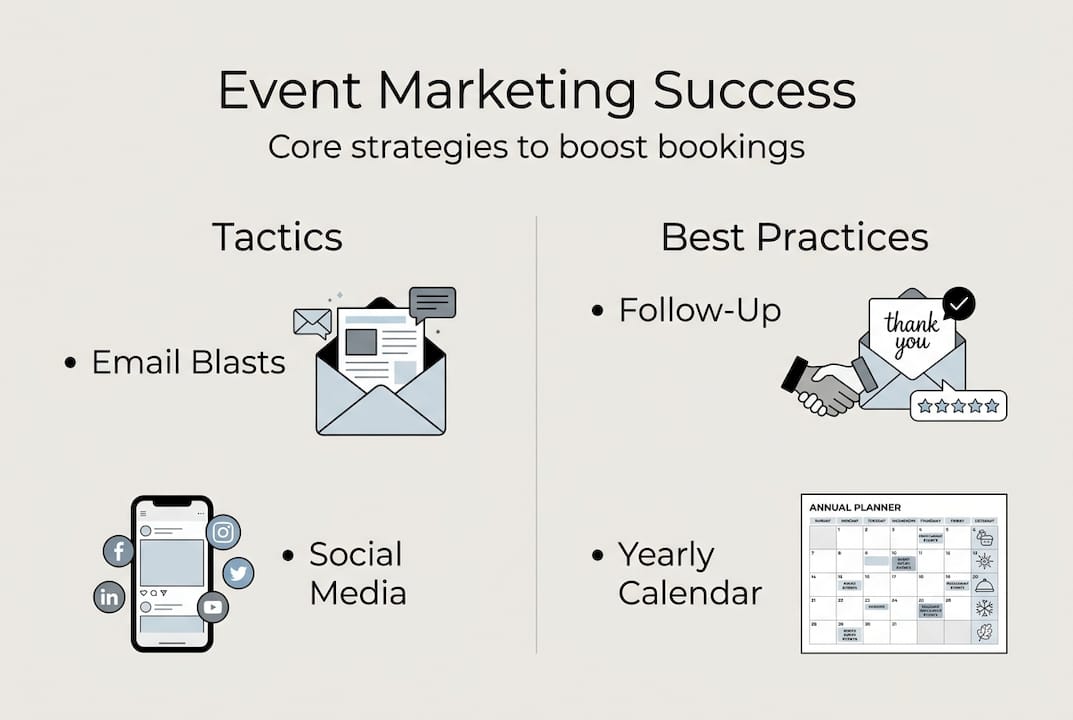
- Identify your target audience. Are you going after corporate clients, birthday celebrations, bachelorette parties, or foodies? Each group needs a different message and a different package.
- Design a memorable experience. Think beyond food. Add a signature cocktail, a themed setup, a live DJ slot, or a custom menu. Details create memories.
- Promote through email first. Your existing customer list is your warmest audience. Send event announcements to them before anyone else.
- Use social media with intention. Post behind-the-scenes setup content, guest testimonials, and event recap reels. Short-form video drives serious engagement.
- Partner locally. Connect with wedding planners, corporate event coordinators, and local businesses. They send referrals consistently.
- Encourage user-generated content (UGC). Set up a photo moment at your event, a neon sign, a flower wall, a dessert display. Guests will post it, and that’s free reach.
Channels that drive the most event bookings:
- ✉️ Email campaigns to your existing list
- 📱 Instagram and Facebook event posts and paid ads
- 🤝 Local business and vendor partnerships
- 🌐 Google Business Profile with event highlights
- 📞 Direct outreach to corporate accounts
Pro Tip: Build a thematic event calendar for the year. Valentine’s Day, Mother’s Day, Halloween, New Year’s Eve. When you plan ahead, you can drive more bookings with better content and more lead time. Themed events also create repeat attendance because guests look forward to what’s next. Use your brand awareness guide to align your event promotions with your overall brand story.
Tracking ROI and optimizing your event marketing efforts
Applying strategies is just the start. Measuring their effectiveness ensures continued growth.
If you’re not tracking, you’re guessing. And guessing is expensive. 60% of event revenue can be directly attributed to your marketing when you have the right tracking in place. Post-event LTV usually rises too, meaning guests who attend events spend more with you over time.
What to track for every event:
| Metric | Why it matters | Tool to use |
|---|---|---|
| Event bookings per campaign | Shows which promotions convert | CRM or booking software |
| Revenue per event | Measures profitability | POS system |
| Email open and click rates | Reveals audience engagement | Mailchimp, Klaviyo |
| Social media reach and saves | Tracks organic event awareness | Meta Business Suite |
| Post-event return visits | Measures LTV impact | Loyalty program or CRM |
Optimization actions that move the needle:
- 🔄 Test different event package prices to find your sweet spot
- 📧 Send a follow-up email within 48 hours of every event
- 📊 Compare booking rates across channels to double down on what works
- 🗣️ Collect feedback from every event host to improve the experience
- 📅 Adjust your event calendar based on what fills fastest
“Post-event lifetime value goes up when you do events strategically. The key is treating every event as the start of a long-term relationship, not just a one-night transaction.”
Stay current with what’s working in the industry by following a solid marketing trends guide. The tools and tactics evolve fast, and staying informed keeps you ahead of competitors who are still guessing.
Why most restaurants underestimate event marketing’s long-term value
Even with clear ROI metrics, most owners still focus on the short-term numbers. They look at one event’s revenue and decide it’s not worth the effort. That’s the wrong lens entirely.
Events build emotional connections. A couple who had their anniversary dinner at your restaurant doesn’t just come back. They tell friends, they post photos, they recommend you to coworkers planning a holiday party. That word-of-mouth compounds over time in ways that a single revenue report will never capture.
Event-driven revenue is also more resistant to economic swings. When budgets tighten, people still celebrate birthdays, weddings, and promotions. They just become more selective about where. If your restaurant is known for exceptional events, you stay on the short list.
What standard metrics miss is the PR value, the loyalty spike, and the repeat group business that flows from a single well-executed event. Monitoring online trends helps you spot when your events are generating organic buzz and capitalize on it before the moment passes. The restaurants winning right now aren’t just running events. They’re building a reputation, one event at a time.
Partner with experts to maximize your restaurant’s event marketing
If you’re ready to get more from your event marketing while saving time, partnering with experts can multiply your results.
At ION Hospitality, we help restaurants build and execute end-to-end event marketing systems that fill private dining rooms and grow revenue without the guesswork. From scroll-stopping social content to targeted ad campaigns, we handle the creative and the strategy so you can focus on running your restaurant.
We specialize in private event booking strategies that generate real inquiries, not just likes. Our social media advertising puts your events in front of the right local audience at the right time, with zero commissions on bookings. Ready to see what’s possible? Book a discovery call and let’s map out a plan built for your restaurant.
Frequently asked questions
What types of events work best for restaurant marketing?
Private celebrations, holiday parties, tasting events, and corporate gatherings are most effective. These formats produce 20 to 60% profit margins and consistently generate repeat business.
How do you track the ROI of restaurant event marketing?
Track bookings, revenue per event, and post-event return visits using a CRM and your POS system. With proper attribution, 60% of event revenue can be directly tied back to your marketing campaigns.
Is restaurant event marketing cost-effective for small venues?
Absolutely. Even smaller restaurants benefit because events drive stable, predictable revenue and build loyalty fast. Event email marketing alone can generate an average of $67,500 per year in attributed revenue.
Which marketing channels work best for promoting restaurant events?
Email, social media, and local partnerships consistently outperform other channels. Event emails produce 2 to 4% conversion rates, making them one of the highest-ROI tools in your marketing mix.

Add a Comment